CUBRID Thread Manager — High-Concurrency Code-Level Deep Dive
Where this document fits: The high-level analysis
cubrid-thread-manager.mdcovers design intent, motivation, and the two-phase (CBRD-26177 + CBRD-26662) evolution; the base engine is framed incubrid-thread-worker-pool.md. This document traces every branch and field at the code level. Each chapter is self-contained, but reading in order follows the full lifecycle of a single client request under high concurrency — accepted by the epoll reactor, placed by the coordinator, handed to a back-end task worker, and (Phase 2) admitted under a per-core concurrency slot it surrenders on any logical wait.Source provenance: Chapters 1–11 trace the merged
developcheckout. Chapters 12–14 trace PR #7323 (feature/worker_pool_elastic), which is not yet merged — those symbols and line numbers are relative to that branch and will shift before it lands. Position-hint rows for PR-only files are marked with aPR:path prefix.
Contents:
Chapter 1: Data Structure Map I the Connection Reactor
Section titled “Chapter 1: Data Structure Map I the Connection Reactor”An accepted connection lives in the new front end as a triangle of three
long-lived C++ objects: a context (the connection’s byte-level
state), a worker (the thread servicing many contexts on one epoll
loop), and a pool (the owner that allocates contexts and holds the
worker vector). This chapter maps every field of that triangle plus the
two CV primitives (thread_watcher, message_blocker) and the control
vocabulary a worker consumes (message and its enums, timer slots,
backpressure record). Later chapters trace the motion; here we fix the
shapes and the invariants that keep the pointers honest.
Cross-link: why this reactor exists — the C10K/reactor rationale, the connection-worker vs back-end-pool split — is in the companion
cubrid-thread-manager.md(“Reactor front end”).
1.1 The reactor triangle at a glance
Section titled “1.1 The reactor triangle at a glance”Ownership runs one way; back-references the other. The pool owns the
worker objects (by std::unique_ptr) and the context storage (an
intrusive freelist). A worker holds a raw pool * and a set of raw
context * it services. A context records only the index of its
owning worker — indices survive a context migrating between workers
(Ch 7), where a raw pointer would dangle.
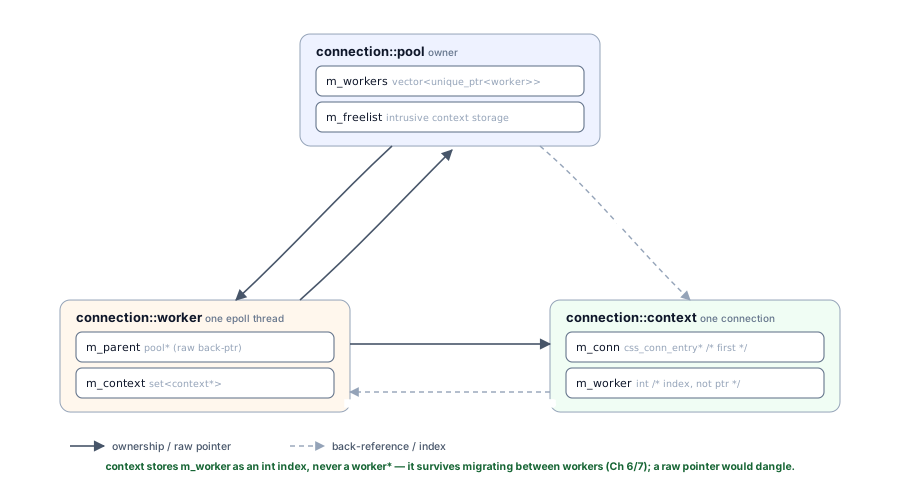 Figure 1-1. The reactor triangle — ownership (solid) versus back-reference / index (dashed). The
 pool sits at the apex owning both the worker vector and the context freelist; the worker and context at the base corners point back with a raw pointer and an integer index respectively.
INVARIANT — a context never owns a raw pointer to its worker.
context::m_worker is an int index into pool::m_workers. On rebalance
(Ch 6/7) only this integer is rewritten; nothing is re-pointed and no
worker * can outlive a worker teardown.
1.2 context — one accepted connection
Section titled “1.2 context — one accepted connection”// connection::context -- src/connection/connection_context.hppstruct context { /* THIS MUST BE THE FIRST */ css_conn_entry *m_conn; int m_worker; uint64_t m_id; ignore_level m_ignore; bool m_removed; struct { state m_state; receiver m_receiver; cubbase::span<std::byte> m_header; int m_request_id; bool m_command; } m_recv; struct { transmitter m_transmitter; std::shared_ptr<message_blocker> m_blocker; } m_send; statistics::metrics<statistics::context> m_stats; /* copy+move deleted; ctors (capacity) and (); reset() */};| Field | Role | Why it exists |
|---|---|---|
m_conn | Pointer to the legacy css_conn_entry wrapped | Bridge to all pre-existing css_conn_entry code; kept first so context * aliases &m_conn |
m_worker | Index of owning worker in pool::m_workers | Survives handoff; an index cannot dangle |
m_id | Monotonic id assigned at claim | Keys m_exhausted and message routing without a pointer |
m_ignore | ignore_level guard on stale ERR/HUP events | After close is decided, later error events are swallowed, not re-run |
m_removed | Torn down but still in m_context | Marks it for purge_stale_contexts; distinguishes closing from gone |
m_recv.m_state | state — HEADER/DATA/ERROR | Read side is a two-phase parser: header, then body sized by it |
m_recv.m_receiver | receiver — pooled reassembly buffer + drain state | Owns socket-to-span reassembly |
m_recv.m_header | span<std::byte> over parsed header | Header stays addressable while its body streams in |
m_recv.m_request_id | Request id from header | Correlates reply to request |
m_recv.m_command | Header was a command packet | If true, a back-end task is pushed once the body fully arrives |
m_send.m_transmitter | transmitter — pooled outbound buffer + deleters | Owns partial-write state |
m_send.m_blocker | shared_ptr<message_blocker> | A back-end worker doing a blocking send parks here; signalled on drain. Source notes it becomes a vector if concurrent blocking sends are allowed |
m_stats | Per-context metrics | Rolled up to worker/coordinator (Ch 11) |
INVARIANT — m_conn is first so context * aliases css_conn_entry **. Both connection::context and master::context mark m_conn
/* THIS MUST BE THE FIRST */; at offset 0, legacy code holding
&ctx->m_conn recovers the enclosing context by address, and the
freelist trick (§1.8) depends on the same guarantee. Reorder and every
such cast breaks silently.
context is non-copyable/non-movable (all four special members
= delete) — it holds pooled buffers and is used only by pointer. Ctor
context (std::size_t capacity) sizes the receiver pool; default
context () defers it. reset() restores pristine state (m_conn=null,
m_worker=-1, m_id=0, both sub-structs, m_stats) for freelist reuse
(Ch 7).
// connection::state / ignore_level -- src/connection/connection_context.hppenum class state { HEADER, DATA, ERROR };enum class ignore_level : uint8_t { DONT_IGNORE = 0, IGNORE_ALL };state is the read-side phase. ignore_level is uint8_t-backed because
it also travels inside a message (§1.5); DONT_IGNORE = 0 is the
default so a zero-initialized context never accidentally suppresses events.
1.3 The sync primitives — thread_watcher, message_blocker
Section titled “1.3 The sync primitives — thread_watcher, message_blocker”Both are CV bundles declared one namespace up (cubconn) because pool,
workers, and coordinator all share them.
// thread_watcher / message_blocker -- src/connection/connection_context.hppstruct thread_watcher { std::mutex mtx; std::condition_variable cv; int active; };struct message_blocker { std::mutex m; std::condition_variable cv; bool done; };| Struct.Field | Role | Why it exists |
|---|---|---|
thread_watcher.mtx | Guards active | active must move atomically vs waiters |
thread_watcher.cv | Signals startup/shutdown quorum | Pool waits while workers spin up/down |
thread_watcher.active | Count of live worker threads | Pool blocks until all N reach READY / all exit |
message_blocker.m | Guards done | Predicate lock for the CV |
message_blocker.cv | Signals the blocked producer | Producer of a blocking message parks here |
message_blocker.done | Predicate: worker finished this request | Guards spurious wakeups and lost signals |
INVARIANT — a message_blocker outlives both parties via
shared_ptr. It is always held by shared_ptr (in
message::waiter_handle and context::m_send.m_blocker); producer and
worker each hold a reference and whoever releases last destroys it. So the
worker can signal cv after the producer timed out, and the producer can
destruct while the worker still holds its copy — a raw pointer would let a
timed-out producer free the blocker under the worker.
1.4 worker — the servicing thread
Section titled “1.4 worker — the servicing thread”One OS thread, one epoll loop, many contexts.
// connection::worker (member layout) -- src/connection/connection_worker.hpppool *m_parent; std::shared_ptr<coordinator> m_coordinator;std::shared_ptr<thread_watcher> m_watcher;std::thread m_thread; std::size_t m_core; status m_status; bool m_stop;cubthread::entry *m_entry; std::unordered_set<context *> m_context; std::size_t m_index;cubsocket::epoll m_events; int m_eventfd; int m_timerfd; uint64_t m_timens;std::array<timer_handle, (size_t) timer_type::TYPE_COUNT> m_timer_handler;bool m_has_retry;tbb::concurrent_queue<message> m_queue[(size_t) queue_type::TYPE_COUNT];std::atomic<uint64_t> m_queue_size[(size_t) queue_type::TYPE_COUNT];std::vector<context *> m_removed_context;size_t m_recv_budget; size_t m_send_budget;std::unordered_map<uint64_t, exhausted_context> m_exhausted;statistics::metrics<statistics::worker> m_stats;| Field | Role | Why it exists |
|---|---|---|
m_parent | Raw pool * owner | Retire contexts / read config; pool outlives every worker |
m_coordinator | shared_ptr<coordinator> | Reports metrics, receives placement (Ch 6); shared by many workers |
m_watcher | shared_ptr<thread_watcher> | Bumps active at start/exit for the pool quorum |
m_thread | The std::thread running run() | OS handle; joined at finalize |
m_core | CPU core pinned to | Affinity for cache locality (Ch 3) |
m_status | status — READY/RUNNING/HIBERNATING/TERMINATING | Drives the loop and hibernation (Ch 4) |
m_stop | Hard-stop flag | Breaks the loop on shutdown regardless of status |
m_entry | cubthread::entry * | Ties this thread into the legacy thread-manager |
m_context | unordered_set<context *> serviced | Membership set the loop iterates; O(1) migration |
m_index | This worker’s index in pool::m_workers | Matches context::m_worker; routing/handoff identity |
m_events | cubsocket::epoll | epoll fd over client sockets + control fds |
m_eventfd | eventfd for cross-thread wakeups | Producer signals it to break epoll_wait |
m_timerfd | timerfd in the epoll set | One fd multiplexes all periodic timers |
m_timens | Current timer period (ns) | Cached resolution the timerfd is armed to |
m_timer_handler | array<timer_handle, TYPE_COUNT> by timer_type | One slot per timer kind; no alloc on hot path |
m_has_retry | Any deferred close awaiting retry | Cheap skip of the retry scan when clear |
m_queue[] | Two concurrent_queue<message> (IMMEDIATE, LAZY) | MPSC control channel from any thread |
m_queue_size[] | atomic<uint64_t> per queue | Bounds one drain pass to messages present at entry |
m_removed_context | Contexts marked removed, pending reap | Deferred cleanup, never erase mid-iteration |
m_recv_budget / m_send_budget | Per-pass byte caps | Fairness so one connection can’t monopolize (Ch 5) |
m_exhausted | map<uint64_t, exhausted_context> | Contexts that hit budget mid-IO, keyed by m_id (§1.7) |
m_stats | Per-worker metrics | Aggregated to coordinator (Ch 11) |
INVARIANT — m_queue_size snapshots bound each drain pass. The worker
reads m_queue_size and processes only that many messages; MPSC arrivals
during the pass wait for next wakeup. Draining “until empty” would let a
hot producer pin the single consumer forever. The counter is atomic:
producers increment from other threads while the one consumer decrements.
// worker::status -- src/connection/connection_worker.hppenum class status { READY, RUNNING, HIBERNATING, TERMINATING };READY = constructed, parked pre-run; RUNNING = active loop; HIBERNATING =
idle, timer-woken only, sockets parked (Ch 4); TERMINATING = draining to
exit. m_stop is orthogonal — it forces exit from any status.
1.5 The control vocabulary — queue_type, message_type, message
Section titled “1.5 The control vocabulary — queue_type, message_type, message”Every instruction is a message on one of two queues. The queue says
when, the type says what.
// worker::queue_type / message_type -- src/connection/connection_worker.hppenum class queue_type : uint8_t { IMMEDIATE, LAZY, TYPE_COUNT };enum class message_type { START, HIBERNATE /*lazy*/, AWAKEN /*lazy*/, SHUTDOWN, NEW_CLIENT, HANDOFF_CLIENT /*lazy*/, TAKEOVER_CLIENT, SHUTDOWN_CLIENT /*lazy*/, SEND_PACKET, RELEASE_PACKET, TYPE_COUNT };IMMEDIATE messages drain before IO; LAZY ones (HIBERNATE, AWAKEN,
HANDOFF_CLIENT, SHUTDOWN_CLIENT, tagged /* lazy queue */ in the enum)
run after IO so they see settled state. TYPE_COUNT in both enums is the
array-sizing sentinel (m_queue, m_queue_size, m_timer_handler), not a
value. message_type groups into worker-control (START, HIBERNATE,
AWAKEN, SHUTDOWN) and client-control (the rest); their handlers are
Ch 7/8.
// worker::message -- src/connection/connection_worker.hppstruct message { message_type type; uint64_t id; context *ctx; css_conn_entry *conn; std::vector<cubbase::span<std::byte>> packet; /* SEND/RELEASE_PACKET */ std::function<void ()> deleter; /* SEND_PACKET */ worker *worker_ptr; int worker_index; /* HANDOFF_CLIENT */ ignore_level ignore; bool retry; /* SHUTDOWN_CLIENT */ std::shared_ptr<message_blocker> waiter_handle; /* START/SHUTDOWN_CLIENT/SEND_PACKET */#if !defined (NDEBUG) uint64_t message_id;#endif};| Field | Role | Used by | Why it exists |
|---|---|---|---|
type | Discriminator | all | Selects handler and live payload fields |
id | Target context id | client msgs | Routes to a context without a pointer (matches m_id) |
ctx | Target context | client msgs | Direct handle when producer already holds it |
conn | Legacy connection entry | NEW_CLIENT etc. | Hands the raw css_conn_entry to wrap |
packet | Byte spans to send/free | SEND/RELEASE_PACKET | Outbound payload, or buffers to release |
deleter | Frees packet after send | SEND_PACKET | Producer keeps buffer-lifetime ownership |
worker_ptr | Destination worker | HANDOFF_CLIENT | Peer worker receiving the migrated context |
worker_index | Destination index | HANDOFF_CLIENT | Index form for routing/logging |
ignore | Suppress-level to stamp | SHUTDOWN_CLIENT | Sets context::m_ignore during teardown |
retry | Retry close if blocked | SHUTDOWN_CLIENT | Defers a close that still has pending tasks |
waiter_handle | Blocker to signal on done | START/SHUTDOWN_CLIENT/SEND_PACKET | Lets a producer block until worker finishes |
message_id | Debug monotonic id | all (debug) | Trace ordering; compiled out in release |
INVARIANT — message is move-only. Copy = delete, move
= default noexcept. It owns a vector, a std::function deleter, and a
shared_ptr blocker — copying would double-free the buffers. It is always
std::move-d into the queue (enqueue (type, std::move (item))); the
noexcept move is what lets tbb::concurrent_queue store it without a
copy fallback.
1.6 The timer machinery — timer_type, timer_latency, timer_handle
Section titled “1.6 The timer machinery — timer_type, timer_latency, timer_handle”One timerfd drives up to four periodic jobs. timer_type names the job
(and indexes m_timer_handler); timer_latency is the period in ns;
timer_handle is one armed slot.
// worker timers -- src/connection/connection_worker.hppenum class timer_type : uint32_t { NA, HIBERNATE, STATISTICS, QUEUE, HA, TYPE_COUNT };enum class timer_latency : uint64_t { NA = 0, /* off */ LOW_LATENCY = (uint64_t)(1 * 1e6), /* 1 msec */ MEDIUM_LATENCY = (uint64_t)(1 * 1e9), /* 1 sec */ HIGH_LATENCY = (uint64_t)(2 * 1e9) };/* 2 sec */struct timer_handle { bool valid; timer_latency latency; std::function<bool ()> function; uint64_t last_time; };timer_type: NA = unused slot 0; HIBERNATE fires the idle check;
STATISTICS flushes metrics; QUEUE re-checks the message queues; HA
drives heartbeat/HA close. timer_latency encodes the period directly
(0 = off, else 1 ms / 1 s / 2 s).
timer_handle field | Role | Why it exists |
|---|---|---|
valid | Slot armed | A fixed array needs per-slot occupancy |
latency | Period for this timer | Compared vs elapsed to decide firing |
function | std::function<bool ()> callback | The job; returns whether to keep the timer |
last_time | ns timestamp of last fire | Elapsed = now − last_time; gates next fire |
INVARIANT — the timerfd period is the minimum active latency. One fd
multiplexes all slots, so it is armed to the smallest latency among
valid slots, then each handler runs only when its own last_time shows
enough elapsed. Arm coarser and a LOW_LATENCY job misses its deadline;
last_time is what stops coarser jobs over-firing.
1.7 The backpressure record — exhausted_context
Section titled “1.7 The backpressure record — exhausted_context”When a context hits m_recv_budget/m_send_budget mid-transfer, the
worker parks it in m_exhausted (keyed by m_id) to resume where it
stopped.
// worker::exhausted_context -- src/connection/connection_worker.hppstruct exhausted_context { bool prepared; uint32_t events; context *ctx; };| Field | Role | Why it exists |
|---|---|---|
prepared | Resume set up | Distinguishes a fresh park from one already re-armed |
events | epoll mask pending when budget ran out | Resume replays the exact EPOLLIN/EPOLLOUT intent |
ctx | The stalled context | Direct resume handle, no re-lookup |
Keying by uint64_t m_id (not a pointer) means a context closed while
exhausted is dropped by id without chasing a possibly-reaped pointer (Ch 5).
1.8 pool — owner and allocator
Section titled “1.8 pool — owner and allocator”pool owns everything and alone touches the freelist and worker vector
under a lock.
// connection::pool (members) -- src/connection/connection_pool.hppstd::mutex m_mutex;#if !defined (NDEBUG)std::atomic<std::thread::id> m_mutex_holder { std::thread::id () };#endifstd::vector<std::unique_ptr<worker>> m_workers;std::shared_ptr<coordinator> m_coordinator; std::shared_ptr<thread_watcher> m_watcher;std::uint32_t m_max_connections, m_max_connection_workers, m_min_connection_workers;struct { freelist *m_head; std::size_t m_max; std::size_t m_claim; } m_freelist;| Field | Role | Why it exists |
|---|---|---|
m_mutex | Guards all pool mutable state | Contexts/workers touched from many threads |
m_mutex_holder | Debug current lock owner | Cheap correct-thread assertions in debug |
m_workers | vector<unique_ptr<worker>> | Sole owner of worker lifetime; clean teardown |
m_coordinator | shared_ptr<coordinator> | Handed to every worker (Ch 2/6) |
m_watcher | shared_ptr<thread_watcher> | Start/stop quorum shared with workers |
m_max_connections | Hard cap on live connections | Sizes the freelist |
m_max_connection_workers | Worker-count ceiling | Auto-scale upper bound (Ch 6) |
m_min_connection_workers | Worker-count floor | Auto-scale lower bound / always-on |
m_freelist.m_head | Head of free context list | O(1) claim/retire |
m_freelist.m_max | Total contexts allocated | Capacity accounting |
m_freelist.m_claim | Contexts currently claimed | Detects exhaustion vs m_max |
The freelist node is intrusive:
// pool::freelist -- src/connection/connection_pool.hppstruct freelist { /* THIS MUST BE THE FIRST */ context m_context; /* embedded by value */ freelist *m_next; freelist (std::size_t capacity) : m_context (capacity), m_next (nullptr) {}};| Field | Role | Why it exists |
|---|---|---|
m_context | The context storage, embedded by value | No per-connection alloc; the node is the context |
m_next | Next free node | Singly-linked free chain off m_head |
INVARIANT — freelist::m_context is first so context * round-trips to
freelist *. claim_context() pops m_head and returns
&node->m_context; because m_context is at offset 0, retire_context (context *ctx) recovers the node with reinterpret_cast<freelist *> (ctx). Put m_next first and retire corrupts the free chain. Same
address-alias trick as m_conn-first (§1.2).
flowchart LR H["m_freelist.m_head"] --> N0["freelist #0<br/>m_context (offset 0)<br/>m_next"] N0 --> N1["freelist #1<br/>m_context<br/>m_next"] N1 --> NIL["nullptr"] CLAIM["claim_context()<br/>returns &head->m_context"] -.-> N0
Figure 1-2. The intrusive freelist: each node embeds a context at
offset 0; claim/retire cast between freelist * and context *.
The sibling master::context and the controller<RX,TX> template (the
Unix-socket control channel in controller.hpp) belong to the
master-connector path, not the reactor, but share the result enum every
IO call here returns — Ok, Partial, Error, Reset, Pending,
BudgetExhausted, PeerReset, RefuseConnection, ClosedConnection,
Aborted, Skewed (buffer.hpp) — which later IO-branch chapters lean on.
1.9 Chapter summary — key takeaways
Section titled “1.9 Chapter summary — key takeaways”- The triangle is
poolownsworkerpoints-to manycontext. Ownership isunique_ptr(workers) and an intrusive freelist (contexts); back-references are a rawpool *and an indexcontext::m_worker, never aworker *. contextholds the whole per-connection byte state —m_connbridge,m_id/m_workeridentity, them_recv(two-phase HEADER→DATA parser + receiver) andm_send(transmitter + optional blocker) sub-structs. It is non-copyable/non-movable and reset for reuse.- Two layout invariants are load-bearing:
context::m_connfirst (aliasescss_conn_entry **) andfreelist::m_contextfirst (letsretire_contextcastcontext *back tofreelist *). Reorder either and casts corrupt silently. - A worker is a control-message consumer, not an RPC target: every
instruction is a move-only
messageon the IMMEDIATE or LAZYtbb::concurrent_queue, andm_queue_sizesnapshots bound each drain pass to prevent producer starvation. - One
timerfdmultiplexes four jobs viam_timer_handler[timer_type]; armed to the minimum activetimer_latency, eachtimer_handle::last_timegates its own firing. - Backpressure is explicit state: a budget-exhausted context is
parked in
m_exhaustedkeyed bym_id, remembering the exact epolleventsto replay next pass. thread_watcherandmessage_blockerare the only two CV primitives — the former counts live workers for the pool’s start/stop quorum; the latter, alwaysshared_ptr, lets a producer block on a specific message until the worker signalsdone.
Chapter 2: Data Structure Map II the Coordinator
Section titled “Chapter 2: Data Structure Map II the Coordinator”Chapter 1 mapped the connection reactor — the per-worker epoll loop that
moves bytes. This chapter maps its counterpart: the single coordinator
thread that never touches a client socket, yet decides which worker owns each
connection, when to hand one off, and how many workers should exist. This is a
field-level map only; the algorithms that read the state — score, rebalance
selection, trial-based auto-scaling — are Chapter 6.
Cross-link: why a single-writer control plane exists is argued in the companion
cubrid-thread-manager.md, sections Auto scaling (CBRD-26406), Score-based connection assignment, and Coordinator + context freelist.
2.1 The coordinator at a glance
Section titled “2.1 The coordinator at a glance”coordinator (in cubconn::connection) is a plain member-owning class whose
members form six functional clusters, walked field-by-field below.
Figure 2-1 — coordinator ownership map.
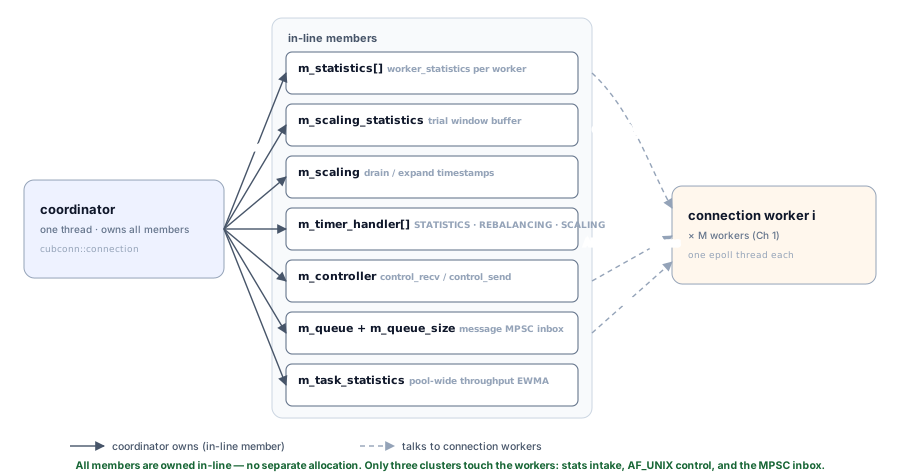
The control cluster (m_controller, control_*) is compile-time optional; see §2.7.
2.2 The statistics primitive — metrics<T, VT>
Section titled “2.2 The statistics primitive — metrics<T, VT>”Every counter is a fixed-size, key-typed vector from connection_statistics.hpp:
// metrics -- src/connection/connection_statistics.hpptemplate <class T, typename VT = std::uint64_t>class metrics { inline metrics<T, double> operator- (const metrics &other); /* <- delta is double */ inline metrics<T, double> operator* (double multiplier); private: VT m_values[static_cast<std::size_t> (T::STATS_COUNT)]; /* <- one slot per key */};T is an enum class whose last real value STATS_COUNT sizes the array — no
per-key allocation. Two vocabularies instantiate it:
| Key enum | Members (each /* count */ unless noted) |
|---|---|
statistics::context | BYTES_IN_TOTAL, BYTES_OUT_TOTAL, OPEND_NS, LAST_ACTIVE_NS, LAST_MOVED_NS, MOVE_COUNT, RECV_BUDGET_HIT, SEND_BUDGET_HIT |
statistics::worker | PACKET_COUNT, CLIENT_NUM, MQ_REQUESTED, MQ_COMPLETED, MQ_NEW_CLIENT, MQ_HANDOFF_CLIENT, MQ_TAKEOVER_CLIENT, MQ_SHUTDOWN_CLIENT, MQ_SEND_PACKET, MQ_RELEASE_PACKET, BLOCKED_RMUTEX (us) |
worker has a trailing NA past STATS_COUNT (never allocated); worker_to_string[]
names each worker key for printing.
INVARIANT — raw/derived type split. Counters collect as
VT = uint64_t, butoperator-/operator*returnmetrics<T, double>. The coordinator keeps two copies of a worker’s counters — auint64“previous” snapshot and adoubleEWMA accumulator — because the type system forbids storing a rate in a raw slot, which is what would overflow the rate math or lose fractional decay.
2.3 worker_statistics — the per-worker scorecard
Section titled “2.3 worker_statistics — the per-worker scorecard”m_statistics is a std::vector<worker_statistics>, one entry per connection
worker — the coordinator’s model of that worker’s load.
// worker_statistics -- src/connection/coordinator.hppstruct worker_statistics { double m_score; /* score */ double m_core; uint64_t m_last_cpu_time; /* resource */ uint32_t m_client_num; uint64_t m_last_updated; /* immediate */ statistics::metrics<statistics::context, double> m_sum; /* sum of contexts */ std::pair<statistics::metrics<statistics::worker, double>, statistics::metrics<statistics::worker>> m_worker; /* accumulated , previous */ std::unordered_map<uint64_t, std::pair<statistics::metrics<statistics::context, double>, statistics::metrics<statistics::context>>> m_contexts;};| Field | Role | Why it exists |
|---|---|---|
m_score | The single scalar placement/scaling compares across workers | Reduces a load vector to one orderable number (Ch 6) |
m_core | Fractional CPU-core share attributed to this worker | Normalizes score by CPU actually received |
m_last_cpu_time | Last CPU-time sample (ns) | Next update computes a CPU-time delta, not an absolute |
m_client_num | Immediate connection count | Fast exact placement input without walking m_contexts |
m_last_updated | Monotonic ns of the last fold | The time_delta denominator for EWMA |
m_sum | Per-update double sum of all context metrics | Aggregate view without iterating the map |
m_worker | first = EWMA-accumulated worker counters; second = previous raw snapshot | The raw/derived pair (§2.2) at worker level |
m_contexts | Map: connection id → per-connection (accumulated, previous) pair | Same pair per live connection, so one hot client is visible |
INVARIANT — slot index equals worker id.
m_statistics[i]is workeri; the vector is index-parallel tom_current_worker(§2.9). Every score lookup, rebalance source/target, andCLIENT_MOVEtarget indexes it — if it diverges from the live worker set, placement writes a stale slot and the model rots.
INVARIANT — accumulate
.first, replace.second. The EWMA update (Ch 6/11) foldscurrent - m_worker.secondintom_worker.firstscaled by the delta, then setsm_worker.second = current..firstis only decayed,.secondonly replaced.m_contextspairs obey the same rule per connection.
2.4 The lifecycle enum — status
Section titled “2.4 The lifecycle enum — status”m_status holds one coordinator::status, gating which timer-driven action is
legal per phase so the coordinator never drains while still preparing.
status | Meaning |
|---|---|
PREPARING | Bring-up before serving; timers not yet armed |
STABLE | Steady state; statistics + rebalancing run, no scale change in flight |
DRAINING | Scale-down underway; one worker sheds its connections |
EXPANDING | Scale-up underway; a new worker is being wired in |
Transitions are the scaling algorithm (Ch 6); m_status is just its discriminator.
2.5 The auto-scaling window — trial state
Section titled “2.5 The auto-scaling window — trial state”Auto-scaling is a trial-and-observe controller: nudge the worker count, watch whether the aggregate score improves, commit or revert. Two enums, one sample record, and two anonymous members hold the window.
// scaling enums + record -- src/connection/coordinator.hppenum class scaling_status { TRIAL, STABLE };enum class scaling_direction { DOWN, UP };struct scaling_statistics { std::size_t scale; double score; }; /* one (count,score) sample */scaling_statistics is a single trial data point — one dot on the score-vs-workers
curve the verdict fits (Ch 6):
| Field | Role | Why it exists |
|---|---|---|
scale (std::size_t) | Worker count at this sample | The x-axis of a trial data point |
score (double) | Aggregate pool score measured at that worker count | The y-axis a verdict compares across samples |
The window that collects those samples is an anonymous member:
// m_scaling_statistics -- src/connection/coordinator.hppstruct { scaling_status status; std::size_t window_size; std::vector<scaling_statistics> history; scaling_direction previous_direction; std::size_t previous_scale; scaling_direction direction; std::size_t count;} m_scaling_statistics;| Field | Role | Why it exists |
|---|---|---|
status | TRIAL (measuring a change) vs STABLE (settled) | Distinguishes measuring from settled |
window_size | Samples a trial averages over | Smooths noisy per-tick scores before judging |
history | Bounded buffer of scaling_statistics samples | The evidence a verdict is computed from |
previous_direction | Direction of the last committed move | Detects oscillation / back-off |
previous_scale | Worker count before the current trial | Baseline the trial’s score compares against |
direction | Direction of the trial under evaluation | The hypothesis under test this window |
count | Samples collected this window | Trips the verdict at window_size |
The mechanics of a move (not its statistics) live in a second anonymous struct:
// m_scaling -- src/connection/coordinator.hppstruct { uint64_t last_drain_ns; uint64_t last_expand_ns; int draining_worker; } m_scaling;| Field | Role | Why it exists |
|---|---|---|
last_drain_ns | Monotonic ns of the last scale-down | Rate-limits shrink; prevents downward thrash |
last_expand_ns | Monotonic ns of the last scale-up | Rate-limits growth symmetrically |
draining_worker | Index of the worker shedding, or negative sentinel | Ensures at most one drain in flight |
INVARIANT — at most one worker drains at a time. While
draining_workeris a valid index (andm_status == DRAINING) no second drain starts, so two workers never race for the same target slots and corruptm_migrating(§2.9).
2.6 The timer wheel — timer_handle and m_timer_handler
Section titled “2.6 The timer wheel — timer_handle and m_timer_handler”One timerfd drives all periodic work; the coordinator dispatches through a
fixed table rather than one fd per task.
// timer types -- src/connection/coordinator.hppenum class timer_latency : uint64_t { NA = 0, /* off */ LOW_LATENCY = static_cast<uint64_t>(1 * 1e9), /* 1 sec */ MEDIUM_LATENCY = static_cast<uint64_t>(5 * 1e9), /* 5 sec */ HIGH_LATENCY = static_cast<uint64_t>(60 * 1e9) /* 1 min */};enum class timer_type : uint32_t { NA, STATISTICS, REBALANCING, SCALING, TYPE_COUNT };struct timer_handle { bool valid; timer_latency latency; std::function<bool ()> function; uint64_t last_time; };m_timer_handler is std::array<timer_handle, TYPE_COUNT>, indexed by timer_type.
timer_handle field | Role | Why it exists |
|---|---|---|
valid | Is this slot armed? | Register/remove without resizing the array |
latency | Desired period (ns timer_latency) | The interval the handler wants |
function | bool() callback (stats/rebalance/scale pass) | Type-erased for uniform dispatch; returns continue/ok |
last_time | Monotonic ns of last run | Fires only when now - last_time >= latency |
Slots: STATISTICS folds samples into m_statistics/m_task_statistics;
REBALANCING emits a CLIENT_MOVE; SCALING runs one trial step (all Ch 6/11).
INVARIANT — one fd, many logical timers.
m_timensis always the shortest active period; each handler self-throttles vialast_time. Arm too slowly and a handler starves; drop thelast_timecheck and every handler fires every tick.
2.7 The control channel — controller + control_* (compile-time optional)
Section titled “2.7 The control channel — controller + control_* (compile-time optional)”Callout — guarded subsystem. In the PR #7323 worktree the entire control cluster —
control_type/control_recv/control_send, them_controllerandm_ctrlfdfields (§2.9), and thehandle_controller*methods — is wrapped in#if defined (ENABLE_CONTROLLER)and is not compiled in a default build. Everything in this section exists only under that macro.
Statistics and messages flow into the coordinator. The control channel is the
reverse: imperative commands out to a specific worker plus a reply, over an
AF_UNIX SOCK_DGRAM socket wrapped by controller<RX, TX>.
// controller -- src/connection/controller.hpptemplate <typename RX, typename TX>class controller { bool open (std::string path, int flags); /* asserts SOCK_NONBLOCK */ result recv (RX &data, sockaddr_un &peer, socklen_t &peerlen); result send (TX &data, sockaddr_un &peer, socklen_t &peerlen); private: int m_ctrlfd; std::string m_path;};The coordinator holds controller<control_recv, control_send> m_controller
(plus the cached m_ctrlfd for its epoll set). Payloads are fixed-size PODs:
// control_type / control_recv / control_send -- src/connection/coordinator.hpp#if defined (ENABLE_CONTROLLER)enum class control_type : uint32_t { SHOW_STATS, SCALE_UP, SCALE_DOWN, CLIENT_MOVE, /* RECV: coordinator -> worker */ OK, NOK, /* SEND: worker -> coordinator */ TYPE_COUNT};struct control_recv { control_type type; int from; int to; int id; };struct control_send { control_type type; };#endifNaming is from the worker’s view: control_recv = command received,
control_send = ack returned.
control_recv field | Role | Why it exists |
|---|---|---|
type | SHOW_STATS / SCALE_UP / SCALE_DOWN / CLIENT_MOVE | Discriminates the four imperatives |
from | Source worker index | CLIENT_MOVE: who gives up the connection |
to | Target worker index | CLIENT_MOVE: who takes it over |
id | Connection id to act on | Identifies the specific connection |
control_send field | Role | Why it exists |
|---|---|---|
type | The OK/NOK verdict returned by the worker | No other payload is needed — the coordinator already knows which command it issued |
INVARIANT — a control datagram is exactly
sizeof(RX)/sizeof(TX).recv/sendreturnresult::Errorunlessrecvfrom/sendtomoved exactly the struct size; a truncated datagram is never partially applied.SOCK_DGRAM+SOCK_NONBLOCKpreserves message boundaries and returnsresult::Pending(sharedresultenum,buffer.hpp) instead of blocking the lone coordinator thread — hence datagrams here, not the byte-stream reactor of Chapter 1.
2.8 The message inbox — message_type and message
Section titled “2.8 The message inbox — message_type and message”The high-volume async path into the coordinator is the message queue: new client, contexts returning, hand-off result, statistics batch, shutdown.
// message_type -- src/connection/coordinator.hppenum class message_type { START, NEW_CLIENT, RETURN_TO_POOL, HANDOFF_REPLY, STATISTICS, SHUTDOWN, TYPE_COUNT };message is a move-only tagged struct (copies = delete, moves defaulted);
type selects which fields are live. It is not a union — all fields coexist —
so type is the reader’s contract, not the compiler’s.
// message -- src/connection/coordinator.hppstruct message { message (const message &) = delete; /* <- move-only: owns conn / vectors */ message (message &&) noexcept = default; message_type type; css_conn_entry *conn; /* NEW_CLIENT */ std::vector<context *> resource; /* RETURN_TO_POOL */ bool transferred; int from; int to; uint64_t id; /* HANDOFF_REPLY */ struct { /* STATISTICS */ uint64_t cpu_time_ns; uint64_t time_ns; std::pair<std::size_t, statistics::metrics<statistics::worker>> worker; std::vector<std::pair<uint64_t, statistics::metrics<statistics::context>>> contexts; } statistics;};Role matrix — which fields are live per type (START/SHUTDOWN carry none):
| Field | NEW_CLIENT | RETURN_TO_POOL | HANDOFF_REPLY | STATISTICS |
|---|---|---|---|---|
conn | accepted css_conn_entry* | – | – | – |
resource | – | contexts to recycle | – | – |
transferred/from/to/id | – | – | move result + endpoints | – |
statistics.cpu_time_ns/time_ns | – | – | – | sample window |
statistics.worker | – | – | – | (worker idx, raw worker metrics) |
statistics.contexts | – | – | – | (conn id, raw context metrics)[] |
The statistics.* metrics arrive raw (uint64); the coordinator folds them
into the double EWMA accumulators of §2.3 on receipt — the raw/derived boundary
is exactly this queue.
Figure 2-2 — the message inbox.
flowchart LR A["accept path"] -->|NEW_CLIENT| Q W["connection worker"] -->|HANDOFF_REPLY / STATISTICS / RETURN_TO_POOL| Q P["pool / shutdown"] -->|START / SHUTDOWN| Q Q["m_queue<br/>tbb::concurrent_queue<message><br/>+ m_queue_size (atomic)"] Q -->|single consumer| C["coordinator thread<br/>handle_message_queue"]
// m_queue / m_queue_size -- src/connection/coordinator.hpptbb::concurrent_queue<message> m_queue; /* multi-producer, single-consumer */std::atomic<uint64_t> m_queue_size;INVARIANT — MPSC discipline + bounded drain. Producers enqueue from anywhere; consumption is only from the coordinator thread.
m_queue_sizebounds one drain pass to the messages present when it started, so a steady producer cannot pin the consumer and starve the timer/control work sharing theepolliteration. Becausemessageis move-only,enqueue(message &&)transfers ownership of the embeddedconnand vectors — the producer must not touch them afterstd::move.
2.9 The remaining coordinator fields
Section titled “2.9 The remaining coordinator fields”Identity, reactor plumbing, and worker accounting, for completeness.
| Field | Type | Role |
|---|---|---|
m_parent | pool * | Back-pointer to the owning connection pool |
m_watcher | shared_ptr<thread_watcher> | Liveness/health registration |
m_thread | std::thread | The coordinator’s own OS thread |
m_core | std::size_t | CPU core the thread is pinned to |
m_status | status | Lifecycle phase (§2.4) |
m_stop | bool | Set by SHUTDOWN to break the run loop |
m_entry | cubthread::entry * | Per-thread engine context (companion doc) |
m_events | cubsocket::epoll | The coordinator’s own epoll set |
m_eventfd | int | Event-based wakeup fd (queue/control) |
m_timerfd | int | The single timer fd (§2.6) |
m_timens | uint64_t | Current timerfd interval (ns) |
m_ctrlfd | int | Cached m_controller fd — guarded, ENABLE_CONTROLLER only (§2.7) |
m_max_worker / m_min_worker | uint32_t | Scale ceiling / floor |
m_current_worker | uint32_t | Live worker count; parallels m_statistics.size() |
m_migrating | unordered_set<uint64_t> | Connection ids currently in a hand-off/take-over |
m_controller | controller<control_recv, control_send> | Outbound control channel — guarded, ENABLE_CONTROLLER only (§2.7) |
m_task_statistics | anon struct | Pool-wide throughput EWMA (below) |
m_statistics | vector<worker_statistics> | Per-worker scorecards (§2.3) |
INVARIANT —
m_migratingbrackets an in-flight move. An id is inserted whenCLIENT_MOVEis issued and erased on the matchingHANDOFF_REPLY; while present it is excluded from placement/rebalance, so no connection is handed to two targets at once. The replyidmust match, or an id leaks and that connection is frozen out of all future rebalancing.
m_task_statistics is the pool-wide analogue of §2.3, one struct for the whole pool:
// m_task_statistics -- src/connection/coordinator.hppstruct { std::uint32_t workers; uint64_t time_ns; std::pair<double, uint64_t> requested; /* first: EWMA rate, second: previous raw */ std::pair<double, uint64_t> started; std::pair<double, uint64_t> completed; std::pair<double, uint64_t> depth;} m_task_statistics;| Field | Role |
|---|---|
workers / time_ns | Worker count + timestamp the last sample covered (EWMA normalizer/denominator) |
requested | (rate, prev) of tasks handed to the back-end pool — scale-up pressure |
started | (rate, prev) of tasks the pool began — pickup rate |
completed | (rate, prev) of tasks finished — throughput |
depth | (rate, prev) of queue depth — backlog signal |
Each pair is the §2.2 split (first = decayed double rate, second = previous
raw uint64); these pool-wide rates drive the back-end elastic pool (Ch 12–14)
and the auto-scaler (Ch 6).
2.10 Chapter summary — key takeaways
Section titled “2.10 Chapter summary — key takeaways”- The coordinator owns six clusters: per-worker scorecards (
m_statistics), the auto-scaling trial window (m_scaling_statistics+m_scaling), the timer table (m_timer_handler), the outbound control channel (m_controller), the inbound message queue (m_queue), and pool-wide throughput (m_task_statistics). - Every counter is a
metrics<T, VT>fixed array kept as a rawuint64previous plus adoubleEWMA accumulator; the type system stops you mixing them. m_statistics[i]is workeri— index-parallel to the live worker set, and every placement/rebalance/scale decision indexes it.- The control channel is compile-time optional (
ENABLE_CONTROLLER): when present it flows commands out as fixed-size AF_UNIX datagrams; messages always flow in on an MPSCtbb::concurrent_queue, drained bounded bym_queue_size. messageis a move-only tagged struct:typeselects live fields, and moving it transfers ownership of the embeddedconnand vectors.- Two membership/count invariants keep moves safe: at most one
draining_workerat a time, and an id sits inm_migratingfor exactly the span of its hand-off. - This chapter is structure only — the score math, rebalancing selection, and
trial scaling that read it are Chapter 6; the back-end pool consuming
m_task_statisticsis Chapters 9–14.
Chapter 3: Initialization and Memory
Section titled “Chapter 3: Initialization and Memory”The reader question: from main() to a fully wired reactor, who allocates what, on which thread, and in what order? The companions explain why the reactor exists (cubrid-thread-manager.md — “Connection worker (CBRD-26212)”, “Coordinator + context freelist (CBRD-26407)”) and what a worker pool is (cubrid-thread-worker-pool.md). This chapter is bring-up mechanics: every new, every std::thread, every epoll_ctl, and every teardown branch.
Two object graphs are stood up back to back inside css_init (server_support.c):
- the back-end request pool —
css_Server_request_worker_pool, acubthread::stats_worker_pool_typebuilt bythread_create_stats_worker_pool. This is the task engine dissected in Ch 9-11. - the connection reactor — a stack-local
cubconn::connection::pool connections, brought up bypool::initialize. This is the epoll front end of Ch 1-8.
Both draw their thread entries from one pre-sized pool that boot allocated earlier. We trace the entry pool first, then the two graphs, then teardown.
3.1 The bring-up call chain — main to css_init
Section titled “3.1 The bring-up call chain — main to css_init”main (server.c) registers fatal-signal handlers, saves the executable path, setsid()s, then calls net_server_start (database_name) and returns its status. All reactor bring-up is downstream.
// main -- src/executables/server.c (condensed) register_fatal_signal_handler (SIGSEGV); /* ... SIGILL/FPE/BUS/SYS/ABRT ... */ database_name = argv[1]; ret_val = net_server_start (database_name); /* <- never returns until shutdown */net_server_start (network_sr.c) is the real orchestrator. Ordered: er_init, cubthread::initialize (thread_p) (creates the manager singleton and the main entry, §3.2), sysprm_load_and_init, css_initialize_server_interfaces (net_server_request), then boot_restart_server (which runs recovery and calls cubthread::initialize_thread_entries to size and allocate the entry pool, §3.2), and only on success css_init (thread_p, packed_name, name_length, TCP_PORT_ID). So by the time css_init runs, the DB is recovered and the entry pool exists; css_init only builds the two thread graphs on top.
flowchart TD
  M["main -- server.c"] --> NS["net_server_start -- network_sr.c"]
  NS --> TI["cubthread::initialize<br/>create manager + main entry"]
  NS --> BR["boot_restart_server<br/>recovery + initialize_thread_entries"]
  NS --> CI["css_init -- server_support.c"]
  CI --> WP["thread_create_stats_worker_pool<br/>back-end request pool"]
  CI --> RP["connections.initialize<br/>connection reactor"]
  CI --> RUN["connector.run port name<br/>blocks until shutdown"]
Figure 3-1. From process entry to the two thread graphs. net_server_start sequences entry-pool sizing before css_init builds the pools.
3.2 Sizing the thread universe — the entry pool
Section titled “3.2 Sizing the thread universe — the entry pool”Thread entries (cubthread::entry, Ch 2 of the companion’s data map) are heavyweight; the manager pre-allocates a fixed array and hands them out by claim/retire rather than constructing per thread. The count is derived, not configured, by manager::set_max_thread_count_from_config:
// manager::set_max_thread_count_from_config -- src/thread/thread_manager.cpp m_max_threads = cubbase::count_registry<connection>::total () + cubbase::count_registry<worker_pool>::total () + cubbase::count_registry<daemon>::total () + 1 /* PAD */;Each subsystem registers its demand at static-init time via macros. The reactor contributes two lines: REGISTER_CONNECTION (coordinator, 1) (coordinator.cpp) reserves one entry, and REGISTER_CONNECTION (connection_worker, [](){ return prm_get_integer_value (PRM_ID_CSS_MAX_CONNECTION_WORKER); }) (connection_worker.cpp) reserves max_connection_worker entries — the getter is evaluated when count_registry::total() sums the registry. The back-end pool registers through REGISTER_WORKERPOOL (transaction, ...PRM_ID_TASK_WORKER). initialize_thread_entries then calls set_max_thread_count_from_config followed by alloc_entries:
// manager::alloc_entries -- src/thread/thread_manager.cpp (SERVER_MODE branch) m_available_entries_count = m_max_threads; m_all_entries = new entry[m_max_threads]; /* the entire entry pool, one shot */ m_entry_dispatcher = new entry_dispatcher (m_all_entries, m_max_threads);init_lockfree_system sizes the lock-free transaction system to m_max_threads + 1, and init_entries stamps each entry’s index and assigns an LF-tran index. From then on every reactor thread pulls its context with manager::claim_entry (which stores it in tl_Entry_p) and returns it with retire_entry.
INVARIANT — reserved entries equal registered demand.
m_available_entries_countstarts atm_max_threadsand is debited bycreate_and_track_resource(§3.3) exactly by the count each pool reserved via itsREGISTER_*macro. The coordinator’sclaim_entryand each worker’sclaim_entryconsume from the same array. IfPRM_ID_CSS_MAX_CONNECTION_WORKERchanged between registration andpool::initialize, the reactor would create more workers than entries reserved andclaim_entrywould eventually returnnullptr— which every caller treats asassert_release (false).
3.3 The back-end request pool — create_worker_pool
Section titled “3.3 The back-end request pool — create_worker_pool”css_init builds the task engine first, through the inline helper thread_create_stats_worker_pool which forwards to the manager template:
// manager::create_worker_pool -- src/thread/thread_manager.hpp (SERVER_MODE) static_assert (std::is_base_of_v<worker_pool, Res>); workerpool = create_and_track_resource<Res> (m_worker_pools, pool_size, /* reserve pool_size entries */ pool_size, core_count, std::forward<CtArgs> (args)...); if (workerpool) { workerpool->initialize (pool_size, core_count); } /* <- only if reservation succeeded */ return workerpool;create_and_track_resource is the gatekeeper. Under m_entries_mutex, if m_available_entries_count < entries_count it returns NULL without constructing anything (this is how an over-subscribed thread budget surfaces); otherwise it debits the count, new Res (...)s the resource, and pushes it onto m_worker_pools.
Res here is stats_worker_pool_type = worker_pool_impl<true> — the true template argument selects the atomic-stats specialization (Ch 11). Its ctor assert (core_count > 0 && core_count <= pool_size) and records m_max_workers = pool_size, then initialize splits the pool into cores: allocate_cores (core_count) + assign_workers_to_cores (worker_count) (the per-core thread spin-up is Ch 9-10). Back in css_init, a NULL return is fatal:
// css_init -- src/connection/server_support.c if (css_Server_request_worker_pool == NULL) { assert (false); er_set (ER_FATAL_ERROR_SEVERITY, ARG_FILE_LINE, ER_GENERIC_ERROR, 0); status = ER_FAILED; goto shutdown; } /* <- skips reactor bring-up, jumps to teardown */pool_size = PRM_ID_TASK_WORKER, core_count = PRM_ID_TASK_GROUP; pooling and idle-timeout come from css_get_server_request_thread_pooling_configuration / _timeout_configuration. Ownership: the raw pointer lives in the file-static css_Server_request_worker_pool and is destroyed by destroy_worker_pool at the tail of css_init.
3.4 connection::pool::initialize — the reactor spine
Section titled “3.4 connection::pool::initialize — the reactor spine”With the task engine up, css_init calls connections.initialize (MAX_CONNECTIONS, max_connection_workers, min_connection_workers). MAX_CONNECTIONS is css_get_max_conn () + 1. Branch-complete:
// pool::initialize -- src/connection/connection_pool.cpp (void) os_set_signal_handler (SIGPIPE, SIG_IGN); /* 1. writes to dead sockets must not kill us */ (void) os_set_signal_handler (SIGFPE, SIG_IGN); max_connection_workers = this->initialize_topology (max_connection_workers); /* 2. clamp to real cores */ if (min_connection_workers > max_connection_workers) /* 3. floor cannot exceed ceiling */ { min_connection_workers = max_connection_workers; } this->lock_resource (); /* 4. take the pool baton */ this->initialize_freelist (max_connections); /* 5. context slab */ this->initialize_coordinator (max_connection_workers, min_connection_workers); /* 6. spawn coordinator thread */ this->initialize_workers (max_connection_workers, min_connection_workers); /* 7. spawn N worker threads */ this->release_resource (); /* 8. hand the baton off */ this->start_coordinator (); /* 9. ping the coordinator */ m_max_connections = max_connections; /* ...record the three sizes... */Step 2, initialize_topology, is where max_connection_workers becomes physical. It reads os::resources::cpu::effective () — whose adjusted_effective is an optional core-id vector and adjusted_max the usable core count — takes the first min(effective.size(), max_connection_workers) cores, maps NICs onto them (net::map_nic_to_index), and returns min(adjusted_max, max_connection_workers). So the configured max is silently reduced to the number of cores the process may actually run on.
flowchart TD
  A["ignore SIGPIPE/SIGFPE"] --> B["initialize_topology<br/>clamp workers to adjusted_max"]
  B --> C{"min > max?"}
  C -- yes --> D["min = max"]
  C -- no --> E["lock_resource<br/>take pool mutex"]
  D --> E
  E --> F["initialize_freelist<br/>slab of contexts"]
  F --> G["initialize_coordinator<br/>make_shared spawns thread"]
  G --> H["initialize_workers<br/>N unique_ptr workers + prewarm"]
  H --> I["release_resource<br/>baton to coordinator"]
  I --> J["start_coordinator<br/>enqueue START + notify"]
Figure 3-2. pool::initialize, every step. Steps 4-8 are one critical section on the css_init thread.
INVARIANT —
m_mutexis a baton, not a scoped lock.pool::initializecallslock_resource()(step 4) but the matchingrelease_resource()(step 8) does not end the story:coordinator::initialize(§3.6) re-acquires the same mutex at its tail and holds it for the coordinator’s entire lifetime, releasing it only incoordinator::finalize. The setup section runs on thecss_initthread; the moment it releases, the freshly spawned coordinator thread (blocked in its ownlock_resource) grabs the mutex and owns it forever. This is whyclaim_context/retire_context/get_workersallassert (m_mutex_holder == std::this_thread::get_id ())— they are only ever called from the coordinator thread, which provably holds the baton. Violating the handoff (e.g. a second thread callingclaim_context) trips the assert.
3.5 initialize_freelist — the context slab
Section titled “3.5 initialize_freelist — the context slab”The freelist is where “every connection object” is pre-allocated so the steady-state path never mallocs. Its node embeds a full context:
// pool::freelist -- src/connection/connection_pool.hpp struct freelist { context m_context; freelist *m_next; freelist (std::size_t capacity) : m_context (capacity), m_next (nullptr) {} };| Field | Role | Why it exists |
|---|---|---|
m_context | embedded per-connection context, constructed with a capacity byte buffer | embedding it in the node means one allocation per connection, not two |
m_next | intrusive free-chain link | O(1) push/pop while the pool baton is held |
The pool tracks the chain in an anonymous struct:
| Field | Role | Why it exists |
|---|---|---|
m_head | LIFO head of the free chain | claim_context pops it, retire_context pushes onto it |
m_max | high-water cap = max_connections * 1.1 | retire_context deletes nodes past this instead of hoarding memory |
m_claim | count of outstanding (claimed) contexts | must be 0 at finalize; the assert catches context leaks |
// pool::initialize_freelist -- src/connection/connection_pool.cpp m_freelist.m_head = nullptr; m_freelist.m_claim = 0; m_freelist.m_max = static_cast<std::size_t> (static_cast<float> (max_connections) * /* margin */ 1.1); for (i = 0; i < m_freelist.m_max; i++) { head = m_freelist.m_head; m_freelist.m_head = new freelist (32 * 1024); /* 32 KB context buffer each */ m_freelist.m_head->m_next = head; }Every node’s context is sized 32 * 1024 bytes — the same literal reused in claim_context’s overflow path, where an empty freelist mints a fresh new freelist (32 * 1024) rather than blocking. So the 10% margin is a soft target, not a hard cap: exceed it and claim_context allocates on demand, and retire_context frees back down to m_max.
INVARIANT —
m_claim == 0at teardown.finalize_freelistopens withassert (m_freelist.m_claim == 0). Everyclaim_contextdoesm_claim++, everyretire_contextdoesm_claim--; a non-zero count at shutdown means a connection context was claimed and never returned to the coordinator’sRETURN_TO_POOLpath (Ch 7). The assert converts that leak into a debug-build crash at the exact shutdown boundary.
3.6 initialize_coordinator — spawning the epoll coordinator
Section titled “3.6 initialize_coordinator — spawning the epoll coordinator”initialize_coordinator picks the coordinator’s home core (adjusted_effective[0], else 0) and make_shared<coordinator> — the ctor does the heavy lifting on the css_init thread, then spawns the coordinator thread:
// coordinator::coordinator -- src/connection/coordinator.cpp (condensed) m_controller.open ("/tmp/cub_server_" + std::to_string (getpid ()) + "_coordinator.sock", SOCK_NONBLOCK | SOCK_CLOEXEC); m_ctrlfd = m_controller.get_fd (); m_eventfd = eventfd (0, EFD_NONBLOCK | EFD_CLOEXEC); /* wake-on-message */ m_timerfd = timerfd_create (CLOCK_MONOTONIC, TFD_NONBLOCK | TFD_CLOEXEC); if (m_eventfd < 0 || m_timerfd < 0) { assert_release (false); } if (!this->eventfd_register (m_eventfd) || !this->eventfd_register (m_timerfd) || !this->eventfd_register (m_ctrlfd)) { assert_release (false); } /* all three into epoll */ /* three timers: STATISTICS/REBALANCING/SCALING via eventfd_addtimer */ m_thread = std::thread (&coordinator::attach, this); /* <- the coordinator thread begins */eventfd_register adds each fd to the coordinator’s private cubsocket::epoll m_events in edge-triggered read mode:
// coordinator::eventfd_register -- src/connection/coordinator.cpp if (!m_events.add_descriptor (fd, EPOLLET | EPOLLIN)) { return false; }The epoll wrapper (epoll.cpp) is a thin RAII shell: its ctor is m_epoll = epoll_create1 (EPOLL_CLOEXEC) (asserting on -1), and add_descriptor packs an epoll_event whose data.ptr is the caller’s cookie (or data.fd when none) before epoll_ctl (EPOLL_CTL_ADD). The coordinator registers bare fds (cookie nullptr → data.fd); §3.7 shows the worker registers context pointers instead.
The spawned thread runs coordinator::attach = initialize(); run(); finalize();. coordinator::initialize is where the coordinator claims its OS identity and grabs the baton:
// coordinator::initialize -- src/connection/coordinator.cpp m_watcher->mtx.lock (); m_watcher->active++; m_watcher->mtx.unlock (); /* announce liveness */ pthread_setname_np (pthread_self (), "coordinator"); os::resources::cpu::setaffinity (m_core); /* pin to home core */ m_entry = cubthread::get_manager ()->claim_entry (); /* pull a thread entry */ if (m_entry == nullptr) { assert_release (false); } m_entry->register_id (); m_entry->type = TT_SERVER; m_entry->tran_index = -1; m_entry->m_status = cubthread::entry::status::TS_RUN; m_entry->shutdown = false; m_entry->get_error_context ().register_thread_local (); m_status = status::STABLE; m_parent->lock_resource (); /* <- takes the baton for life */m_watcher is a thread_watcher { std::mutex mtx; std::condition_variable cv; int active; } shared (via shared_ptr) by pool, coordinator, and every worker. active is the count of live reactor threads; the pool’s finalize waits on cv for it to drain.
graph TD
  P["pool<br/>owns via value"] -->|shared_ptr| C["coordinator<br/>m_thread + epoll m_events"]
  P -->|"vector unique_ptr"| W["worker[0..N-1]<br/>each m_thread + epoll m_events"]
  P -->|shared_ptr| WA["thread_watcher<br/>mtx cv active"]
  C -->|shared_ptr| WA
  W -->|shared_ptr| WA
  C -->|shared_ptr held by workers| C2["coordinator<br/>(for handoff msgs)"]
Figure 3-3. Ownership after pool::initialize. The coordinator is shared_ptr (workers hold it for handoff); workers are unique_ptr owned only by the pool; the watcher is shared by all.
3.7 initialize_workers — connection worker creation and pre-warm
Section titled “3.7 initialize_workers — connection worker creation and pre-warm”initialize_workers reserves the vector, resolves the core list, and constructs exactly max_connection_workers workers, one per core:
// pool::initialize_workers -- src/connection/connection_pool.cpp m_workers.reserve (max_connection_workers); cores = ctx.adjusted_effective ? *ctx.adjusted_effective : /* iota 0..adjusted_max */ ...; assert (cores.size () >= max_connection_workers); for (i = 0; i < max_connection_workers; i++) { m_workers.emplace_back (std::make_unique<worker> (this, m_coordinator, m_watcher, cores[i], i)); }Each worker ctor (connection_worker.cpp) mirrors the coordinator’s: it reserves m_context, reads the RECV/SEND_BUDGET params, creates its own eventfd/timerfd, registers them, installs three timers (HIBERNATE/STATISTICS/HA), and spawns m_thread = std::thread (&worker::attach, this). The worker’s eventfd_register differs from the coordinator’s — it wraps each fd in a fake context so the run loop can treat wakeups uniformly with real connections:
// worker::eventfd_register -- src/connection/connection_worker.cpp ctx = new context (); conn = reinterpret_cast<css_conn_entry *> (new int { fd }); /* a heap int masquerading as a conn */ ctx->m_conn = conn; if (!m_events.add_descriptor (fd, EPOLLET | EPOLLIN, ctx)) { delete ctx; delete conn; return false; }The cookie is the context*; worker::run reads events[i].data.ptr back as a context* and compares ctx->m_conn->fd against m_eventfd/m_timerfd to route wakeups vs. client I/O (Ch 4). worker::initialize (on the worker thread) does the same watcher/affinity/claim_entry sequence as the coordinator, minus the baton, and clears m_context/m_removed_context.
After all workers are constructed, initialize_workers pre-warms every queue to dodge a startup race:
// pool::initialize_workers -- src/connection/connection_pool.cpp (prewarm) for (std::unique_ptr<worker> &worker : m_workers) for (i = 0; i < static_cast<std::size_t> (worker::queue_type::TYPE_COUNT); i++) { worker::message request; request.type = worker::message_type::START; if (!worker->enqueue_and_notify ((worker::queue_type) i, std::move (request), nullptr, -1 /* infinite */)) { assert_release (false); } }enqueue_and_notify with -1 blocks until the worker acknowledges, so every worker’s IMMEDIATE and LAZY queue is exercised before any real client arrives.
INVARIANT — one worker per core, and all
maxare created up front.assert (cores.size () >= max_connection_workers)guarantees the topology (§3.4) supplied enough cores; worker i is pinned tocores[i]. Note that allmax_connection_workersare constructed here regardless ofmin— the coordinator’sm_current_workeris seeded tomax_workerin its ctor, so the reactor boots fully expanded and the auto-scaler (Ch 6) later drains workers down towardmin.min_connection_workersis only the floor forscale_down; it never limits the initial allocation.
3.8 start_coordinator — the wake-up handshake
Section titled “3.8 start_coordinator — the wake-up handshake”The coordinator thread is already looping in run by now (spawned in §3.6). start_coordinator merely posts a START message and rings the eventfd:
// pool::start_coordinator -- src/connection/connection_pool.cpp request.type = coordinator::message_type::START; m_coordinator->enqueue (std::move (request)); if (!m_coordinator->notify ()) { assert_release (false); }enqueue pushes onto the coordinator’s TBB queue and bumps m_queue_size (release order); notify writes 1 to the eventfd, which the epoll loop already registered. handle_message_queue_start is a no-op returning true — START exists so the loop makes one full pass and the handler table (indexed by message_type) is proven wired before NEW_CLIENT traffic. After this returns, css_init attaches the connector and calls connector.run, which blocks until shutdown.
3.9 Teardown — pool::finalize and the reverse baton
Section titled “3.9 Teardown — pool::finalize and the reverse baton”Shutdown runs connections.finalize () on the css_init thread. It reverses bring-up but must repatriate the mutex baton from the coordinator. Branch-complete:
// pool::finalize -- src/connection/connection_pool.cpp this->finalize_workers (); /* 1. SHUTDOWN every worker, wait until active == 1 */ this->finalize_coordinator (); /* 2. SHUTDOWN coordinator, wait until active == 0 */ this->try_to_lock_resource (); /* 3. reclaim the baton the coordinator just dropped */ m_workers.clear (); /* 4. ~worker joins each thread */ this->finalize_freelist (); /* 5. assert m_claim==0; delete the chain */ this->release_resource (); this->finalize_topology (); /* no-op */ m_max_connections = -1; /* ... */finalize_workers posts SHUTDOWN to each worker’s IMMEDIATE queue and notifys, then blocks on the watcher condition variable with the shutdown timeout: cv.wait_for (lock, wait_for, [this]{ return m_watcher->active == 1; }) — the surviving 1 is the coordinator. Each worker thread, on receiving SHUTDOWN, runs worker::finalize: it forces every live context closed (ignore_level::IGNORE_ALL + handle_connection_close), drains the LAZY queue and purge_stale_contexts in a 1 ms loop until m_context is empty, then retire_entry, and finally active-- + cv.notify_one. If the deadline passes with active != 1, finalize_workers logs and _exit (0) — a stuck worker aborts the process rather than hanging shutdown.
finalize_coordinator then posts SHUTDOWN to the coordinator and waits for active == 0. The coordinator’s handle_message_queue_shutdown sets m_stop = true, breaking run; coordinator::finalize runs m_parent->release_resource () first (dropping the baton), then retire_entry, active--, cv.notify_one. Same _exit (0) on timeout.
Only now does the css_init thread reclaim the mutex via try_to_lock_resource — 1000 tries at 10 ms each, _exit (0) if the coordinator somehow never released it. With the baton back, m_workers.clear() destroys each unique_ptr<worker>; ~worker joins the thread and closes the worker’s eventfd/timerfd. finalize_freelist asserts m_claim == 0 and walks m_head deleting nodes. ~coordinator (when the last shared_ptr drops) joins the coordinator thread and closes its fds.
flowchart TD
  F0["finalize_workers<br/>SHUTDOWN + notify each"] --> F1{"active == 1<br/>before timeout?"}
  F1 -- no --> X1["_exit 0"]
  F1 -- yes --> F2["finalize_coordinator<br/>SHUTDOWN + notify"]
  F2 --> F3{"active == 0<br/>before timeout?"}
  F3 -- no --> X2["_exit 0"]
  F3 -- yes --> F4["try_to_lock_resource<br/>reclaim baton"]
  F4 --> F5["m_workers.clear<br/>join threads"]
  F5 --> F6["finalize_freelist<br/>assert claim==0"]
Figure 3-4. pool::finalize. Workers must reach active == 1 before the coordinator is stopped, and the baton is reclaimed only after active == 0.
INVARIANT — teardown order: workers before coordinator. The reactor stops workers first (waiting for
activeto fall to1), then the coordinator (waiting for0). The coordinator outlives the workers because workerSHUTDOWN/context-return still funnelsRETURN_TO_POOLmessages the coordinator must drain (Ch 7). Reversing this — killing the coordinator first — would strand the pool mutex it holds and abandon in-flight context returns, corruptingm_claimand tripping thefinalize_freelistassert. The back-end request pool (css_Server_request_worker_pool) is torn down after the reactor, viadestroy_worker_poolat the end ofcss_init, because active client tasks must finish before their task engine disappears.
3.10 Chapter summary — key takeaways
Section titled “3.10 Chapter summary — key takeaways”- Bring-up is a two-graph sequence inside
css_init: the back-end request pool (create_worker_pool→worker_pool_impl<true>::initialize) first, then the connection reactor (pool::initialize).net_server_startsequences DB recovery and entry-pool allocation before either. - The entry pool is sized by registration, not config-at-init.
set_max_thread_count_from_configsums theREGISTER_CONNECTION/REGISTER_WORKERPOOLcounts (coordinator = 1, connection_worker =max_connection_worker, transaction =task_worker) plus a PAD;alloc_entriesmakes onenew entry[]array that every thread claims from. - The pool mutex is a baton, not a scope.
pool::initializelocks it on thecss_initthread and releases it so the spawned coordinator thread can grab it for life;claim_context/retire_contextassert the holder is the coordinator. Teardown repatriates it viatry_to_lock_resource. - The freelist pre-allocates
max_connections * 1.1contexts of 32 KB each; overflow allocates on demand and retire trims back tom_max.m_claim == 0is the leak-detecting shutdown assert. - The coordinator and each worker build private epoll instances and register eventfd + timerfd; the coordinator also registers a control unix socket. Workers wrap each fd in a fake
context(new int{fd}as a pseudo-css_conn_entry) so the run loop routes wakeups and client I/O uniformly. - All
maxworkers boot up front, pinned one-per-core (assert cores.size() >= max);min_connection_workeris only the auto-scaler’s drain floor. Every queue is pre-warmed with a blockingSTARTto close a startup race. - Teardown is strictly ordered: workers to
active == 1, coordinator toactive == 0, reclaim baton, join and free — with_exit(0)guards on every shutdown-timeout branch, and the task engine destroyed last.
Chapter 4: The epoll Connection Worker Loop
Section titled “Chapter 4: The epoll Connection Worker Loop”Chapter 3 built and initialized a worker: it owns an epoll set, an eventfd, a timerfd, a per-worker timer table, and two tbb::concurrent_queue<message> inboxes. worker::attach — the constructor’s std::thread entry — runs initialize (); run (); finalize ();. This chapter dissects run: once running, how does one worker thread wait for events across hundreds of client sockets and dispatch them without blocking on any one connection? The why (reactor pattern, C10K) lives in the “Reactor and the single event loop” section of cubrid-thread-worker-pool.md; this is the line-by-line how.
Invariant 4-A (reactor non-blocking rule). A worker services every connection assigned to it and blocks in exactly one place:
m_events.wait ()(epoll_wait) at the top ofrun. Every socket is edge-triggered non-blocking, so no per-connectionread/writestalls the thread, and sockets are drained only up to a budget (Chapter 5). If any handler blocked on one connection, every other client on that worker would freeze.
4.1 Three event sources, one wait
Section titled “4.1 Three event sources, one wait”A worker’s epoll set holds three descriptor kinds, all registered with epoll_event.data.ptr pointing at a context *: client sockets (EPOLLET | EPOLLIN | EPOLLRDHUP, plus EPOLLOUT when a send is pending); m_eventfd, the wakeup counter other threads poke; and m_timerfd, armed to the shortest active timer latency. The two control fds were each wrapped in a throwaway context during construction (eventfd_register does new context () and stores the raw fd via reinterpret_cast<css_conn_entry *> (new int { fd })), so the callback data is uniformly a context *. run tells them apart by comparing ctx->m_conn->fd against m_eventfd / m_timerfd.
flowchart LR
  C1["client fd 1<br/>EPOLLIN/OUT/RDHUP"] --> EP["epoll m_events"]
  C2["client fd N"] --> EP
  EF["m_eventfd<br/>(queue doorbell)"] --> EP
  TF["m_timerfd<br/>(shortest latency)"] --> EP
  EP -- "data.ptr = context*" --> RUN["worker::run demux"]
  RUN -- "eventfds[0]" --> MQ["handle_message_queue"]
  RUN -- "eventfds[1]" --> TMR["timer callbacks"]
  RUN -- "client fd" --> IO["reception / transmission"]
Figure 4-1. Every source funnels through one epoll instance; run demuxes on the fd identity carried in context.
4.2 worker::run — branch-complete
Section titled “4.2 worker::run — branch-complete”The frame: a stack array of 512 epoll_events, a two-slot bool eventfds[2] deferral latch, and while (!m_stop).
// worker::run -- src/connection/connection_worker.cpp nfds = m_events.wait (events.data (), events.size (), m_exhausted.empty () ? TIMEOUT_INFINITE : TIMEOUT_NOWAIT); /* <- 4.2.1 */ if (nfds < 0) { if (errno == EINTR) continue; assert_release (false); continue; } /* signal: retry; else log+loop */ m_timens = this->get_time_ns (CLOCK_MONOTONIC); /* <- one clock read, reused all loop */ // ... per-fd demux (4.2.2) ... if (m_exhausted.size () > 0) this->handle_exhausted (); /* <- Chapter 5 */ if (eventfds[0] || eventfds[1]) this->eventfd_handler (eventfds);4.2.1 The timeout branch. TIMEOUT_INFINITE (-1) when m_exhausted is empty, else TIMEOUT_NOWAIT (0). m_exhausted holds contexts that hit their per-connection IO budget with work still pending; if any exist the worker must poll (return at once, possibly nfds == 0) to revisit them via handle_exhausted — Chapter 5’s machinery. Empty map → sleep until an fd is ready.
4.2.2 The per-fd demux. For each of nfds descriptors: (1) ctx = reinterpret_cast<context *> (events[i].data.ptr) (asserted non-null). (2) Hangup/error: if events[i].events carries any of EPOLLHUP | EPOLLRDHUP | EPOLLERR and the fd is neither m_eventfd nor m_timerfd, call handle_hangup_or_error (ctx, events[i].events & EPOLLERR) and continue — the control fds are excluded so a spurious HUP is not read as a client disconnect. (3) Stamp LAST_ACTIVE_NS = m_timens. (4) EPOLLIN: fd == m_eventfd → eventfds[0] = true; continue;; fd == m_timerfd → eventfds[1] = true; continue;; else client → handle_reception (ctx, false): ClosedConnection/PeerReset → continue, Error → log + return false (fatal), Ok/Pending → fall through. (5) EPOLLOUT: handle_transmission (ctx, false), same three-way handling.
The control fds are only latched inside the fd loop; their work defers to eventfd_handler after every client fd in the batch is serviced — client IO always precedes control-plane bookkeeping.
flowchart TD
  A["epoll_wait<br/>timeout = exhausted? 0 : -1"] --> B{"nfds < 0?"}
  B -- "EINTR / other" --> A
  B -- "no" --> C["m_timens = now"]
  C --> D{"for each ready fd"}
  D --> E{"HUP/RDHUP/ERR<br/>and not eventfd/timerfd?"}
  E -- yes --> F["handle_hangup_or_error; continue"]
  E -- no --> G{"EPOLLIN?"}
  G -- "fd==eventfd" --> H["eventfds[0]=true; continue"]
  G -- "fd==timerfd" --> I["eventfds[1]=true; continue"]
  G -- "client" --> J["handle_reception"]
  J -- "Closed/PeerReset" --> D
  J -- "Error" --> Z["return false"]
  G -- no --> K{"EPOLLOUT?"}
  K -- yes --> L["handle_transmission"]
  L -- "Error" --> Z
  D -- "done" --> M{"m_exhausted>0?"}
  M -- yes --> N["handle_exhausted"]
  M -- no --> O{"eventfds set?"}
  N --> O
  O -- yes --> P["eventfd_handler"]
  O -- no --> A
  P --> A
Figure 4-2. worker::run, every branch. A fatal Error from reception/transmission is the only non-m_stop exit; on return, attach proceeds to finalize.
4.3 worker::eventfd_handler — the deferred demux
Section titled “4.3 worker::eventfd_handler — the deferred demux”Called once per iteration when either latch is set; it consumes both latches and resets m_has_retry at entry.
// worker::eventfd_handler -- src/connection/connection_worker.cpp m_has_retry = false; if (eventfds[0]) { eventfds[0] = false; if (!this->eventfd_clear (m_eventfd)) return false; /* <- drain the counter */ if (!this->handle_message_queue ()) return false; /* <- 4.5 */ m_timer_handler[(size_t) timer_type::QUEUE].last_time = m_timens; } if (eventfds[1]) { eventfds[1] = false; for (i = 0; i < timer_type::TYPE_COUNT; i++) { if (!m_timer_handler[i].valid) continue; if (m_timens - m_timer_handler[i].last_time > (uint64_t) m_timer_handler[i].latency) { if (!m_timer_handler[i].function ()) return false; /* <- fire callback */ m_timer_handler[i].last_time = m_timens; } } if (!this->eventfd_clear (m_timerfd)) return false; if (!m_has_retry) return this->eventfd_removetimer (timer_type::QUEUE); } return true;Eventfd branch (eventfds[0]). eventfd_clear runs a non-blocking read loop on m_eventfd (retry EINTR, break EAGAIN) to zero the 64-bit counter — the counterpart to notify’s write. Then handle_message_queue drains both inboxes, and the QUEUE timer’s last_time is refreshed so the retry timer does not immediately re-fire.
Timerfd branch (eventfds[1]). The timerfd is armed to a single period equal to the shortest active latency (eventfd_starttimer), so on expiry the handler walks all slots and fires each whose own elapsed time exceeds its latency. Any callback returning false propagates false and kills the loop. The four slots (set in the constructor):
timer_type | Latency | Callback | Purpose |
|---|---|---|---|
HIBERNATE | MEDIUM 1 s | hibernate_check | park an idle worker |
STATISTICS | MEDIUM 1 s | statistics_metrics_to_coordinator | push metrics to coordinator |
HA | HIGH 2 s | ha_close_all_connections | drop connections on HA standby |
QUEUE | LOW 1 ms | handle_message_queue | fast retry for deferred close |
The QUEUE-timer retry. handle_connection_close, when it must retry a client shutdown, re-enqueues SHUTDOWN_CLIENT on LAZY, sets m_has_retry = true, and adds a QUEUE timer bound to handle_message_queue. A pending retry keeps the 1 ms timer alive; the final if (!m_has_retry) eventfd_removetimer (QUEUE) tears it down once no retry is outstanding — a stuck-closing connection is polled aggressively without a permanent 1 ms wheel.
flowchart TD
  S["m_has_retry=false"] --> A{"eventfds[0]?"}
  A -- yes --> B["eventfd_clear(eventfd)"] --> C["handle_message_queue"] --> D["QUEUE last_time=now"]
  A -- no --> E{"eventfds[1]?"}
  D --> E
  E -- yes --> F["fire each valid timer<br/>whose elapsed > latency"] --> G["eventfd_clear(timerfd)"] --> H{"m_has_retry?"}
  H -- no --> I["eventfd_removetimer(QUEUE)"] --> J["return true"]
  H -- yes --> J
  E -- no --> J
Figure 4-3. eventfd_handler: queue drain, timer fan-out, QUEUE-timer teardown.
4.4 The producer side: enqueue, notify, enqueue_and_notify
Section titled “4.4 The producer side: enqueue, notify, enqueue_and_notify”The queues are MPSC — coordinator, peer workers, and the network layer push; only the owning worker pops. enqueue pushes into the selected TBB queue then bumps the count with memory_order_release, pairing with the consumer’s exchange (acquire) (4.5) to publish message contents:
// worker::enqueue -- src/connection/connection_worker.cpp m_queue[(size_t) type].push (std::move (item)); /* MPSC producer push */ m_queue_size[(size_t) type].fetch_add (1, std::memory_order_release); /* publishes the push */Its leading assert requires a routable target (live conn fd, live ctx fd, positive id, or a control type START/SHUTDOWN/HIBERNATE/AWAKEN). enqueue does not wake the worker — kept separate so a caller may batch pushes and notify once. notify writes 1 to m_eventfd, retrying EINTR; a short write returns false; EAGAIN (counter saturated) is treated as success (break) since the worker is already scheduled:
// worker::notify -- src/connection/connection_worker.cpp bytes = ::write (m_eventfd, &u /*=1*/, sizeof (u)); if (bytes == sizeof (u)) break; if (bytes == 0 || (bytes > 0 && bytes < sizeof (u))) return false; /* short write */ if (errno == EINTR) continue; if (errno == EAGAIN) break; /* saturated == fine */ return false;Invariant 4-C (notify coalescing is loss-safe). The message lives in the queue; the eventfd is only a doorbell. Because the consumer snapshots the count with
exchange (0)rather than trusting the eventfd value, any number ofnotifywrites — even a saturating one — guarantees pending messages are seen. The one forbidden order isnotifybeforeenqueue; every path enqueues first.
enqueue_and_notify combines them, with an optional synchronous wait via a message_blocker:
// worker::enqueue_and_notify -- src/connection/connection_worker.cpp if (wait_time) { handle = std::make_shared<message_blocker> (); handle->done = false; lock = std::unique_lock<std::mutex> (handle->m); /* LOCK BEFORE enqueue: no lost wakeup */ item.waiter_handle = handle; } this->enqueue (type, std::move (item)); if (!this->notify ()) { if (func) func (); return false; } if (func) func (); /* post-notify hook, runs on success too */ if (wait_time) { if (wait_time < 0) handle->cv.wait (lock, [&]{ return handle->done; }); else handle->cv.wait_for (lock, std::chrono::seconds (wait_time), [&]{ return handle->done; }); }wait_time is asserted to only START, SHUTDOWN_CLIENT, SEND_PACKET — the only handlers that call wakeup_blocked_worker (item.waiter_handle) to set done and signal. wait_time < 0 waits forever, > 0 bounds it, 0 (default) allocates no handle at all.
Invariant 4-D (waiter lock ordering). The caller holds
message_blocker::mfrom beforeenqueueuntil it enterscv.wait; the consumer’swakeup_blocked_workertakes the same mutex before settingdone. This bracketing makes the cross-thread wait safe even if the worker completes the request first — the re-checked predicatehandle->donecloses the race.
4.5 handle_message_queue and the dispatch table
Section titled “4.5 handle_message_queue and the dispatch table”handle_message_queue drains both queues in fixed order, then reclaims dead contexts via purge_stale_contexts (batch-return to the coordinator). queue_type has two values: IMMEDIATE (drained first — NEW_CLIENT, TAKEOVER_CLIENT, SEND_PACKET, RELEASE_PACKET) and LAZY (HIBERNATE, AWAKEN, HANDOFF_CLIENT, SHUTDOWN_CLIENT); the producer picks the queue at enqueue time per each message_type’s tag. handle_message_queue_by_index is the dispatch core — a constexpr array of { member-fn-ptr, statistics-slot } indexed directly by message_type, with static_asserts pinning it to exactly 10 entries starting at 0:
// worker::handle_message_queue_by_index -- src/connection/connection_worker.cpp size = m_queue_size[(size_t) type].exchange (0, std::memory_order_acquire); /* SNAPSHOT + reset */ while (i++ < size && m_queue[(size_t) type].try_pop (request)) /* bounded by snapshot */ { if (! (message_type::START <= request.type && message_type::TYPE_COUNT > request.type)) { assert_release (false); continue; } /* corrupt type: skip */ if (! (this->*handler[(size_t) request.type].first) (request)) return false; /* member fn ptr */ /* ... stats: MQ_<slot> + MQ_COMPLETED ... */ }Any handler returning false aborts the drain and propagates false to run, killing the loop.
Invariant 4-B (bounded drain, no producer starvation).
size = exchange (0, acquire)snapshots the count at this instant and zeroes it atomically. Thewhile (i++ < size && ...)processes at mostsizemessages even if producers keep pushing mid-drain; new pushes re-increment the counter and carry their ownnotify, so they serve on a later pass. This caps one drain’s work. Theacquirepairs withenqueue’sreleaseso thesizemessages’ contents are fully visible.
4.6 handle_message_queue_send_packet — branch-complete
Section titled “4.6 handle_message_queue_send_packet — branch-complete”SEND_PACKET transmits bytes on an owned connection. All work runs under the connection’s recursive cmutex, shared with the epoll EPOLLOUT path.
assert (item.conn);rmutex_lock (&item.conn->cmutex).ctx = item.conn->context. If null (context torn down): unlock, runitem.deleter ()if present,wakeup_blocked_worker (item.waiter_handle),return true— send silently dropped.- Push each span in
item.packetviapush_for_send, thenstamp (), thenpush_for_deleter (std::move (item.deleter))(buffer freed once fully sent). status = ctx->m_send.m_transmitter.fill (fd)— immediate non-blocking write.PeerReset/Error: unlock, wake waiter, setctx->m_ignore = IGNORE_ALL(main loop force-removes it),return true— fatal to the connection, not the worker.assert (Ok || Pending).Ok:m_transmitter.clear (), unlock, wake waiter,return true.Pending(kernel buffer full):m_events.modify_descriptor (fd, EPOLLET|EPOLLIN|EPOLLOUT|EPOLLRDHUP, ctx). Fail → unlock, wake waiter,return false(epoll broken, fatal). Ok → unlock, thenctx->m_send.m_blocker = std::move (item.waiter_handle)— the waiter is not woken; the blocker parks on the context and is released later when the pending send drains.
flowchart TD
  A["lock cmutex"] --> B{"ctx==null?"}
  B -- yes --> C["unlock; run deleter;<br/>wake waiter; return true"]
  B -- no --> D["push spans + deleter; fill(fd)"] --> E{"status?"}
  E -- "PeerReset/Error" --> F["unlock; wake waiter;<br/>m_ignore=IGNORE_ALL; return true"]
  E -- "Ok" --> G["clear; unlock;<br/>wake waiter; return true"]
  E -- "Pending" --> H["modify_descriptor +EPOLLOUT"]
  H -- fail --> I["unlock; wake waiter; return false"]
  H -- ok --> J["unlock;<br/>m_blocker = move(waiter); return true"]
Figure 4-4. handle_message_queue_send_packet. Every terminal branch wakes the waiter except Pending, which parks the blocker on the context — so a wait_time caller blocks until its bytes actually leave the machine.
4.7 handle_message_queue_release_packet
Section titled “4.7 handle_message_queue_release_packet”RELEASE_PACKET returns received-packet memory to the connection’s receiver pool after a back-end task finished with it (the task ran on a pool thread and may not touch the receiver directly — only the owning worker may). Branches: (1) assert (item.conn), assert (item.packet.size () > 0), rmutex_lock (&item.conn->cmutex). (2) ctx = item.conn->context; if null → unlock, log, return true (connection and its arena already gone). (3) for each span, ctx->m_recv.m_receiver.release (packet.data ()). (4) unlock, return true. No waiter, no failure path beyond the null guard — releasing memory cannot fail the worker. This closes the “bytes to task” ownership loop of Chapter 8.
4.8 handle_message_queue_new_client
Section titled “4.8 handle_message_queue_new_client”NEW_CLIENT installs a freshly accepted connection (the coordinator, Chapter 6, hands off a pre-built context). Branches:
assert (item.conn && item.conn->fd != -1);ctx = item.ctx; ctx->m_conn = item.conn;.rmutex_lock (&ctx->m_conn->cmutex); publish ownership:conn->worker = this; conn->context = ctx;— now peer threads’SEND_PACKET/RELEASE_PACKETcan resolve this context viaconn->context.m_events.add_descriptor (fd, EPOLLET|EPOLLIN|EPOLLRDHUP, ctx). Fail → nullworker/context, unlock,m_removed_context.push_back (ctx),return false.m_context.insert (ctx). Duplicate (.second == false) → nullworker/context, unlock,m_events.remove_descriptor (fd)(undo step 3), push to removed,return false.- Unlock. Seed stats (
OPEND_NS,LAST_ACTIVE_NS = m_timens,LAST_MOVED_NS = 0,MOVE_COUNT = 0); bumpCLIENT_NUM. - Defensive: if
m_status == HIBERNATING(which “theoretically cannot be true” for a new client), restart the timer wheel viaeventfd_starttimerso a mis-ordered queue does not strand a live client on a parked worker.return true.
Invariant 4-E (ownership publication order).
conn->worker/conn->contextare set undercmutexand before the fd joins epoll, andm_contextinsertion is under the same lock. From the moment a client fd can produce an epoll event,conn->contextalready resolves to a live, registered context — and a failed registration rolls both back (steps 3–4) so no half-installed client survives.
m_context is the worker’s private roster; the coordinator never touches it directly. Context teardown and the per-worker freelist are Chapter 7.
4.9 Chapter summary — key takeaways
Section titled “4.9 Chapter summary — key takeaways”- One thread, one blocking point.
runblocks only inepoll_wait; edge-triggered non-blocking sockets keep any one connection from stalling the reactor (Invariant 4-A), and the wait polls (timeout 0) wheneverm_exhaustedis non-empty so budget-throttled contexts are revisited. - Three fd kinds, uniform callback. Client sockets,
m_eventfd, andm_timerfdall carry acontext *indata.ptr;rundemuxes by comparing against the two control fds and defers both toeventfd_handlerafter all client IO in the batch. - The eventfd is a doorbell, not a mailbox.
notifywrites a coalescing counter (a saturatingEAGAINcounts as success); messages live in the queue, and the consumer snapshots the count withexchange (0, acquire)— making wakeups loss-safe (4-C) and drains bounded against producer starvation (4-B), withenqueue’sfetch_add (release)completing the pairing. - Synchronous callers ride a
message_blocker.enqueue_and_notifylockshandle->mbefore enqueuing (4-D); onlySTART/SHUTDOWN_CLIENT/SEND_PACKETsignal it, andSEND_PACKETdefers the signal to real send completion on thePendingpath. - Handlers guard on a vanished context and the QUEUE timer self-disarms.
send_packet/release_packet/new_clientresolveconn->contextfirst and bail if null;new_clientpublishes ownership undercmutexbefore the fd enters epoll, rolling back on failure (4-E). A deferred close re-arms the 1 msQUEUEtimer withm_has_retry;eventfd_handlerremoves it once no retry is outstanding, so aggressive polling never becomes permanent.
Chapter 5: Send Recv Budgets and IO Bounding
Section titled “Chapter 5: Send Recv Budgets and IO Bounding”Chapter 4 established the epoll loop: a single connection worker owns hundreds
of sockets and, on each wakeup, walks the list of ready file descriptors
calling handle_reception and handle_transmission. That design has one
obvious failure mode. A client that keeps its socket perpetually readable — a
bulk LOAD, a runaway result-set fetch, a slow-loris that trickles bytes
forever — could sit inside handle_reception draining its socket until the
kernel buffer empties, while every other connection the same worker owns waits.
The reactor turns one thread per many connections (see the reactor-pattern
motivation in cubrid-thread-manager.md) into one greedy connection starving
its siblings.
This chapter answers: what stops one busy connection from starving the
others inside a single worker? The answer is a per-connection byte budget
charged per epoll tick, a partial-progress protocol that yields the worker
the instant the budget is spent, and a two-phase re-arm that guarantees
every other ready fd is serviced before the yielded connection runs again. We
trace every branch of the budget check, the requeue-vs-continue decision, and
the three close-path helpers (is_wait_required, has_remaining_tasks,
purge_stale_contexts) that keep the budget bookkeeping consistent when a
connection dies mid-flight. Pool sizing and the C10K backdrop are covered in
cubrid-thread-worker-pool.md; this chapter is the per-tick IO discipline
built on top of it.
5.1 The two budget parameters
Section titled “5.1 The two budget parameters”Each worker reads two server parameters once in its constructor and caches
them as plain size_t members — they are never re-read per tick, so the cost
of the fairness check is a register compare.
// worker::worker -- src/connection/connection_worker.cppm_recv_budget = static_cast<size_t> (prm_get_integer_value (PRM_ID_CSS_RECV_BUDGET_PER_CONNECTION));m_send_budget = static_cast<size_t> (prm_get_integer_value (PRM_ID_CSS_SEND_BUDGET_PER_CONNECTION));m_exhausted.reserve (128); /* <- the yielded-context sidebar, sized for churn */The prm_Def[] entries fix the value envelope (member order is
default_value, value, upper_limit, lower_limit):
| Parameter | Default | Upper | Lower | Meaning of the value |
|---|---|---|---|---|
recv_budget_per_connection | 16 KB | 1 GB | 0 | Max bytes recv()’d for one connection per tick |
send_budget_per_connection | 32 KB | 1 GB | 0 | Max bytes sendmsg()’d for one connection per tick |
The send default is double the recv default: replies are typically larger than requests, and the send path holds no reply-parsing cost, so it can afford a looser cap.
INVARIANT (0 means unlimited). A budget of
0disables bounding. Every accounting site guards withlimit > 0 && consumption >= limit— whenlimit == 0the left conjunct short-circuits and the connection is never yielded for budget reasons. Becauselower_limitis0, an operator can legally set either budget to0and restore the pre-fairness “drain untilEAGAIN” behaviour. Do not “simplify” the guard toconsumption >= limit; that would turn0into “yield after every byte” and wedge the worker.
Note the width mismatch worth remembering before you widen these: m_send_budget
is a size_t, but transmitter::fill (int fd, int limit) takes an int.
The 1 GB upper_limit fits a signed 32-bit int (0x40000000), so the current
envelope is safe; raising upper_limit past INT_MAX would silently make
fill see a negative limit and disable bounding on the send side.
5.2 exhausted_context — the yielded-connection record
Section titled “5.2 exhausted_context — the yielded-connection record”When a connection spends its budget, the worker cannot simply forget it —
it must remember which half (recv, send, or both) still has pending work so
it can resume exactly there next tick. That memory is exhausted_context,
stored in a map keyed by the context id.
// worker::exhausted_context -- src/connection/connection_worker.hppstruct exhausted_context{ bool prepared; /* <- has this record survived one full loop yet? */ uint32_t events; /* <- EPOLLIN and/or EPOLLOUT still owed */ context *ctx; /* <- the connection to resume */};// ...std::unordered_map<uint64_t, exhausted_context> m_exhausted; /* keyed by ctx->m_id */| Field | Role | Why it exists |
|---|---|---|
prepared | One-tick deferral latch. false on insert; flipped true on the first handle_exhausted pass, which then skips the record | Guarantees at least one full epoll pass over every other ready fd before a just-yielded connection is retried — the core anti-starvation delay |
events | Bitmask of the IO directions still owed (EPOLLIN, EPOLLOUT, or both) | A connection can exhaust recv and send in the same tick; each direction is cleared independently as it completes |
ctx | Back-pointer to the context (Chapter 7) whose IO is deferred | The resume target; validated against the map key on re-add |
The map is keyed by ctx->m_id (a monotonic per-context id, Chapter 7), not
by the fd or the pointer. That matters: fds are recycled by the kernel and
context pointers by the freelist, but m_id is unique for the life of the
process, so a stale entry can never alias a freshly reused connection.
INVARIANT (one map entry per live context).
handle_exhausted_add_contextlooks upm_idbefore inserting. On a hit it assertsit->ctx == ctxand OR-folds the new direction intoeventsrather than creating a second record. Two records for one connection would lethandle_exhaustedprocess the samectxtwice per tick and double-charge — or worse, resume after the context was freed. The single-entry rule is what makesm_exhausted.erase (ctx->m_id)in the close path (§5.7) a complete removal.
flowchart LR
subgraph W["worker (one thread)"]
MAP["m_exhausted<br/>unordered_map<uint64_t, exhausted_context>"]
RB["m_recv_budget"]
SB["m_send_budget"]
end
E1["exhausted_context<br/>prepared / events / ctx"]
C1["context (Ch 7)<br/>m_id, m_recv, m_send"]
MAP -->|"value"| E1
E1 -->|"ctx"| C1
MAP -.->|"key = ctx->m_id"| C1
Figure 5-1. m_exhausted maps a context id to the record that remembers which
IO directions it still owes and whether it has been deferred a tick.
5.3 Charging the budget inside drain and fill
Section titled “5.3 Charging the budget inside drain and fill”The budget is spent by the IO primitives, not by the worker. receiver::drain
runs its recv state machine (Chapter 8 turns the bytes into tasks) accumulating
a local consumption, and every state that advances re-checks the cap:
// receiver::receive_in_allocated -- src/connection/receiver.cppm_received += bytes;consumption += bytes; /* <- charge the tick */// ... condensed: parse the now-complete packet ...if (limit > 0 && consumption >= limit) { return result::BudgetExhausted; /* <- stop; do not loop for more */ }return result::Ok;drain’s dispatch loop treats BudgetExhausted as a terminal status that
first records a metric, then returns it up unchanged:
// receiver::drain -- src/connection/receiver.cppcase result::BudgetExhausted: m_stats->add (statistics::context::RECV_BUDGET_HIT, 1); /* <- observability, Ch 11 */ [[fallthrough]];case result::Pending:case result::Error:case result::PeerReset: return status;The send side mirrors this. transmitter::fill walks the iovec array of the
msghdr, and checks the cap before each sendmsg rather than after — so it
never issues a syscall it has no budget to pay for:
// transmitter::fill -- src/connection/transmitter.cppwhile (msg->msg_iovlen) { if (limit > 0 && consumption >= limit) { m_stats->add (statistics::context::SEND_BUDGET_HIT, 1); return result::BudgetExhausted; } bytes = ::sendmsg (fd, msg, MSG_NOSIGNAL); // ... condensed: advance iov_base/iov_len by bytes, consumption += bytes ... }return result::Ok; /* <- iovec fully drained; nothing left to send */INVARIANT (budget is checked at frame boundaries, never mid-syscall). Neither primitive interrupts a
recv/sendmsgin progress; the cap is examined only between kernel calls. A single syscall can therefore overshoot the budget by up to one socket-buffer’s worth of bytes. The budget bounds the number of tick-hogging iterations, not the exact byte count. This is deliberate: partial syscalls would require restartable framing the receiver (Chapter 8) does not have. Both statuses —Ok(nothing left) andBudgetExhausted(cap hit with work remaining) — are distinct fromPending(EAGAIN, kernel buffer drained). The requeue decision in §5.4 turns on exactly this three-way distinction.
5.4 The requeue-vs-continue decision
Section titled “5.4 The requeue-vs-continue decision”handle_reception and handle_transmission each take a boolean
in_exhausted — false when the call comes from the fresh epoll pass in
run, true when it comes from the deferred re-run in handle_exhausted.
That flag is the entire requeue gate. On the recv side:
// worker::handle_reception -- src/connection/connection_worker.cppio_status = ctx->m_recv.m_receiver.drain (ctx->m_conn->fd, m_recv_budget);if (io_status == result::PeerReset || io_status == result::Error)  {    ctx->m_send.m_transmitter.empty ();    this->handle_connection_close (ctx);          /* <- socket is dead: close, do not requeue */    return io_status;  }assert (io_status == result::Pending || io_status == result::BudgetExhausted);
if (!in_exhausted && io_status == result::BudgetExhausted)  {    handle_exhausted_add_context (ctx, EPOLLIN);  /* <- yield: remember to resume recv */  }// still dispatch whatever WAS parsed this tick:if (ctx->m_recv.m_receiver.get_result ()->empty ())  {    return io_status;  }// ... condensed: for each parsed packet -> handle_packet (Ch 8) ...
Three things to read off this. First, partial progress is never discarded:
even when the budget is hit, any whole packets drain already parsed are
handed to handle_packet in the same call. The connection yields the worker,
not its already-received data. Second, the requeue happens only when
!in_exhausted — a call already originating from the exhausted list does not
re-add itself; it just returns BudgetExhausted and stays in the map for the
next tick (its events bit is still set). Third, Pending never requeues: it
means the kernel buffer is empty, so epoll level/edge triggers will wake the
worker naturally when more bytes arrive.
handle_transmission adds a fourth status, Ok, because a send can finish:
// worker::handle_transmission -- src/connection/connection_worker.cppstatus = ctx->m_send.m_transmitter.fill (ctx->m_conn->fd, m_send_budget);if (status == result::PeerReset || status == result::Error) { /* close, return */ }assert (status == result::Ok || status == result::Pending || status == result::BudgetExhausted);if (status == result::Ok) { this->wakeup_blocked_worker (ctx->m_send.m_blocker); /* <- reply fully flushed */ // ... condensed: if CONN_CLOSING -> handle_connection_close; else rearm EPOLLIN ... ctx->m_send.m_transmitter.clear (); }else if (!in_exhausted && status == result::BudgetExhausted) { handle_exhausted_add_context (ctx, EPOLLOUT); /* <- yield: resume send */ }return status;flowchart TD
A["handle_reception / handle_transmission(ctx, in_exhausted)"]
A --> B["drain / fill charged against budget"]
B --> C{"io_status?"}
C -->|"PeerReset / Error"| D["handle_connection_close<br/>return (no requeue)"]
C -->|"Ok (send only)"| E["wakeup blocker, clear<br/>rearm EPOLLIN or close"]
C -->|"Pending"| F["dispatch parsed packets<br/>return (epoll will re-wake)"]
C -->|"BudgetExhausted"| G{"in_exhausted?"}
G -->|"true"| H["stay in m_exhausted<br/>events bit still set"]
G -->|"false"| I["handle_exhausted_add_context<br/>set EPOLLIN / EPOLLOUT"]
I --> J["dispatch parsed packets, return"]
Figure 5-2. Every terminal status of the per-tick IO call and whether it requeues the connection onto the exhausted list.
5.5 The two-phase re-arm and the busy-wait tick
Section titled “5.5 The two-phase re-arm and the busy-wait tick”handle_exhausted_add_context is the only writer that grows the map. It sets
prepared = false on a brand-new record and OR-folds events on an existing
one:
// worker::handle_exhausted_add_context -- src/connection/connection_worker.cppif (m_exhausted.find (ctx->m_id) == m_exhausted.end ()) { m_exhausted[ctx->m_id].prepared = false; /* <- must survive one loop before resume */ m_exhausted[ctx->m_id].events = event; m_exhausted[ctx->m_id].ctx = ctx; }else { assert (m_exhausted[ctx->m_id].ctx == ctx); m_exhausted[ctx->m_id].events |= event; /* <- recv+send owed at once */ }The run loop closes the fairness circuit in two places. First, the epoll wait
timeout collapses to non-blocking whenever the exhausted list is non-empty, so
the worker keeps spinning instead of sleeping on epoll_wait while it owes
work:
// worker::run -- src/connection/connection_worker.cppnfds = m_events.wait (events.data (), events.size (), m_exhausted.empty () ? TIMEOUT_INFINITE : TIMEOUT_NOWAIT);// ... condensed: for each of nfds ready fds -> handle_reception / handle_transmission ...if (m_exhausted.size () > 0) { if (!this->handle_exhausted ()) { return false; } /* <- after the fresh fds */ }The ordering is the whole point: on every tick the fresh epoll set is
serviced first, then the exhausted list. A greedy connection that yielded last
tick cannot cut in front of a sibling that just became ready. handle_exhausted
then applies the second delay via prepared:
// worker::handle_exhausted -- src/connection/connection_worker.cppfor (auto it = m_exhausted.begin (); it != m_exhausted.end (); ) { if (!it->second.prepared) { it->second.prepared = true; /* <- first sighting: arm, but skip this tick */ it++; continue; } ctx = it->second.ctx; if (it->second.events & EPOLLIN) { status = this->handle_reception (ctx, true); /* <- in_exhausted = true */ if (status == result::ClosedConnection || status == result::PeerReset) { it = m_exhausted.erase (it); continue; } /* <- gone: drop record */ if (status == result::Error) { return false; } /* <- fatal: kill worker */ if (status == result::Pending) /* <- recv fully drained now */ { it->second.events &= ~EPOLLIN; /* <- clear the owed direction */ if (!it->second.events) { it = m_exhausted.erase (it); continue; } } /* BudgetExhausted again: fall through, EPOLLIN stays set, retry next tick */ } if (it->second.events & EPOLLOUT) { status = this->handle_transmission (ctx, true); // ... symmetric: erase on Closed/PeerReset, return false on Error ... if (status == result::Ok || status == result::Pending) { it->second.events &= ~EPOLLOUT; if (!it->second.events) { it = m_exhausted.erase (it); continue; } } } it++; }Trace every exit for one record: (a) first pass — prepared flips false→true,
continue, record untouched; (b) connection died — erase and move on;
(c) Error — return false, run tears the worker down; (d) direction
completed (Pending for recv, Ok/Pending for send) — clear that bit, and if
events is now zero, erase; (e) budget hit again — no branch matches, the
bit stays set, it++, retried next tick still bounded to one budget’s worth. The
it = m_exhausted.erase (it) idiom is the correct erase-while-iterating pattern
for unordered_map (erase returns the next valid iterator).
INVARIANT (bounded work per connection per tick). Between two consecutive service opportunities for any one connection there is at least one full pass over every other ready fd (ordering) plus, on first exhaustion, one extra tick of deferral (
prepared). No connection can consume more thanrecv_budget + send_budgetbytes of socket IO before the worker turns to its siblings. Violate either half — service the exhausted list before the fresh fds, or skip thepreparedskip — and the starvation this chapter exists to prevent returns.
5.6 Close-path helpers: is_wait_required and has_remaining_tasks
Section titled “5.6 Close-path helpers: is_wait_required and has_remaining_tasks”The send budget’s flush counterpart shows up when a connection is being torn
down: the worker must not drop bytes the client is still owed. Two predicates
inside handle_connection_close gate that.
is_wait_required decides whether a connection whose transaction index is not
yet assigned (a client still inside boot_client_register) is worth sleeping
50 ms for:
// worker::is_wait_required -- src/connection/connection_worker.cppbool worker::is_wait_required (context *ctx){ if (ctx->m_conn->fd == cdc_Gl.conn.fd) /* <- the change-data-capture pseudo-connection */ { return false; /* <- CDC has no boot handshake: never wait */ } return true; /* <- every real client: wait once, then re-read tran index */}Only two outcomes. The single special case is the CDC global connection, which
never runs the client boot handshake, so waiting on its transaction index would
be a pure 50 ms stall for nothing; every ordinary client returns true and the
caller sleeps once before re-reading tran_index/client_id.
has_remaining_tasks is the send-flush gate — it decides whether close must be
retried because a reply is still buffered:
// worker::has_remaining_tasks -- src/connection/connection_worker.cppbool worker::has_remaining_tasks (context *ctx){ this->handle_message_queue_by_index (queue_type::IMMEDIATE); /* <- drain queued RELEASE_PACKET first */ if (ctx->m_ignore < ignore_level::IGNORE_ALL && !ctx->m_send.m_transmitter.empty ()) { return true; /* <- graceful close: unsent bytes remain, retry later */ } return false; /* <- forced close (IGNORE_ALL) OR send buffer empty: proceed */}Three branches. It first services the IMMEDIATE queue, because a pending
RELEASE_PACKET message may free memory the transmitter is about to inspect.
Then: a graceful close (m_ignore < IGNORE_ALL) with a non-empty
transmitter returns true, sending handle_connection_close down its retry
path so the reply gets one more flush attempt. A forced close
(m_ignore == IGNORE_ALL, set on Error/PeerReset in §5.4) short-circuits
the && and returns false immediately — pending sends are abandoned because
the peer is already gone.
5.7 purge_stale_contexts — scrubbing the budget map on close
Section titled “5.7 purge_stale_contexts — scrubbing the budget map on close”handle_connection_close does not free a context inline; it marks
ctx->m_removed = true and appends it to m_removed_context. The deferred
reaper, called at the end of handle_message_queue, ha_close_all_connections,
and finalize, is where the context leaves both the live set and the exhausted
map:
// worker::purge_stale_contexts -- src/connection/connection_worker.cppcoordinator::message message;message.type = coordinator::message_type::RETURN_TO_POOL;message.resource = m_removed_context;             /* <- hand the batch to the coordinator (Ch 6) */
for (context *ctx : m_removed_context)  {    if (m_context.erase (ctx) == 0)      {        er_log_conn (__FILE__, __LINE__, "... context not found\n");        continue;                                 /* <- already gone: skip the exhausted scrub */      }    m_exhausted.erase (ctx->m_id);                /* <- THE critical line: drop any owed IO */  }m_removed_context.clear ();m_coordinator->enqueue (std::move (message));if (!m_coordinator->notify ()) { assert_release (false); }
Two branches per context. If m_context.erase returns 0 the context was
never in this worker’s live set (a double-removal race) — log and continue,
skipping the exhausted scrub. Otherwise m_exhausted.erase (ctx->m_id) removes
any deferred-IO record. The else branch matters more than it looks: without
it, a connection that hit its budget (§5.4) and then got closed would leave a
dangling exhausted_context whose ctx points at memory the coordinator is
about to recycle into the freelist (Chapter 7). The next handle_exhausted
would dereference it. The same one-line scrub appears wherever a context leaves
a worker abruptly — handle_message_queue_handoff_client runs it too — which is
exactly why §5.2’s single-entry invariant makes the erase-by-m_id complete.
INVARIANT (no exhausted record outlives its context). Every path that removes a context from
m_contextalso erasesctx->m_idfromm_exhaustedin the same critical section (the worker thread, no lock needed — both maps are worker-private). The exhausted map may only reference live contexts owned by this worker; a violation is a use-after-free the very next tick.
5.8 Chapter summary — key takeaways
Section titled “5.8 Chapter summary — key takeaways”-
Two cached budgets bound per-tick IO.
recv_budget_per_connection(16 KB) andsend_budget_per_connection(32 KB) are read once intom_recv_budget/m_send_budget;drainandfillcharge a localconsumptionand returnBudgetExhaustedoncelimit > 0 && consumption >= limit. A budget of0disables bounding. -
The budget is checked at frame boundaries, so it bounds iterations, not exact bytes. A syscall in progress is never interrupted; overshoot up to one socket-buffer is expected and intentional.
-
Partial progress is preserved. Hitting the budget yields the worker, never the connection’s data — already-parsed packets are dispatched in the same call before the connection is deferred.
-
exhausted_contextremembers the owed directions. Keyed by the immortalctx->m_id, it carriesevents(EPOLLIN/EPOLLOUT still owed) andprepared(a one-tick deferral latch); one entry per live context is an enforced invariant. -
Fairness comes from ordering plus deferral.
runservices the fresh epoll set before the exhausted list and spins withTIMEOUT_NOWAITwhile the list is non-empty;handle_exhaustedskips each record for one tick viaprepared. Together they guarantee bounded work per connection per tick. -
The requeue gate is
in_exhausted. A call from the fresh pass requeues onBudgetExhausted; a call already from the exhausted list does not re-add, leaving itseventsbit set for the next tick.Pendingnever requeues;Ok(send only) finishes and clears. -
Close-path helpers keep the accounting consistent.
is_wait_requiredspecial-cases the CDC connection;has_remaining_tasksretries a graceful close while the transmitter holds unsent bytes but lets a forced (IGNORE_ALL) close proceed; andpurge_stale_contextserasesctx->m_idfromm_exhaustedon every removal so no deferred record ever outlives its context.
Chapter 6: The Coordinator Placement Rebalance and Auto Scale
Section titled “Chapter 6: The Coordinator Placement Rebalance and Auto Scale”Every connection worker emits a STATISTICS message to one dedicated thread —
the coordinator. This chapter answers: how does that thread decide where a
new connection goes, when to move one off an overloaded worker, and when to add
or drop a worker? All three reduce to one scalar — the worker score — plus
a small state machine on top. The companion cubrid-thread-manager.md sections
Score-based connection assignment (CBRD-26424) and Auto scaling (CBRD-26406)
explain why; here we trace the arithmetic and every branch. Struct fields
(m_scaling, m_scaling_statistics, m_task_statistics, worker_statistics)
were tabulated in Chapter 2; this chapter recalls only the ones that drive
control flow.
6.1 The control loop — coordinator::run and its three timers
Section titled “6.1 The control loop — coordinator::run and its three timers”coordinator::run is a single-consumer epoll loop over exactly three fds:
m_eventfd (a wakeup from any thread that enqueued a message), m_timerfd
(a coalesced periodic tick), and m_ctrlfd (the debug control socket). It never
touches connection sockets — those live on the workers.
// coordinator::run -- src/connection/coordinator.cppwhile (!m_stop) { nfds = m_events.wait (events.data (), events.size (), TIMEOUT_INFINITE); if (nfds < 0) { if (errno == EINTR) { continue; } /* <- signal, retry */ assert_release (false); continue; /* <- other error: fatal in debug */ } m_timens = this->get_monotonic_ns (); /* <- one clock read per loop */ for (i = 0; i < nfds; i++) if (events[i].events & EPOLLIN) { if (events[i].data.fd == m_eventfd) { eventfd_clear (m_eventfd); handle_message_queue (); } else if (events[i].data.fd == m_timerfd) { /* dispatch timers, below */ } else if (events[i].data.fd == m_ctrlfd) { handle_controller (); } } }m_timerfd is armed to the minimum latency of all registered timers, so one
physical tick may only mean the fastest handler is due. Each handler is
re-gated against its own last_time:
// coordinator::run (timerfd branch) -- src/connection/coordinator.cppfor (j = 0; j < static_cast<int> (timer_type::TYPE_COUNT); j++) { if (!m_timer_handler[j].valid) { continue; } if (m_timens - m_timer_handler[j].last_time > static_cast<uint64_t> (m_timer_handler[j].latency)) { if (!m_timer_handler[j].function ()) { return false; } /* <- handler asked to stop */ m_timer_handler[j].last_time = m_timens; /* <- rearm this handler only */ } }eventfd_clear (m_timerfd); /* <- drain the timerfd counter last */The three handlers, installed in the constructor:
timer_type | latency | Handler | Job |
|---|---|---|---|
STATISTICS | LOW_LATENCY 1 s | statistics_update | Fold new counters into EWMAs and scores |
REBALANCING | MEDIUM_LATENCY 5 s | statistics_rebalancing | Move one hot connection max→min |
SCALING | HIGH_LATENCY 60 s | statistics_scaling | Step the auto-scale trial machine |
INVARIANT (single-consumer coordinator state).
m_statistics,m_scaling,m_scaling_statistics,m_migratingare mutated only on the coordinator thread — fromhandle_message_queue(eventfd) or the timer handlers, both insiderun. Producers touch only the lock-freem_queue+m_queue_size. That is why nothing in this chapter takes a lock: one writer.
flowchart TD
  W["epoll wait TIMEOUT_INFINITE"]
  N{"nfds < 0"}
  E{"errno == EINTR"}
  T["m_timens = get_monotonic_ns"]
  L["for each ready fd"]
  EV["eventfd\nclear + handle_message_queue"]
  TM["timerfd\ngate each handler by last_time"]
  CT["ctrlfd\nhandle_controller"]
  W --> N
  N -->|yes| E
  E -->|yes| W
  E -->|no| W
  N -->|no| T --> L
  L --> EV --> W
  L --> TM --> W
  L --> CT --> W
Figure 6-1. coordinator::run — one clock read per wakeup, then fan ready fds
to handlers; timers self-gate on elapsed time.
6.2 Turning raw counters into one number — the score
Section titled “6.2 Turning raw counters into one number — the score”Placement, rebalancing, and scaling all rank by worker_statistics::m_score,
recomputed by statistics_update_score whenever a worker’s stats change. Two
macros weight it, both on VAL_TO_SCORE (w, m, s) = w * s / m — weight w on
sample s normalized by reference magnitude m:
// score macros -- src/connection/coordinator.cpp#define VAL_TO_SCORE(w, m, s) ((w) * static_cast<double> (s) / (m))#define EVAL_WORKER(mq, rmutex) (VAL_TO_SCORE (25, 3.5, (mq)) + VAL_TO_SCORE (500, 1, (rmutex)))#define EVAL_CONTEXT(bytes, budget) (VAL_TO_SCORE (50, 1000, (bytes)) + VAL_TO_SCORE (10, 1, (budget)))// coordinator::statistics_update_score -- src/connection/coordinator.cppm_statistics[worker].m_score = 1 * static_cast<double> (m_statistics[worker].m_client_num) / 1 + /* <- one point per client */ EVAL_WORKER (EWMA_WORKER (MQ_COMPLETED), EWMA_WORKER (BLOCKED_RMUTEX)) + EVAL_CONTEXT (EWMA_CONTEXT (BYTES_IN_TOTAL) + EWMA_CONTEXT (BYTES_OUT_TOTAL), EWMA_CONTEXT (RECV_BUDGET_HIT) + EWMA_CONTEXT (SEND_BUDGET_HIT));Three additive pressures: headcount (m_client_num), worker pressure
(completed MQ work at 25/3.5, plus recv-mutex blocking at a heavy 500 — a
blocked worker is expensive), and context pressure (bytes in+out at 50/1000,
plus send/recv budget-hit frequency at 10). The EWMA_* operands are
exponentially-weighted moving averages, so the score tracks sustained load, not
spikes. The STATISTICS timer body drives the fold:
// coordinator::statistics_update -- src/connection/coordinator.cppthis->handle_message_queue (); /* <- absorb STATISTICS messages queued since last tick */this->statistics_update_task (); /* <- fold the global task-worker counters */Per-worker EWMA folding happens in handle_message_queue_statistics (Ch 7/11),
which calls statistics_update_connection then statistics_update_score. The
kernel is statistics_EWMA:
// coordinator::statistics_EWMA (scalar overload) -- src/connection/coordinator.cppdiff = 0;if (current > prev) { diff = static_cast<double> (current - prev); } /* <- counters only rise; clamp */acc = acc * (1 - alpha) + diff * (alpha / (time_delta * 1e-6)); /* <- rate per us, alpha = EWMA_ALPHA */prev = current;statistics_update_connection branches on m_last_updated: first sample
(== 0) copies raw values into both accumulator and “previous” slot (no phantom
delta); every later sample resets m_sum, folds the worker metric and each
context metric, then rebuilds m_sum as the summation of every context’s
smoothed value — that m_sum is what EVAL_CONTEXT reads.
INVARIANT (no first-sample spike). A counter’s first observation must not be a delta from zero, or a fresh worker shows a huge fake rate.
m_last_updated(and the parallelrequested.secondgauge instatistics_update_task) gate the first fold; break it and every new worker looks overloaded and repels arrivals.
Caveat from the merged checkout: css_get_task_stats is a stub (body commented
out in server_support.c), so m_task_statistics folds zeros — the
task-completion term that later feeds scale_selection is inert until that
plumbing lands (see parent doc Cross-check Notes).
6.3 Placement — statistics_find_score_extremes
Section titled “6.3 Placement — statistics_find_score_extremes”Placement is the min side of one two-extreme pass:
// coordinator::statistics_find_score_extremes -- src/connection/coordinator.cppmax = 0; min = 0;for (i = 1; i < m_current_worker; i++) /* <- only ACTIVE workers; index 0 seeds both */ { if (m_statistics[i].m_score < m_statistics[min].m_score) { min = i; } else if (m_statistics[i].m_score >= m_statistics[max].m_score) { max = i; } }return { min, max };Two subtleties. The bound is m_current_worker, not m_max_worker: hibernated
workers above the current count are invisible, so a new client never lands on a
sleeping worker. The else if means no worker is min and max in one
iteration, and >= biases max-ties to the higher index while < keeps the
lowest index for min — a deterministic tie-break. New-client placement
(handle_message_queue_new_client, Ch 7) calls this, hands the client to
min, bumps m_client_num, and recomputes the score. That is all of “where new
connections go”: the score-minimum active worker.
coordinator::random_bit (a bernoulli(0.5) over a static mt19937) is the
intended randomized tie-break, but in the merged checkout it has no
caller — the deterministic >=/< stands in for it. If you wire real tie
randomization, note the generator is a function-local static, safe only
because random_bit too runs solely on the coordinator thread.
6.4 Rebalancing — statistics_rebalancing and transfer_connection
Section titled “6.4 Rebalancing — statistics_rebalancing and transfer_connection”The 5 s REBALANCING timer moves at most one connection hottest→coldest, only
if the imbalance is worth the migration cost:
// coordinator::statistics_rebalancing -- src/connection/coordinator.cppconstexpr double threshold = 0.2;std::tie (min, max) = statistics_find_score_extremes ();diff = m_statistics[max].m_score - m_statistics[min].m_score;if (diff <= m_statistics[max].m_score * threshold) { return true; }  /* <- within 20%: leave it */
score = -1; id = 0;for (auto &stats : m_statistics[max].m_contexts)  {    target = EVAL_CONTEXT (/* this context's smoothed bytes + budget hits */);    if (target <= diff / 2 && score < target) { score = target; id = stats.first; }  /* <- biggest that fits */  }if (id != 0) { this->transfer_connection (id, max, min); }
Branches: (1) scores within 20% → return, no churn. (2) Else scan the hot
worker’s contexts for the connection whose own EVAL_CONTEXT is the largest
that still fits under diff / 2 — the anti-oscillation ceiling; moving more than
half the gap would make min the new max. (3) If none qualifies (id stays
0, e.g. one giant connection dominates), nothing moves.
transfer_connection performs the hand-off (also reached from scale_down and
the controller’s CLIENT_MOVE):
// coordinator::transfer_connection -- src/connection/coordinator.cppif (m_migrating.find (id) != m_migrating.end ()) { return false; } /* <- already in flight, skip */m_migrating.insert (id);auto stats = m_statistics[from].m_contexts.find (id);m_statistics[to].m_contexts.emplace (stats->first, /* copy both EWMA slots to destination */);/* the stats in worker[from] are removed when the worker responds. */request.type = connection::worker::message_type::HANDOFF_CLIENT;request.id = stats->first; request.worker_ptr = workers[to].get (); request.worker_index = to;workers[from]->enqueue (queue_type::LAZY, std::move (request)); /* <- tell SOURCE to hand off */if (!workers[from]->notify ()) { assert_release (false); }Optimistic-copy-then-confirm: the destination map gets the stats immediately (a
copy of both accumulator and previous metrics), but the source copy is erased
only when the worker replies HANDOFF_REPLY (Ch 7), which flips
m_client_num on both sides and, if the hand-off failed (!transferred),
reverts by erasing the speculative destination copy. The message goes on the
source’s LAZY queue (Ch 5): a hand-off is not latency-critical.
INVARIANT (one hand-off per connection).
m_migratingis the in-flight set keyed by connection id.transfer_connectionrefuses a second migration of the same id; it is erased only inhandle_message_queue_handoff_reply. Drop this andscale_downlooping over contexts while a rebalance is mid-flight could emit twoHANDOFF_CLIENTs for one connection, double-countingm_client_num.
flowchart TD
  R["statistics_rebalancing (5s)"]
  X["find score extremes -> min,max"]
  D{"diff <= max_score * 0.20"}
  S["scan max.contexts\npick biggest EVAL_CONTEXT <= diff/2"]
  F{"id != 0"}
  T["transfer_connection id max->min"]
  M{"id in m_migrating"}
  C["copy stats to dest\nHANDOFF_CLIENT to source LAZY"]
  Z["return, no move"]
  R --> X --> D
  D -->|balanced| Z
  D -->|no| S --> F
  F -->|no fit| Z
  F -->|yes| T --> M
  M -->|in flight| Z
  M -->|new| C
Figure 6-2. statistics_rebalancing — one bounded move per tick, gated by the
20% band, the diff/2 fit ceiling, and the in-flight set.
6.5 Auto-scaling — the trial-and-observe state machine
Section titled “6.5 Auto-scaling — the trial-and-observe state machine”The coordinator cannot compute the “right” worker count, so it experiments.
Two enums drive it: m_status (STABLE/DRAINING/EXPANDING) is the
physical state — is a worker mid-migration; m_scaling_statistics.status
(STABLE/TRIAL) is the experiment state — are we probing. The experiment
fields (from Ch 2):
| Field | Role |
|---|---|
status | STABLE idle, TRIAL probing this many more ticks |
window_size | Max probe length; auto_scaling_window_size default 4 |
history | Per-probe {scale, score} samples, one per TRIAL tick |
direction | Which way this trial steps (UP/DOWN) |
count | Ticks remaining in this trial |
previous_direction | Direction of the last completed trial |
previous_scale | Worker count when the last trial began |
Arming — scale_trial (called when scaling is STABLE, and after each
trial to chain the next):
// coordinator::scale_trial -- src/connection/coordinator.cppm_scaling_statistics.history.clear ();if (m_scaling_statistics.previous_scale == m_current_worker) /* <- last trial changed nothing */ direction = (previous_direction == DOWN) ? UP : DOWN; /* <- so try the other way */else direction = m_scaling_statistics.previous_direction; /* <- it helped, keep going */if (direction == DOWN) count = min (m_current_worker - m_min_worker, window_size);else count = min (m_max_worker - m_current_worker, window_size);if (m_scaling_statistics.count == 0) /* <- no headroom this way */ { previous_direction = flip (previous_direction); status = STABLE; }else { m_scaling_statistics.status = TRIAL; }Direction flips if the last trial ended where it began (fruitless), else
persists; count clamps to remaining headroom and window_size; zero
headroom aborts to STABLE after flipping previous_direction so the next
scale_trial probes the other way.
Stepping — statistics_scaling (the 60 s SCALING timer):
// coordinator::statistics_scaling -- src/connection/coordinator.cppif (m_scaling_statistics.status == scaling_status::STABLE) { this->scale_trial (); return true; }assert (m_scaling_statistics.status == scaling_status::TRIAL);bytes_inout = /* sum of BYTES_IN_TOTAL + BYTES_OUT_TOTAL over all workers' m_sum */;m_scaling_statistics.history.push_back ({ m_current_worker, VAL_TO_SCORE (50, 1000, bytes_inout) + m_task_statistics.completed.first * 2 }); /* <- throughput score */m_scaling_statistics.count--;if (m_scaling_statistics.count == 0) { m_scaling_statistics.previous_scale = m_current_worker; selected = this->scale_selection (); if (selected < m_current_worker) { previous_direction = DOWN; scale_down (); scale_trial (); } else if (selected > m_current_worker) { previous_direction = UP; for (...) scale_up (); scale_trial (); } else { m_scaling_statistics.status = STABLE; } /* <- current won */ }else { if (m_scaling_statistics.direction == DOWN) { this->scale_down (); } else { this->scale_up (); } }Branches: a STABLE tick just arms a trial and returns. A TRIAL tick records
the current count and a throughput score (aggregate bytes 50/1000 plus twice
the smoothed task-completion rate) into history, then decrements count. If
ticks remain, it steps once in direction. If this was the last tick
(count == 0), scale_selection picks the best-scoring recorded scale and it
moves toward it — scale_down, a loop of scale_up, or drop to STABLE if
current already won — then rearms via scale_trial.
// coordinator::scale_selection -- src/connection/coordinator.cppmax_score = max over history of stats.score;for (auto &stats : history) if (max_score * 0.95 < stats.score) candidates.push_back (stats.scale);if (candidates.size () != 0) return candidates[uniform_int (0, size-1)]; /* <- random among top 5% */return m_current_worker; /* <- empty history: stay put */Physical steps. scale_up wakes the next dormant worker:
// coordinator::scale_up -- src/connection/coordinator.cppif (m_current_worker >= m_max_worker || m_status != status::STABLE) { return false; } /* <- no room / busy */m_scaling.draining_worker = -1;m_status = status::EXPANDING;m_statistics[m_current_worker].m_score = 0; /* <- zero score => wins placement, absorbs new clients *//* enqueue AWAKEN (LAZY) to workers[m_current_worker]; notify */m_current_worker++;m_scaling.last_expand_ns = get_monotonic_ns ();m_status = status::STABLE;Zeroing the new worker’s score before incrementing m_current_worker steers
the next statistics_find_score_extremes min to the fresh worker, filling it
fast. scale_down is the only two-phase op:
// coordinator::scale_down -- src/connection/coordinator.cppif (m_current_worker <= m_min_worker || m_status != status::STABLE) { return false; }m_current_worker--; /* <- worker now invisible to placement */for (auto &stats : m_statistics[m_current_worker].m_contexts) /* <- evict every connection */ { std::tie (newhome, std::ignore) = statistics_find_score_extremes (); transfer_connection (stats.first, m_current_worker, newhome); }m_scaling.draining_worker = m_current_worker;m_status = status::DRAINING; /* <- stay DRAINING until it empties */It decrements first so placement and the extremes scan (i < m_current_worker)
stop targeting the doomed worker, then hands off every connection to the current
score-min home. It cannot finish synchronously — workers must confirm each
hand-off — so it parks in DRAINING. Completion is async, from
handle_message_queue_statistics: when the draining worker’s next report shows
an empty context set, scale_down_finish fires:
// coordinator::scale_down_finish -- src/connection/coordinator.cpp/* enqueue HIBERNATE (LAZY) to workers[draining_worker]; notify */m_statistics[draining_worker].m_score = 0; /* ...clear m_core, m_client_num, m_sum, m_worker, m_contexts... */m_scaling.last_drain_ns = get_monotonic_ns ();m_scaling.draining_worker = -1;m_status = status::STABLE;INVARIANT (only STABLE scales). Both
scale_up/scale_downrefuse to start unlessm_status == STABLE, and each leaves it non-STABLEwhile a hand-off is outstanding.scale_uprestoresSTABLEsynchronously;scale_downwaits forscale_down_finish. So a trial that issuesscale_downcannot issue another step until the drain completes — them_statusgate serializes structural changes. Remove it and a secondscale_downcould pick the still-draining worker as a hand-off target.
stateDiagram-v2
  [*] --> STABLE
  STABLE --> TRIAL: scale_trial \n count > 0
  STABLE --> STABLE: scale_trial \n count == 0 no headroom
  TRIAL --> TRIAL: tick \n count > 0 step up or down
  TRIAL --> STABLE: count == 0 \n selected == current
  TRIAL --> TRIAL: count == 0 \n selected differs then rearm
Figure 6-3. m_scaling_statistics.status — the experiment machine. Each
TRIAL tick appends one history sample; count == 0 commits to the
best-scoring scale and rearms.
flowchart TD
  S["statistics_scaling (60s)"]
  Q{"scaling status"}
  A["scale_trial arm next"]
  REC["record history\nscore = bytes + 2*completed\ncount--"]
  C{"count == 0"}
  STEP{"direction"}
  SU["scale_up"]
  SD["scale_down"]
  SEL["scale_selection\ntop-5% band pick"]
  CMP{"selected vs current"}
  DN["dir=DOWN; scale_down; rearm"]
  UP["dir=UP; scale_up xN; rearm"]
  ST["status = STABLE"]
  S --> Q
  Q -->|STABLE| A
  Q -->|TRIAL| REC --> C
  C -->|no| STEP
  STEP -->|UP| SU
  STEP -->|DOWN| SD
  C -->|yes| SEL --> CMP
  CMP -->|less| DN
  CMP -->|greater| UP
  CMP -->|equal| ST
Figure 6-4. statistics_scaling — every branch. A STABLE tick arms a trial;
a TRIAL tick records a sample and either steps once more or, at count == 0,
commits toward the best-scoring scale.
6.6 Chapter summary — key takeaways
Section titled “6.6 Chapter summary — key takeaways”- One thread, one number.
coordinator::runis a lock-free single-consumer epoll loop over eventfd/timerfd/ctrlfd; all decisions rank workers bym_score, and all coordinator state is mutated only here — the invariant that lets the chapter run lock-free. - Score = headcount + worker pressure + context pressure, each EWMA-smoothed
(
VAL_TO_SCORE/EVAL_WORKER/EVAL_CONTEXT), withBLOCKED_RMUTEXweighted 500 so a stalled worker repels load hardest; first-sample folding is gated bym_last_updated. - Placement is the min side of
statistics_find_score_extremes, scanned only over[0, m_current_worker)so sleeping workers are unreachable;>=/<is the current deterministic tie-break andrandom_bitis wired in name only. - Rebalancing moves at most one connection per 5 s, only past a 20% band,
choosing the largest context under
diff/2to avoid overshoot;transfer_connectioncopies to the destination optimistically and erases the source only onHANDOFF_REPLY, guarded bym_migrating. - Scaling is trial-and-observe.
scale_trialpicks a direction (flip if the last trial was fruitless, else persist), clampscountto headroom andwindow_size(default 4);statistics_scalingrecords a throughput score per tick and, atcount == 0, commits toward the best viascale_selection’s top-5% band. - Two status flavors serialize structure changes.
m_status(STABLE/DRAINING/EXPANDING) gates physical changes;scale_uprestores STABLE synchronously and zeroes the new worker’s score so it absorbs arrivals, whilescale_downstays DRAINING untilscale_down_finishfires from the emptied worker’s next report. - Known inert path:
css_get_task_statsis stubbed, so the task-completion term in both the score and the scaling throughput metric folds zero — restore it before tuning weights.
Chapter 7: Context Lifecycle and Per Worker Freelist
Section titled “Chapter 7: Context Lifecycle and Per Worker Freelist”The reader question: how is a connection::context allocated and recycled without touching new/delete on the hot path? The companions (“The connection reactor”, “Why a freelist”) explain why a per-connection object must never hit the general allocator during a connect/disconnect storm; this chapter is the how — the exact ownership hops, every branch of claim/retire, and the close protocol that lazily returns a context to the pool. Three collaborators share the work:
poolowns the memory: a LIFO offreelistnodes, each embedding onecontext. It exposesclaim_context/retire_context.coordinatoris the only thread that calls claim/retire, and it holds the pool’sm_mutexfor its whole lifetime (lock_resourceat the tail ofinitialize,release_resourceat the head offinalize), so the freelist is single-writer by construction — no per-node lock exists.workernever allocates a context. It receives one already-claimed via aNEW_CLIENTmessage, tracks it in anm_contextroster, and when the connection dies stages the pointer inm_removed_contextfor a batchedRETURN_TO_POOLhand-back.
So “per-worker freelist” is really two layers: a shared, coordinator-serialized memory pool, plus a per-worker roster + retire-staging buffer.
7.1 The three structs
Section titled “7.1 The three structs”The freelist node. A node is a context plus a next-pointer, with the context deliberately first:
// pool::freelist -- src/connection/connection_pool.hppstruct freelist { context m_context; /* THIS MUST BE THE FIRST -- so reinterpret_cast<freelist*>(&m_context) round-trips */ freelist *m_next; freelist (std::size_t capacity) : m_context (capacity), m_next (nullptr) {} bool prepare () { return m_context.prepare (); } /* <- allocates the receiver backing store */};// ... the freelist control block, an anonymous struct member of pool ...struct { freelist *m_head; std::size_t m_max; std::size_t m_claim; } m_freelist;| Field | Role | Why it exists |
|---|---|---|
freelist::m_context | The recycled context payload | Placed first so retire_context recovers the node from a bare context* by a zero-offset reinterpret_cast. |
freelist::m_next | Intrusive LIFO link | Threads free nodes without a side container; valid only while the node sits on m_head. |
m_freelist.m_head | Top of the free stack | nullptr means the reserve is drained — claim then falls back to new. |
m_freelist.m_max | Retain ceiling = max_connections * 1.1 | Above this, retired nodes are freed instead of pooled, so a transient spike does not permanently bloat RSS. |
m_freelist.m_claim | Count of contexts currently out | Compared against m_max to decide recycle-vs-free; asserted == 0 at finalize_freelist. |
The connection::context struct — the object being recycled. Every field:
// connection::context -- src/connection/connection_context.hppstruct context { css_conn_entry *m_conn; /* THIS MUST BE THE FIRST */ int m_worker; uint64_t m_id; ignore_level m_ignore; bool m_removed; struct { state m_state; receiver m_receiver; NET_HEADER m_header; int m_request_id; bool m_command; } m_recv; struct { transmitter m_transmitter; std::shared_ptr<message_blocker> m_blocker; } m_send; statistics::metrics<statistics::context> m_stats;};| Field | Role | Why it exists |
|---|---|---|
m_conn | Back-pointer to css_conn_entry | Bridge to the legacy engine; m_conn->context points back here, so either side recovers the other. First member by contract. |
m_worker | Index of the owning worker | Stamped by the coordinator at claim time; lets RETURN_TO_POOL decrement the right worker’s stats bucket. |
m_id | Process-unique context id | Keys the coordinator’s per-worker stats maps and the worker’s m_exhausted map; survives handoff between workers. |
m_ignore | ERR/HUP suppression level | Governs whether a dying connection still drains its send buffer (role matrix below). |
m_removed | ”Already torn down” flag | Idempotency guard so a duplicate SHUTDOWN_CLIENT cannot double-close. |
m_recv.m_state | Reception sub-state (HEADER/DATA/ERROR) | Selects the packet handler in handle_packet; detailed in Ch 8. |
m_recv.m_receiver | Owned receive buffer/parser | Holds partially-received packets; backing store allocated by prepare(), recycled (not freed) on reset. |
m_recv.m_header | The parsed fixed-size packet header (NET_HEADER) | A 9-field struct packet_header (type/version/host_id/transaction_id/request_id/db_error/function_code/flags/buffer_size); default-initialised to DEFAULT_HEADER_DATA. |
m_recv.m_request_id | Id of the in-flight request | Correlates a command header with its data body. |
m_recv.m_command | ”A command packet is mid-assembly” | When the data body completes, gates whether a task is pushed into the back-end pool. |
m_send.m_transmitter | Owned send queue + iovec state | Buffers outbound bytes; drained or abandoned before recycle. |
m_send.m_blocker | Optional message_blocker handle | When a task worker issues a blocking send, this cond-var wakes it once the bytes leave or the conn dies. |
m_stats | Per-context metrics | Snapshotted to the coordinator each stats tick; reset on recycle. |
INVARIANT — two stacked “first member” contracts.
m_connis first incontext, andm_contextis first infreelist.m_connat offset 0 lets C-side code treat acontext*and itscss_conn_entry*interchangeably;m_contextat offset 0 letsretire_contextdoreinterpret_cast<freelist*>(ctx)to reach the node header. Reorder either and the cast silently reads the wrong bytes — the freelist links corrupt, orcssdereferences garbage.
The two enums. state { HEADER, DATA, ERROR } is the reception state machine (Ch 8 owns its transitions). ignore_level : uint8_t { DONT_IGNORE = 0, IGNORE_ALL } is a small ordered scale — code compares with <, so intermediate levels could slot between. Its meaning shifts by teardown phase:
m_ignore | On a healthy connection | During close |
|---|---|---|
DONT_IGNORE | Normal I/O; errors surface | has_remaining_tasks still waits for the send buffer to drain before closing. |
IGNORE_ALL | Set on EPOLLERR/RDHUP, PeerReset, protocol error | Skips the drain — the peer is gone, so has_remaining_tasks returns false immediately. |
flowchart TD
  subgraph POOL["pool - coordinator-serialized"]
    H["m_freelist.m_head"] --> N1["freelist node<br/>m_context : context<br/>m_next"]
    N1 --> N2["freelist node<br/>m_context : context<br/>m_next = null"]
  end
  subgraph WK["worker - per-thread"]
    R["m_context : set of context*"]
    RM["m_removed_context : vector of context*"]
  end
  CO["coordinator<br/>holds m_mutex for life"]
  CO -- "claim / retire" --> H
  CO -- "NEW_CLIENT ctx" --> R
  RM -- "RETURN_TO_POOL batch" --> CO
  N1 -. "css_conn_entry.context" .-> R
Figure 7-1. The context lives inside a pool freelist node; the coordinator moves it into a worker’s roster and back.
7.2 Acquire: claim_context and the exhaustion fallback
Section titled “7.2 Acquire: claim_context and the exhaustion fallback”claim_context runs only on the coordinator (which already holds m_mutex; the assert documents that). Every branch:
// pool::claim_context -- src/connection/connection_pool.cppcontext *pool::claim_context () { freelist *head; assert (m_mutex_holder == std::this_thread::get_id ()); /* <- caller must own m_mutex */ head = m_freelist.m_head; if (head) { m_freelist.m_head = m_freelist.m_head->m_next; } /* pop the LIFO */ else { head = new freelist (32 * 1024); /* <- reserve drained: grow */ if (!head->prepare ()) { /* allocate the receiver backing store */ delete head; return nullptr; /* <- allocation failure: caller must cope with null */ } } m_freelist.m_claim++; return &head->m_context;}- Reserve hit (
m_head != nullptr): pop the top node, advancem_headtom_next. No allocation — the hot path. The popped node’sm_nextis now stale but harmless (overwritten on the next retire). - Reserve drained (
m_head == nullptr):new freelist (32 * 1024)constructs a node whosecontexthas a 32 KiB-capacity receiver object, thenprepare()allocates that receiver’s backing buffer. This is the only place the hot path can allocate, and only when live connections exceed the pre-warmed reserve (initialize_freelistseedsm_maxnodes up front, each alsoprepare()-d). prepare()failure (out of memory on grow):delete head; return nullptr.m_claimis not incremented — the count stays honest. This is the freelist’s only null return.- Both success branches
m_claim++and return&head->m_context. Ownership of the node stays with the pool; the caller gets a borrowedcontext*.
Downstream of the null return. The only caller is coordinator::handle_message_queue_new_client. It checks the result and, on nullptr, css_free_conns the incoming connection and silently drops the client — this is the terminal case of exhaustion + allocation failure:
// coordinator::handle_message_queue_new_client -- src/connection/coordinator.cppctx = m_parent->claim_context ();if (!ctx) { css_free_conn (item.conn); return true; } /* failed to allocate: just ignore */// ... else: pick worker, stamp ctx->m_worker/m_id, enqueue NEW_CLIENT ...On success the coordinator stamps the still-stale identity fields (request.ctx->m_worker = worker; request.ctx->m_id = id++;) before the context is any worker’s concern.
flowchart TD
  A["claim_context - holds m_mutex"] --> B{"m_freelist.m_head?"}
  B -- "non-null" --> C["head = m_head<br/>m_head = m_head->m_next"]
  B -- "null - drained" --> D["head = new freelist 32K"]
  D --> P{"head->prepare?"}
  P -- "false" --> Q["delete head<br/>return nullptr"]
  P -- "true" --> E
  C --> E["m_claim++"]
  E --> F["return &head->m_context"]
  Q -. "caller" .-> G["coordinator: css_free_conn; drop client"]
Figure 7-2. claim_context: pop, grow, or fail-null — the last handled by the coordinator’s if (!ctx).
7.3 Release: retire_context, rotation, and the shrink branch
Section titled “7.3 Release: retire_context, rotation, and the shrink branch”Retire is the mirror. It reconstructs the node from the context pointer, scrubs the context, then decides whether the node rejoins the reserve or dies:
// pool::retire_context -- src/connection/connection_pool.cppvoid pool::retire_context (context *ctx) { freelist *head; assert (m_mutex_holder == std::this_thread::get_id ()); head = reinterpret_cast<freelist *> (ctx); /* <- valid only because m_context is first */ head->m_context.reset (); /* scrub all fields before reuse */ if (m_freelist.m_claim > m_freelist.m_max) { delete head; } /* over ceiling: shrink */ else { head->m_next = m_freelist.m_head; m_freelist.m_head = head; } /* push back: rotate */ m_freelist.m_claim--;}- Node recovery:
reinterpret_cast<freelist*>(ctx)— a no-op offset, legal precisely becausem_contextis first (7.1 invariant). - Scrub:
head->m_context.reset ()(7.4) returns every field to its constructed default so the next claimer sees a pristine object. This is what lets reuse skip a destructor/constructor round-trip. - Shrink branch (
m_claim > m_max): live population is above the retain ceiling, so this node is surplus —delete head. - Rotate branch (else): push onto
m_head(LIFO). “Rotation” is exactly this pop-in-claim / push-in-retire cycle — the same nodes circulate, so steady-state churn touches no allocator. - Both branches
m_claim--.
INVARIANT —
m_claimis the exact count of contexts handed out. Everyclaim_contextsuccess does+1, everyretire_contextdoes-1, both single-threaded on the coordinator, so no atomic is needed.finalize_freelistassertsm_claim == 0; a leaked context drifts the count and trips the assert at shutdown. It is also the sole input to the shrink decision — a driftedm_claimwould leak memory (never shrinking) or thrash (new/deleteevery cycle).
initialize_freelist pre-builds the reserve (m_max = max_connections * 1.1 nodes, each new freelist (32*1024) then prepare(); if any prepare() fails it deletes the node and returns false). finalize_freelist walks m_head deleting every node after asserting the claim count is zero.
flowchart TD
  A["retire_context - holds m_mutex"] --> B["head = reinterpret_cast to freelist*"]
  B --> C["head->m_context.reset"]
  C --> D{"m_claim > m_max?"}
  D -- "yes - over ceiling" --> E["delete head"]
  D -- "no" --> F["head->m_next = m_head<br/>m_head = head"]
  E --> G["m_claim--"]
  F --> G
Figure 7-3. retire_context: scrub, then shrink-or-rotate.
7.4 context::reset — scrubbing for reuse
Section titled “7.4 context::reset — scrubbing for reuse”Reuse hinges on reset restoring the exact constructed state — re-seeding scalars, resetting the owned I/O machinery, zeroing stats:
// connection::context::reset -- src/connection/connection_context.cppvoid context::reset () { m_conn = nullptr; m_worker = -1; m_id = 0; m_ignore = ignore_level::DONT_IGNORE; m_removed = false; m_recv.m_state = state::HEADER; m_recv.m_receiver.reset (); /* buffers recycled, not freed */ m_recv.m_header = DEFAULT_HEADER_DATA; /* {0,0,0,NULL_TRAN_INDEX,0,0,0,0,0} */ m_recv.m_request_id = -1; m_recv.m_command = false; m_send.m_transmitter.clear (); m_send.m_blocker = nullptr; /* drop shared_ptr ref */ m_stats.reset ();}This mirrors the two constructors field-for-field. Both ctors set the same scalars and m_recv.m_header = DEFAULT_HEADER_DATA; they differ only in how the receiver/transmitter are sized — the capacity ctor uses receiver (capacity, &m_stats) / transmitter (&m_stats), the default ctor uses receiver () / transmitter (). Because reset calls m_recv.m_receiver.reset () rather than freeing, a recycled context keeps its 32 KiB buffer warm — the allocator is untouched even for the byte buffers. Dropping m_send.m_blocker to nullptr releases the last shared_ptr reference to any blocked task’s handle; by the time close reaches retire, that task has already been woken (7.5).
7.5 Close protocol: handle_connection_close, the retry helper, and lazy return
Section titled “7.5 Close protocol: handle_connection_close, the retry helper, and lazy return”A context leaves a worker only through handle_connection_close. It is the branchiest function in the subsystem: it must quiesce transactions, drain or abandon I/O, and it may retry itself via a lazy message rather than block the reactor. Branch-complete:
- Idempotency guard:
if (ctx->m_removed)— already torn down. Wake any waiter (wakeup_blocked_worker (handle)), log,return true. This makes a duplicateSHUTDOWN_CLIENTsafe. Thenassert_release (ctx->m_conn). - Registering-client early-retry. Before touching status, five conjuncts are tested:
m_status != TERMINATINGand!css_is_shutdowning_server ()andrequires_client_info (ctx)andctx->m_conn->get_tran_index () == NULL_TRAN_INDEXandis_registering_client (ctx). If all hold, the client is still insideboot_client_register(no transaction index yet) but has a pending request or a working task (has_pending_request() || has_working_task()). Closing now would race the registration, so underrmutexthe code setsctx->m_conn->stop_talk = true(signals the registration path to abort), thenreturn retry_connection_close (ctx, is_retry, handle)— defer and let the register finish.requires_client_inforeturns false only for the CDC internal fd (ctx->m_conn->fd == cdc_Gl.conn.fd), which has no client to wait on. - Status flip: under
rmutex,CONN_OPEN→CONN_CLOSING; snapshotstatus. - Transaction-index acquisition (
start_connection_close, undertran_index_lock): readstran_index/client_idand, if valid, binds the worker’sm_entryto this conn viacss_set_thread_info (..., NET_SERVER_SHUTDOWN). Iftran_index == NULL_TRAN_INDEXit returns{-1,-1}. In that case, ifrequires_client_info (ctx), the retry was already skipped (step 2 didn’t fire), so registration will never publish a transaction index — recoverclient_id = ctx->m_conn->client_idand close without retry. There is no sleep and no re-read. Unlocktran_index_lock. css_end_server_request; set entry statusTS_CHECK(breaks a potential infinitextran_wait_server_active_trans); ifsession_pis set,ssession_stop_attached_threads.- Non-retry wakeup:
if (!is_retry)→net_server_wakeup_workersinterrupts in-flight task threads. On a retry pass this is skipped (already interrupted). - Active-workers gate:
net_server_active_workers (...) > 0→ some task thread still runs for this conn →goto retry. - Remaining-tasks gate:
has_remaining_tasks (ctx)first drains the IMMEDIATE queue (a queuedRELEASE_PACKETmight free receiver memory), then — only ifm_ignore < IGNORE_ALL— returns true if the transmitter is non-empty →goto retry. AnIGNORE_ALLcontext skips this: a dead peer’s unsent bytes are abandoned. - Teardown (no remaining work), in source order:
m_events.remove_descriptor (fd); iftran_index != NULL_TRAN_INDEXthennet_server_conn_down;end_connection_close(below); then undercmutex(viarmutex_lock) null outm_conn->workerandm_conn->context; thenm_send.m_transmitter.clear ();css_shutdown_socket (fd),fd = INVALID_SOCKET; wake the close waiter (handle) and anym_send.m_blocker;css_prepare_shutdown_conn. - Lazy release:
ctx->m_removed = true; m_removed_context.push_back (ctx);— the context is not retired here; it is staged for the batchedpurge_stale_contexts.m_stats.sub (CLIENT_NUM, 1);return true. retry:label:end_connection_close;return retry_connection_close (ctx, true, handle).
The nulling in step 9 happens before transmitter.clear (), so no message handler can bind new work to a context whose transmitter is being wiped.
INVARIANT —
m_conn->contextis nulled undercmutexbefore the context is staged for retire. Step 9 setsm_conn->context = nullptrundercmutex; every message handler that might race (send_packet,release_packet,shutdown_client) re-readsm_conn->contextunder the samecmutexand bails if null (7.6). Once the pointer is cleared, no new work binds to the context, so staging it for a laterretire_contextcannot race a concurrent use.
The shared retry helper. Both step 2 and the retry: label funnel into retry_connection_close, which never blocks the reactor: it builds a SHUTDOWN_CLIENT message (carrying conn, ctx, m_id, m_ignore, retry, and the waiter handle), enqueue (queue_type::LAZY, ...), sets m_has_retry = true, and arms a LOW_LATENCY QUEUE timer bound to handle_message_queue so the retry fires soon without spinning. Its eventfd_addtimer result is returned.
// worker::end_connection_close -- src/connection/connection_worker.cppvoid worker::end_connection_close () { pthread_mutex_lock (&m_entry->tran_index_lock); css_set_thread_info (m_entry, -1, 0, -1, -1); /* detach client/tran from this entry */ m_entry->conn_entry = NULL; m_entry->m_status = cubthread::entry::status::TS_RUN; pthread_mutex_unlock (&m_entry->tran_index_lock);}end_connection_close runs on both exits — teardown (step 9) and retry (step 11) — because either way the worker’s entry must stop impersonating this client before it moves on. It holds tran_index_lock because the entry lives in the thread-manager’s global list and other paths may inspect it.
purge_stale_contexts — the batched hand-back. The main loop and ha_close_all_connections call it after processing, so retire happens once per tick, not once per close:
// worker::purge_stale_contexts -- src/connection/connection_worker.cppmessage.type = coordinator::message_type::RETURN_TO_POOL;message.resource = m_removed_context; /* copy the batch to the coordinator */for (context *ctx : m_removed_context) { if (m_context.erase (ctx) == 0) { /* drop from the live roster */ er_log_conn (...); continue; /* not in roster: log, skip local cleanup */ } m_exhausted.erase (ctx->m_id); /* also drop any IO-budget deferral */}m_removed_context.clear ();m_coordinator->enqueue (std::move (message));if (!m_coordinator->notify ()) { assert_release (false); }Branch: if m_context.erase returns 0 the pointer was never in the roster (a bug or double-stage) — log and continue, though the pointer is still in the already-copied message.resource. The coordinator side, handle_message_queue_return_to_pool, is where memory actually returns: for each context it decrements m_statistics[m_worker].m_client_num, erases the context’s stats (m_id key) from every worker map, then css_free_conn (ctx->m_conn) and retire_context (ctx) (7.3). Only there — on the coordinator, under m_mutex — does the context re-enter the freelist.
flowchart TD
  A["handle_connection_close ctx"] --> B{"ctx->m_removed?"}
  B -- yes --> Z["wake waiter; return true"]
  B -- no --> C{"not TERMINATING and not shutdowning<br/>and requires_client_info<br/>and tran_index == NULL<br/>and is_registering_client?"}
  C -- yes --> RH["stop_talk = true<br/>retry_connection_close"]
  C -- no --> D["status -> CONN_CLOSING<br/>start_connection_close"]
  D --> E{"tran_index < 0?"}
  E -- "yes and requires_client_info" --> E2["client_id = m_conn->client_id<br/>close without retry"]
  E -- no --> F["end_server_request; TS_CHECK"]
  E2 --> F
  F --> G{"active_workers > 0?"}
  G -- yes --> RT["retry:"]
  G -- no --> H{"has_remaining_tasks?"}
  H -- yes --> RT
  H -- no --> I["remove fd; conn_down; end_connection_close<br/>null m_conn->worker/context under cmutex<br/>transmitter.clear; shutdown socket; wake waiters"]
  I --> J["m_removed=true<br/>m_removed_context.push_back<br/>CLIENT_NUM--"]
  RT --> RH
Figure 7-4. handle_connection_close: every gate leads to lazy-stage or self-retry, never a blocking spin.
7.6 The null-context guard (CBRD-26412)
Section titled “7.6 The null-context guard (CBRD-26412)”Once step 9 nulls m_conn->context, a message enqueued before the close can still arrive referencing a conn whose context is gone. Three handlers — handle_message_queue_send_packet, handle_message_queue_release_packet, handle_message_queue_shutdown_client — recover the context by re-reading m_conn->context under cmutex and null-check it first:
// worker::handle_message_queue_shutdown_client -- src/connection/connection_worker.cppr = rmutex_lock (m_entry, &item.conn->cmutex);ctx = reinterpret_cast<context *> (item.conn->context);if (ctx == nullptr) { /* <- context already cleared by a prior close */ rmutex_unlock (m_entry, &item.conn->cmutex); er_log_conn (..., "context is already cleared for conn = %p", item.conn); this->wakeup_blocked_worker (item.waiter_handle); return true; /* drop the stale request, do not deref null */}The send_packet variant additionally runs item.deleter () in the null branch (the buffer it would have queued must still be freed) and wakes item.waiter_handle; release_packet just logs and returns. Without this guard the handler would reinterpret_cast a null pointer and dereference it — a use-after-close crash whenever a SEND/RELEASE/SHUTDOWN lost the race with a concurrent close. Reading the pointer under the same cmutex step 9 used to clear it closes the window: the handler sees either a live context or a definitive nullptr, never a torn value.
Contrast the reactor’s own control-fd allocations: eventfd_register builds its internal context with a bare new context () and frees it with delete, and the master connector likewise uses new/delete. Those are one-per-process control fds, not per-client hot-path objects, so they intentionally bypass the freelist.
7.7 Chapter summary — key takeaways
Section titled “7.7 Chapter summary — key takeaways”- No hot-path
new/delete. Acontextis claimed by popping a pre-warmedfreelistnode and retired by pushing it back; the allocator is touched only when the reserve is exhausted (claimgrows, and may fail tonullptr) or the live count exceedsm_max = max_connections * 1.1(retireshrinks). - Two stacked “first member” contracts.
context::m_connat offset 0 bridges tocss_conn_entry;freelist::m_contextat offset 0 letsretire_contextrecover the node viareinterpret_cast. Reordering either corrupts the cast. - The freelist is single-writer, not locked per node. Only the coordinator calls claim/retire while holding the pool
m_mutex;m_claimis a plain counter asserted to zero at shutdown. - Recycling means scrubbing.
context::resetre-seeds every field to its constructed default (m_header = DEFAULT_HEADER_DATA) and recycles — not frees — the receiver/transmitter buffers, keeping the 32 KiB store warm. - Close is lazy and self-retrying.
handle_connection_closenever blocks the reactor: a still-registering client, active task threads, or a non-empty send buffer on a live peer all funnel through the sharedretry_connection_closehelper (aLAZYSHUTDOWN_CLIENT+ low-latency timer); the actual retire is batched bypurge_stale_contexts→RETURN_TO_POOL. m_removed+ null-under-cmutexmake it race-safe. The context pointer is cleared undercmutexbefore staging (and before the transmitter is wiped); the CBRD-26412 guard re-reads it under the same lock and drops staleSEND/RELEASE/SHUTDOWNrequests instead of dereferencing null.ignore_leveldecides drain-vs-abandon.DONT_IGNOREmakes close wait for the send buffer;IGNORE_ALLshort-circuitshas_remaining_tasksso a dead connection tears down immediately.
Chapter 8: From Bytes to a Task
Section titled “Chapter 8: From Bytes to a Task”Chapters 4–7 followed a connection worker (the reactor) as it drained a socket and reassembled a full request from epoll fragments. This chapter closes that arc: once a request is fully received, how does it cross out of the reactor and become a runnable job on the back-end task-worker pool — without the reactor ever blocking on query execution?
The crossing is deliberately thin: one wrapper (push_task_into_worker_pool),
one free function (css_push_server_task), one heap task (css_server_task),
and the generic pool enqueue (push_task_on_core → execute_on_core →
core_impl::execute_task). The reactor never links against
thread_worker_pool_impl.hpp; the whole pool hides behind the
css_push_server_task symbol. The redesign rationale for that split lives in
the companion’s Two pools, one process; here we
trace the seam line by line, including the stopped-pool reject, the full-pool
enqueue, and the separate wakeup_blocked_worker back-pressure handshake.
8.1 The two call sites
Section titled “8.1 The two call sites”Two reactor states declare a request dispatchable, both via the same wrapper. A command header with no data body pushes immediately; a header with a body defers until the body arrives:
// worker::handle_command_header_packet -- src/connection/connection_worker.cppif (ntohl (header->buffer_size) > 0) ctx->m_recv.m_command = true; /* <- defer; wait for the data packet */else this->push_task_into_worker_pool (ctx); /* <- e.g. LOG_CHECKPOINT: dispatch now */// worker::handle_data_packet -- src/connection/connection_worker.cppif (ctx->m_recv.m_command) { this->push_task_into_worker_pool (ctx); ctx->m_recv.m_command = false; /* <- exactly one dispatch per command/body pair */ }NEXT_STATE (ctx, m_recv, HEADER); /* <- reactor rearms immediately, does not wait */m_command is the anti-double-dispatch guard (header sets, data
consumes-and-clears); NEXT_STATE rearms the recv machine in the same turn, so
the reactor never waits for the pushed task.
8.2 worker::push_task_into_worker_pool — the one-line boundary
Section titled “8.2 worker::push_task_into_worker_pool — the one-line boundary”// worker::push_task_into_worker_pool -- src/connection/connection_worker.cppvoid worker::push_task_into_worker_pool (context *ctx){ css_push_server_task (*ctx->m_conn);}Its brevity is the design. It dereferences ctx->m_conn (a CSS_CONN_ENTRY &)
and forwards to the C-linkage css_push_server_task. The reactor class
cubconn::connection::worker never names cubthread::worker_pool or
css_server_task — this one symbol is its only pool import. No return value, no
error check, no wait: the call completes as fast as an enqueue, the mechanical
form of the §8.6 boundary invariant.
8.3 css_push_server_task — accounting then dispatch
Section titled “8.3 css_push_server_task — accounting then dispatch”// css_push_server_task -- src/connection/server_support.cvoid css_push_server_task (CSS_CONN_ENTRY &conn_ref){ // note: cores are partitioned by connection index ... to avoid pushing tasks to cores that are full. // some of those tasks may belong to threads holding locks ... conn_ref.add_pending_request (); /* <- ++pending_request_count (atomic) */ conn_ref.add_working_task (); /* <- ++working_task_count (atomic) */ thread_get_manager ()->push_task_on_core (css_Server_request_worker_pool, new css_server_task (conn_ref), static_cast<size_t> (conn_ref.idx), conn_ref.in_method);}Two atomic counters are bumped first. Both live on CSS_CONN_ENTRY as
std::atomic<size_t>, touched only through member functions:
| Counter | Bumped by (reactor) | Drained by (pool) | Role |
|---|---|---|---|
pending_request_count | add_pending_request | start_request | Requests received but not yet begun executing. |
working_task_count | add_working_task | end_working_task | Tasks in flight; its drain to zero gates teardown of a CONN_CLOSING connection. |
They increment on the reactor before the push, so the pool never sees a live task whose connection counters read zero.
The core is chosen by connection index, not round-robin. conn_ref.idx
becomes core_hash; the comment gives the reason — hashing a lock-holding task
onto a full core could stall unrelated lock waiters for a full queue drain, so
every request of one connection pins to one core. (Plain push_task, used by
css_push_external_task, instead takes whatever get_next_core round-robins.)
The css_server_task is heap-allocated and its ownership transfers to the
pool — from here the pool must delete it (§8.4). The last argument
conn_ref.in_method (true for a method/SP callback channel) becomes the pool’s
is_temp flag, steering the no-worker branch of §8.5 to a temp thread so a
callback never wedges behind a full core.
8.4 css_server_task — the task object and the thread-entry handoff
Section titled “8.4 css_server_task — the task object and the thread-entry handoff”// css_server_task -- src/connection/server_support.cclass css_server_task : public cubthread::entry_task{public: css_server_task (void) = delete; /* <- must carry a connection */ css_server_task (CSS_CONN_ENTRY &conn) : m_conn (conn) {} void execute (context_type &thread_ref) override final; // retire not overwritten; task is automatically deletedprivate: CSS_CONN_ENTRY &m_conn; /* <- only state: which connection this runs for */};cubthread::entry_task is the alias task<entry>, so context_type is a
cubthread::entry — the pooled per-thread THREAD_ENTRY. The task’s sole
state is the reference m_conn. It does not override retire, inheriting
the base delete this after execute — the counterpart to the new in §8.3,
and why the pushing side must never touch the pointer again.
execute binds the connection to a pool thread and runs the request:
// css_server_task::execute -- src/connection/server_support.cthread_ref.conn_entry = &m_conn; /* <- graft connection onto this pool thread */session_p = thread_ref.conn_entry->session_p;m_conn.start_request (); /* <- --pending_request_count */if (session_p != NULL) { thread_ref.private_lru_index = session_get_private_lru_idx (session_p); pgbuf_thread_variables_init (&thread_ref); }thread_ref.m_status = cubthread::entry::status::TS_RUN;pthread_mutex_lock (&thread_ref.tran_index_lock);(void) css_internal_request_handler (thread_ref, m_conn); /* <- the actual query dispatch */thread_ref.conn_entry = NULL;thread_ref.m_status = cubthread::entry::status::TS_FREE;if (m_conn.end_working_task () == 0 && m_conn.status == CONN_CLOSING) /* <- last task out of a closing conn */ css_request_shutdown_conn (&m_conn, /*DONT_IGNORE*/, false, 0 /* no wait */);else css_wakeup_handler (&m_conn); /* <- otherwise nudge the reactor to flush replies */end_working_task returns the post-decrement count. Its two branches: if it
hits zero and the connection is CONN_CLOSING, this task was the last one
out, so it initiates shutdown itself (no wait, to avoid blocking a pool
thread on teardown); otherwise it calls css_wakeup_handler to poke the
reactor’s message queue so replies produced by the handler get flushed.
Invariant — a request’s counters bracket exactly one pool execution. The
increments run once on the reactor before the push; the decrements run once on
the pool inside execute, and the push happens-before the execute
(release/acquire inside the pool mutex) so they are visible. Push without both
increments, or run execute twice, and working_task_count never returns to
zero — a CONN_CLOSING connection then leaks, never reaching
css_request_shutdown_conn.
flowchart TB
  subgraph reactor["reactor thread"]
    W["push_task_into_worker_pool"] --> C["css_push_server_task"]
    C -->|"new"| T["css_server_task<br/>holds CSS_CONN_ENTRY &"]
    C -->|"++counters"| CE["CSS_CONN_ENTRY<br/>pending_request_count<br/>working_task_count"]
  end
  C -->|"push_task_on_core, ownership moves"| POOL["request pool<br/>core = conn.idx % ncores"]
  subgraph backend["back-end pool thread"]
    POOL -->|"execute (entry &)"| EX["css_server_task::execute<br/>binds conn_entry, runs handler"]
    EX -->|"delete this"| GONE["task retired"]
  end
  T -.->|"references"| CE
  EX -.->|"decrements"| CE
Figure 8-1 — One push creates a heap css_server_task owned by the pool and
referencing the connection; the pool thread binds it to a cubthread::entry,
runs the handler, decrements the counters, and self-deletes.
8.5 push_task_on_core → execute_on_core → execute_task — every branch
Section titled “8.5 push_task_on_core → execute_on_core → execute_task — every branch”push_task_on_core is the manager façade with one guard branch:
// manager::push_task_on_core -- src/thread/thread_manager.cppif (worker_pool_arg == NULL) { exec_p->execute (get_entry ()); exec_p->retire (); } /* <- inline; SA_MODE / null pool only */else { check_not_single_thread (); worker_pool_arg->execute_on_core (exec_p, core_hash, method_mode); }For cub_server the pool is always non-null, so control reaches
execute_on_core, which is pure arithmetic — reduce the index to a slot and
forward: core_index = core_hash % m_cores.size (); m_cores[core_index]->execute_task (work_arg, is_temp);.
core_impl::execute_task holds all real branching:
// worker_pool_impl<Stats>::core_impl::execute_task -- src/thread/thread_worker_pool_impl.hppif (!m_parent_pool->is_running ()) /* branch 1: pool stopped */ { task_p->retire (); return; } /* <- delete and drop silently */wrapped_task task_ref (task_p);std::unique_lock<std::mutex> ulock (m_workers_mutex); /* <- guards m_available_workers */if (!m_available_workers.empty ()) /* branch 2: idle worker parked */ { refp = static_cast<worker_impl *> (m_available_workers.back ()); m_available_workers.pop_back (); ulock.unlock (); /* <- unlock before notify */ refp->assign_task (std::move (task_ref)); }else if (is_temp) /* branch 3: no worker, temp task */ { ulock.unlock (); execute_task_as_temp (std::move (task_ref)); }else /* branch 4: no worker, normal task */ m_task_queue.push (std::move (task_ref));- Branch 1 — stopped pool (reject).
is_running()is!m_stopped(std::atomic<bool>, flipped during shutdown). The task is retired and dropped — the only path that discards a received request, reachable only at shutdown. The §8.3 counters are intentionally not undone; the connection is torn down wholesale. - Branch 2 — idle worker. Pop a parked
worker_impl, releasem_workers_mutex, thenassign_task. Unlock-before-notify keeps the critical section short and avoids waking a thread that would block on the mutex. - Branch 3 — no worker, temp task. When
is_temp(fromin_method),execute_task_as_tempspins up a throwaway worker with its own OS thread, so method/SP callbacks progress even when all steady workers are busy — the guard against re-entrant SP self-deadlock. - Branch 4 — no worker, normal task (full pool). The task is moved into
m_task_queue. A full pool queues; it neither blocks the pusher nor drops the task; a steady worker pulls it on finishing its current task. This is how the reactor’s push stays non-blocking under overload — back-pressure becomes queue depth.
assign_task completes the handoff into a worker’s private slot and applies
the lazy-thread policy:
// worker_pool_impl<Stats>::core_impl::worker_impl::assign_task -- src/thread/thread_worker_pool_impl.hppstd::unique_lock<std::mutex> ulock (m_task_mutex);m_wrapped_task.emplace (std::move (task_ref)); /* <- m_task_mutex guards this optional slot */if (m_is_temp) { m_has_thread = true; start_thread (); }if (m_has_thread) { ulock.unlock (); m_task_cv.notify_one (); } /* <- wake parked worker (Ch 10) */else { m_has_thread = true; ulock.unlock (); start_thread (); } /* <- first task: create OS thread */The OS thread is created only on the first task assigned to a slot; afterward
the slot keeps its thread and assign only notifies m_task_cv. Chapter 10
picks up the run loop on the other side of that condition variable.
flowchart TB
  S["execute_task (task, is_temp)"] --> R{"pool is_running?"}
  R -- no --> RJ["retire; drop; return"]
  R -- yes --> L["lock m_workers_mutex"]
  L --> A{"available worker?"}
  A -- yes --> P["pop; unlock;<br/>assign_task -> notify"]
  A -- no --> TE{"is_temp?"}
  TE -- yes --> TT["unlock;<br/>spawn temp thread"]
  TE -- no --> Q["m_task_queue.push<br/>(full pool: queue, do not block)"]
Figure 8-2 — core_impl::execute_task decision tree. The stopped-pool reject
(left) is the only task-dropping path; the full-pool case (bottom right) queues
rather than blocking the reactor.
8.6 The boundary invariant — the reactor never blocks on execution
Section titled “8.6 The boundary invariant — the reactor never blocks on execution”Invariant — the reactor thread never waits for a request to execute.
push_task_into_worker_pool returns after an enqueue at worst (§8.5 branch 4)
and never runs css_internal_request_handler on the reactor thread. Execution
happens exclusively on request-pool threads inside css_server_task::execute;
the reactor’s only feedback is asynchronous (css_wakeup_handler posting to
its message queue). Violate this — e.g. by running the handler inline under
SERVER_MODE — and one slow query freezes the epoll loop and stalls every
other connection multiplexed onto that reactor worker. This is exactly the
head-of-line blocking the reactor/back-end split exists to prevent (companion:
Why two pools).
8.7 wakeup_blocked_worker and the back-pressure handshake
Section titled “8.7 wakeup_blocked_worker and the back-pressure handshake”The task push of §8.2–8.5 is fire-and-forget — css_server_task carries no
blocker. But some control operations (a SEND_PACKET whose socket buffer is
full, START, SHUTDOWN_CLIENT) need the originating thread to wait until
the reactor acts. That handshake runs through message_blocker, released by
wakeup_blocked_worker:
// worker::wakeup_blocked_worker -- src/connection/connection_worker.cppvoid worker::wakeup_blocked_worker (std::shared_ptr<message_blocker> handle){ if (handle) /* <- null handle = fire-and-forget, nothing to wake */ { std::lock_guard<std::mutex> lock (handle->m); handle->done = true; /* <- set predicate under the lock */ handle->cv.notify_one (); }}message_blocker is a three-field rendezvous shared via shared_ptr so it
outlives whichever side finishes first:
| Field | Role | Why it exists |
|---|---|---|
m (std::mutex) | Guards done, pairs with cv. | Serializes set-predicate and wait-check so a wakeup can’t slip between them. |
cv (std::condition_variable) | Wait/notify channel. | Lets the blocked thread sleep instead of spin. |
done (bool) | Predicate: request handled. | Distinguishes a real wakeup from a spurious one; cv.wait re-checks it. |
The wait side lives in enqueue_and_notify. With a non-zero wait_time it
builds the blocker and takes the lock before enqueuing — the lost-wakeup
guard:
// worker::enqueue_and_notify -- src/connection/connection_worker.cppif (wait_time) { handle = std::make_shared<message_blocker> (); handle->done = false; lock = std::unique_lock<std::mutex> (handle->m); /* <- hold m before the item is visible */ item.waiter_handle = handle; }this->enqueue (type, std::move (item));if (!this->notify ()) { ... return false; } /* <- notify failed: give up, never wait */if (wait_time) { if (wait_time < 0) handle->cv.wait (lock, [&] { return handle->done; }); else handle->cv.wait_for (lock, std::chrono::seconds (wait_time), [&] { return handle->done; }); }Holding m from before enqueue until the wait means a reactor that
processes the message and calls wakeup_blocked_worker in between blocks on m
until the waiter is parked on cv; the predicate lambda absorbs spurious wakes.
The failure branch matters: if notify() fails the message is enqueued but
unsignalable, so the function returns false without waiting — waiting on a
blocker no one will release would hang forever.
The reactor fires wakeup_blocked_worker wherever the awaited outcome settles,
and — critically — on every teardown exit so a waiter is never orphaned.
handle_connection_close releases both the close handle and the send blocker:
// worker::handle_connection_close -- src/connection/connection_worker.cppthis->wakeup_blocked_worker (handle); /* <- release the close waiter */this->wakeup_blocked_worker (ctx->m_send.m_blocker); /* <- and any thread blocked on an unsent packet */The send blocker is moved into the context when a SEND_PACKET message is
dequeued (ctx->m_send.m_blocker = std::move (item.waiter_handle)), so whether
the send succeeds, the epoll re-arm fails, or the connection closes underneath
it, exactly one wakeup_blocked_worker (ctx->m_send.m_blocker) site releases the
waiter. This synchronous valve is distinct from, and complementary to, the
fire-and-forget task push that carries the query.
8.8 css_get_task_stats — the disabled hook
Section titled “8.8 css_get_task_stats — the disabled hook”// css_get_task_stats -- src/connection/server_support.cvoid css_get_task_stats (UINT64 *stats_out){// css_Server_request_worker_pool->get_task_stats (stats_out);}The body is commented out — in this revision the hook is a no-op stub that
leaves stats_out untouched, so a caller that doesn’t pre-zero its buffer reads
stale bytes. A reader wiring up task metrics must know this accessor is dead:
the live per-core scan for SHOW JOB QUEUES goes through
css_wp_core_job_scan_mapper/get_stats, and Chapter 11 covers the atomic
free-statistics that are maintained.
8.9 Chapter summary — key takeaways
Section titled “8.9 Chapter summary — key takeaways”- The seam is four thin hops. A completed request calls the one-line
push_task_into_worker_pool→css_push_server_task→new css_server_task→push_task_on_core. The reactor never names a pool internal. - The task is owned by the pool.
css_server_taskholds a singleCSS_CONN_ENTRY &and does not overrideretire, so thenewincss_push_server_taskand the basedelete thisbracket its life. - Counters bracket exactly one execution.
add_pending_request/add_working_taskrun on the reactor before the push;start_request/end_working_taskrun on the pool insideexecute.working_task_countreaching zero is what lets aCONN_CLOSINGconnection tear down. execute_taskhas four branches. Stopped pool → drop (shutdown only); idle worker → assign and notify; no worker + temp → spawn temp thread; no worker + normal → queue. Only the stopped branch drops; the full-pool branch queues rather than blocking the pusher.- The boundary invariant is mechanical. The push returns after an enqueue at worst and never runs the handler inline, so one slow query cannot freeze the epoll loop multiplexing many connections.
wakeup_blocked_workeris a separate synchronous channel. For the control/send paths that must block,message_blocker(mutex + cv +done) plus lock-before-enqueue closes the lost-wakeup window, and teardown always fires it so no waiter is orphaned. The query push never uses it.css_get_task_statsis a stub — its body is commented out; task stats come from the per-core scan, not this accessor.
Chapter 9: Back End Pool Engine I Structure and Dispatch
Section titled “Chapter 9: Back End Pool Engine I Structure and Dispatch”The connection reactor of Chapters 1–8 turns bytes into a task and calls
execute() on a back-end pool. This chapter opens that pool. The reader
question is concrete: inside the back-end pool, how is work partitioned
across cores and handed to a free worker? The answer is a three-tier
nesting — worker_pool_impl owns cores, each core_impl owns workers,
each worker_impl owns one OS thread and one context — plus two selection
steps: pick a core, then pick a worker. Chapter 10 takes over at the
worker’s run() loop; here we stop when a task lands in a worker’s
m_wrapped_task.
Cross-link: why the pool shards into cores (single-queue cache-line contention, C10K, pool sizing) is in
cubrid-thread-worker-pool.md, section “Core partitioning”; why the redesign leaves this engine intact is incubrid-thread-manager.md, section “The two-layer split”.
Everything is templated on template <bool Stats>; that boolean makes the
statistics machinery either real (worker_pool<true>) or an empty,
if constexpr-elided base. Prose drops the <Stats> suffix.
9.1 The three-tier partition
Section titled “9.1 The three-tier partition”Figure 9-1 is the ownership skeleton: containment (who unique_ptr-owns
whom) plus two non-owning back-pointers (m_parent_pool, m_parent_core)
that let a leaf reach its root.
flowchart TD WP["worker_pool_impl<Stats><br/>m_cores : vector<unique_ptr<core>><br/>m_max_workers, m_round_robin_counter, m_stopped"] C0["core_impl #0<br/>m_workers / m_available_workers / m_task_queue<br/>m_workers_mutex"] C1["core_impl #1<br/>..."] W0["worker_impl<br/>m_context_p / m_wrapped_task<br/>m_task_cv / m_task_mutex / m_has_thread"] W1["worker_impl<br/>..."] WP -->|owns| C0 WP -->|owns| C1 C0 -->|owns| W0 C0 -->|owns| W1 W0 -.->|m_parent_core| C0 C0 -.->|m_parent_pool| WP
Figure 9-1 — ownership (solid) and back-pointer (dashed) edges.
The pool selects a core (9.6), the core selects a worker or queues the
task (9.7), and the worker owns the running thread. Two mutexes live at two
tiers: core_impl::m_workers_mutex guards the per-core lists,
worker_impl::m_task_mutex guards one worker’s handoff slot. Keeping their
scopes disjoint is the whole correctness story.
INVARIANT — worker/core partition is fixed at init. Every worker belongs to one core for life.
assign_workers_to_coresgives the firstremaindercoresquotient + 1and the restquotient, so per-core counts sum tom_max_workers. Only tasks move at runtime; break the sum andget_round_robin_core_hash’s proportional dispatch skews.
9.2 worker_pool_impl — the root
Section titled “9.2 worker_pool_impl — the root”// worker_pool_impl<Stats> -- src/thread/thread_worker_pool_impl.hpptemplate <bool Stats>class worker_pool_impl : public worker_pool{ std::vector<std::unique_ptr<core>> m_cores; /* the cores, owned */ std::size_t m_max_workers; /* cap across all cores */ std::atomic<bool> m_stopped; /* one-way latch */ std::atomic<std::size_t> m_round_robin_counter; /* dispatch cursor */};| Field | Role | Why it exists |
|---|---|---|
m_cores | Vector of owned cores; index is the “core hash” domain | Middle tier that shards the worker set; unique_ptr so cores destruct with the pool |
m_max_workers | Total concurrent-worker cap (sum over cores) | Bounds thread count; also the wrap modulus of the round-robin cursor (9.6) |
m_stopped | false until stop_execution, then true forever | is_running() gate read by execute_task; atomic so any producer sees the latch |
m_round_robin_counter | Monotonic dispatch cursor in [0, m_max_workers) | Default core-selection policy; atomic CAS makes concurrent execute() lock-free |
Four base-class fields (worker_pool, in thread_worker_pool.hpp) matter
downstream: m_name (thread name), m_entry_manager (mints/retires the
context — Ch 7), m_pool_threads (prestart at init vs on first task),
m_idle_timeout (Ch 10’s condvar wait bound).
INVARIANT —
m_stoppedis a one-way latch.stop_executiondoesm_stopped.exchange(true); whoever sees the priorfalseowns teardown. It never clears, soexecute_tasktreats “not running” as terminal and retires the task. A racing producer reading stalefalseenqueues one task thatretire_queued_taskslater drops — safe, not a leak.
9.3 core_impl — the middle tier
Section titled “9.3 core_impl — the middle tier”// worker_pool_impl<Stats>::core_impl -- src/thread/thread_worker_pool_impl.hpptemplate <bool Stats>class worker_pool_impl<Stats>::core_impl : public worker_pool::core{ std::vector<std::unique_ptr<worker>> m_workers; /* pooled workers, owned */ std::vector<worker *> m_available_workers; /* idle & ready (non-owning) */ std::queue<wrapped_task> m_task_queue; /* overflow when none idle */ mutable std::mutex m_workers_mutex; /* guards the three above */
std::vector<std::unique_ptr<worker>> m_temp_workers; /* throwaway SP/method workers */ std::vector<std::unique_ptr<worker>> m_free_temp_workers; /* finished temps, pending join */ mutable std::mutex m_temp_workers_mutex;/* guards the two temp lists */};| Field | Role | Why it exists |
|---|---|---|
m_workers | The core’s fixed roster of pooled workers | Owning store; size never changes after initialize |
m_available_workers | Raw pointers to workers currently idle and ready | The free-list execute_task pops from; raw because m_workers owns |
m_task_queue | FIFO of tasks that arrived with no idle worker | Absorbs bursts without blocking the producer |
m_workers_mutex | Serializes the three lists above | Makes pop-worker / push-task atomic; mutable so const observers can lock |
m_temp_workers | Non-pooled workers for a nested SP/method task | A task running inside a task must not steal the running worker; a temp thread runs it (9.7) |
m_free_temp_workers | Temps that finished and parked here | Deferred destruction — a temp cannot delete its own unique_ptr while its thread runs |
m_temp_workers_mutex | Guards both temp lists | Separate lock so temp churn never contends with the hot pooled path |
Inherited from worker_pool::core: m_parent_pool (reaches
is_running() and the entry manager) and m_pool_threads.
INVARIANT — availability bounds membership.
m_available_workers.size() <= m_workers.size()always; bothget_task_or_become_availableandbecome_availableassertit afterpush_back. A worker appears at most once — popped before assign (9.7), re-pushed only when its thread loops back idle (Ch 10). Double-listing would let two tasks clobber one worker’s singlem_wrapped_task.
9.4 worker_impl — the leaf that owns a thread
Section titled “9.4 worker_impl — the leaf that owns a thread”// worker_pool_impl<Stats>::core_impl::worker_impl -- src/thread/thread_worker_pool_impl.hpptemplate <bool Stats>class worker_pool_impl<Stats>::core_impl::worker_impl : public worker_pool::core::worker{ context_type *m_context_p; /* execution context, lives with the thread */ std::optional<wrapped_task> m_wrapped_task; /* the one pending/current task */ std::condition_variable m_task_cv; /* wake on assign or stop */ std::mutex m_task_mutex; /* guards m_wrapped_task / m_has_thread / m_stop */ bool m_stop; /* pool asked this worker to stop */ bool m_has_thread; /* an OS thread is live for this worker */ bool m_is_temp; /* throwaway temp worker */ stats_base m_stats; /* empty base unless Stats */};| Field | Role | Why it exists |
|---|---|---|
m_context_p | Pointer to the thread_entry context bound to the thread | Reused across tasks; created in init_run, retired in finish_run (Ch 7/10) |
m_wrapped_task | std::optional holding the single assigned task | Handoff slot; has_value() is the “I have work” predicate the condvar waits on |
m_task_cv | Condition variable the parked thread sleeps on | Turns assign into a wake instead of a spin; also woken on stop |
m_task_mutex | Per-worker lock for the handoff | Scope is one worker, so assigns to different workers never contend |
m_stop | Set true when the pool tears down | Breaks the condvar predicate so the thread exits instead of waiting |
m_has_thread | True while an OS thread services this worker | The false→true→false flip that decides wake vs spawn in assign_task |
m_is_temp | Marks a non-pooled temp worker | Temp path skips the condvar: run once, then self-park in the free-temp list |
m_stats | stats_base — empty when Stats==false | Zero-size base under EBO when off; real statset when on |
Inherited: m_parent_core (reaches the queue, entry manager, pool name).
INVARIANT — one task per worker.
assign_taskasserts!m_wrapped_task.has_value()beforeemplace. A worker gets a task only after being popped fromm_available_workers(no second producer can target it), or, for a queued task, inside its ownrunloop. Violating theoptionaldrops a task.
9.5 wrapped_task and the stats family
Section titled “9.5 wrapped_task and the stats family”wrapped_task is a move-only envelope around the raw task_type *. Its
payload is chosen at compile time so the non-stats build carries no timing.
// worker_pool_impl<Stats>::wrapped_task -- src/thread/thread_worker_pool_impl.hppstruct task_only { task_type *task; };struct task_with_stats { task_type *task; cubperf::time_point time; };using inner_type = typename std::conditional_t<Stats, task_with_stats, task_only>;// ...inner_type m_inner; /* the only data member */| Field / type | Role | Why it exists |
|---|---|---|
task_only::task | Raw task pointer, no timing | The whole envelope when Stats==false |
task_with_stats::task | Same pointer | Payload when Stats==true |
task_with_stats::time | Enqueue timestamp (cubperf::time_point) | Lets stats measure queue-to-execute latency |
inner_type | conditional_t<Stats, ...> alias | Picks the layout at compile time — no runtime branch |
m_inner | The sole member | Keeps wrapped_task a thin, movable wrapper |
INVARIANT — move-only, no double-retire. Copy ctor/assign are
= delete; the move ctor nulls the source and the destructor assertsm_inner.task == nullptr. So a live envelope owns the task once, andretire()nullstaskaftertask->retire(), making any second retire an assert-caught no-op. Every consuming path usesstd::move.
The stats family is three cooperating types. stats is an all-static
policy class holding the metric taxonomy and helpers (each guarded by
if constexpr (Stats)); stats_base is the per-worker storage that the
worker_pool<true> specialization fills and the primary template leaves
empty. Chapter 11 dissects accumulation; here it is enough that m_stats
costs nothing in the false build.
| Field / type | Role | Why it exists |
|---|---|---|
stats::id | enum class id : cubperf::stat_id, values start_thread..retire_context (0–7) then type_count sentinel | Names the eight lifecycle metrics; type_count sizes the definition array |
stats::statdef | static const cubperf::statset_definition — one COUNTER_AND_TIMER pair per id | The compile-time metric registry (a count and a duration per event) |
stats_base (primary) | Empty class — zero-size under EBO when Stats==false | Makes m_stats free in the non-stats build |
stats_base<true>::statset | cubperf::statset *, owned; deleted in stats::destroy | Live per-worker counter/timer storage |
stats_base<true>::time | cubperf::time_point clock baseline | Anchor for the “time since last event” deltas Ch 11 accumulates |
9.6 Selecting a core — execute and get_round_robin_core_hash
Section titled “9.6 Selecting a core — execute and get_round_robin_core_hash”execute is two lines: choose a core index, then dispatch onto it.
// worker_pool_impl<Stats>::execute -- src/thread/thread_worker_pool_impl.hppvoid worker_pool_impl<Stats>::execute (task_type *work_arg){ execute_on_core (work_arg, get_next_core ()); /* policy -> core index */}// execute_on_core:core_index = core_hash % m_cores.size (); /* fold hash into range */m_cores[core_index]->execute_task (work_arg, is_temp);get_next_core is virtual, defaulting to get_round_robin_core_hash
(Ch 6 subclasses override the policy). The counter wraps at
m_max_workers, not at m_cores.size() — deliberate.
// worker_pool_impl<Stats>::get_round_robin_core_hash -- src/thread/thread_worker_pool_impl.hppwhile (true) { index = m_round_robin_counter; next_index = index + 1; if (next_index == m_max_workers) /* <- wrap on TOTAL workers, not core count */ { next_index = 0; } if (m_round_robin_counter.compare_exchange_strong (index, next_index)) { break; /* <- won the CAS, index is mine */ } /* lost the race: CAS reloaded `index`, retry */ }return index; /* caller does index % m_cores.size() */Figure 9-2 traces both branches of the CAS loop.
flowchart TD
  A["read index = m_round_robin_counter"] --> B["next = index + 1"]
  B --> C{"next == m_max_workers ?"}
  C -->|yes| D["next = 0 (wrap)"]
  C -->|no| E["keep next"]
  D --> F{"CAS(counter, index -> next) ?"}
  E --> F
  F -->|success| G["return index"]
  F -->|failed race| A
  G --> H["execute_on_core: core = index % m_cores.size()"]
Figure 9-2 — get_round_robin_core_hash CAS loop feeding
execute_on_core.
The cursor’s period is m_max_workers and the fold modulus is
m_cores.size(), so each core is visited in proportion to its worker
count — e.g. 15 workers over 4 cores fold 0..14 under % 4 to give
cores 0–2 four visits and core 3 three visits per cycle:
| Cursor 0..14 | % 4 sequence | Core 0 | Core 1 | Core 2 | Core 3 |
|---|---|---|---|---|---|
| one full period | 0 1 2 3 0 1 2 3 0 1 2 3 0 1 2 | 4 | 4 | 4 | 3 |
INVARIANT — dispatch is proportional to core size. Cursor period
m_max_workersand fold modulusm_cores.size()give each core a task share equal to its worker share — but only becausem_max_workersis the sum of per-core counts (9.1). Wrapping atm_cores.size()would share equally and overload the small core. The strong CAS claims each index once; visibility ordering is irrelevant, soseq_cstis incidental.
9.7 Dispatch inside a core — core_impl::execute_task
Section titled “9.7 Dispatch inside a core — core_impl::execute_task”Once a core is chosen, execute_task routes the task to one of three
destinations — idle worker, fresh temp thread, or overflow queue — after a
reject check. Figure 9-3 is branch-complete.
flowchart TD
  S["execute_task(task_p, is_temp)"] --> A{"parent pool is_running() ?"}
  A -->|no| R["task_p->retire(); return"]
  A -->|yes| B["wrap task; lock m_workers_mutex"]
  B --> C{"m_available_workers empty ?"}
  C -->|no| D["refp = back(); pop_back()<br/>unlock; refp->assign_task(move)"]
  C -->|yes| E{"is_temp ?"}
  E -->|yes| F["unlock; execute_task_as_temp(move)"]
  E -->|no| G["m_task_queue.push(move)<br/>(still holding lock)"]
Figure 9-3 — core_impl::execute_task destinations.
// worker_pool_impl<Stats>::core_impl::execute_task -- src/thread/thread_worker_pool_impl.hppassert (task_p != nullptr);if (!m_parent_pool->is_running ()) { task_p->retire (); /* REJECT: pool stopping, never enqueue */ return; }wrapped_task task_ref (task_p);std::unique_lock<std::mutex> ulock (m_workers_mutex);if (!m_available_workers.empty ()) { refp = static_cast<worker_impl *> (m_available_workers.back ()); m_available_workers.pop_back (); ulock.unlock (); /* release BEFORE assign to avoid lock nesting */ refp->assign_task (std::move (task_ref)); /* FAST: hand to idle worker */ }else { if (is_temp) { ulock.unlock (); /* drop m_workers_mutex before spawning temp */ execute_task_as_temp (std::move (task_ref)); /* TEMP path */ } else { m_task_queue.push (std::move (task_ref)); /* QUEUE path, lock held */ } }Two subtleties the inline comments flag: the fast path unlocks
m_workers_mutex before assign_task (which takes the worker’s
m_task_mutex) so the two locks never nest — no core-vs-worker deadlock;
the queue path pushes while still holding m_workers_mutex, so
enqueue is atomic against a worker’s get_task_or_become_available (Ch 10),
which checks the queue under the same lock. The temp path serves a
nested SP/method task via a throwaway worker_impl so it never waits behind
the worker blocked on it.
INVARIANT — a task is claimed under exactly one lock hold. Pop-worker and push-queue are mutually exclusive under
m_workers_mutex; combined withget_task_or_become_availablechecking the queue before adding to the free-list under the same lock, no window lets a task and an idle worker miss each other. The lost-wakeup is closed by the shared lock.
9.8 Handing off to a worker — assign_task and become_available
Section titled “9.8 Handing off to a worker — assign_task and become_available”assign_task(wrapped_task &&) is where the task crosses from core into
worker: place the task, then wake a parked thread or spawn a new one
— the choice hinges on m_has_thread.
// worker_impl::assign_task(wrapped_task &&) -- src/thread/thread_worker_pool_impl.hppstd::unique_lock<std::mutex> ulock (m_task_mutex);assert (!m_wrapped_task.has_value ());m_wrapped_task.emplace (std::move (task_ref)); /* place the task */if (m_is_temp) { m_has_thread = true; assert (m_context_p == nullptr); start_thread (); /* temp: always a fresh thread */ }if (m_has_thread) { ulock.unlock (); /* WAKE: notify outside the lock */ m_task_cv.notify_one (); }else { m_has_thread = true; ulock.unlock (); assert (m_context_p == nullptr); start_thread (); /* SPAWN: first task, new thread */ }The temp branch always start_threads (and its trailing notify_one is a
harmless no-op — a temp thread never waits on m_task_cv, Ch 10). The wake
branch unlocks before notify_one so the woken thread does not
immediately re-block on the just-held mutex. The spawn branch flips
m_has_thread under the lock, unlocks, then start_threads a detached
thread running worker_impl::run.
The prestart overload assign_task(void) assigns no task — it just
guarantees a live parked thread. It is used to prestart pooled threads:
from initialize_workers when m_pool_threads is set, and from warmup,
which prestarts any available worker that lacks a thread.
// worker_impl::assign_task(void) -- src/thread/thread_worker_pool_impl.hppassert (!m_wrapped_task.has_value ());assert (!m_is_temp); /* never prestart a temp */if (m_has_thread) { ulock.unlock (); /* already has a thread: nothing to do */ }else { m_has_thread = true; ulock.unlock (); assert (m_context_p == nullptr); start_thread (); /* spawn a thread that will block waiting */ }A prestarted thread enters run with no task, finds the queue empty, and
parks — so the first real task takes the cheap wake path instead of paying
thread-creation latency on the hot path.
become_available is the inverse micro-op, used by a stopping worker
(m_stop set) that must still re-declare availability for consistent
teardown accounting:
// core_impl::become_available -- src/thread/thread_worker_pool_impl.hppstd::unique_lock<std::mutex> ulock (m_workers_mutex);m_available_workers.push_back (&worker_arg);assert (m_available_workers.size () <= m_workers.size ());Unlike get_task_or_become_available (Ch 10) it does not check the queue
first — the stopping thread wants no more work, only to keep the pop/push
accounting the partition invariant depends on balanced.
INVARIANT —
m_has_threadfalse→true is a one-shot spawn gate. Underm_task_mutex, exactly one path flips it false→true and immediatelystart_threads; the reverse flip happens only inget_new_taskwhen a parked thread times out empty. So a worker never has more than one live thread, and a task assigned while a thread exists is always a wake. Lose the mutex discipline and two threads could drain onem_wrapped_task.
9.9 Chapter summary — key takeaways
Section titled “9.9 Chapter summary — key takeaways”- Three tiers, two selections.
worker_pool_implowns cores,core_implowns workers,worker_implowns one thread+context; dispatch is pick-a-core (get_next_core) then pick-a-worker-or-queue (execute_task). - The partition is static; only tasks move.
assign_workers_to_coresfixes each worker to one core for life (firstremaindercores get one extra); the per-core counts sum tom_max_workers. - Round-robin is proportional, not uniform. The cursor wraps at
m_max_workers, folded byindex % m_cores.size(), so each core’s task share equals its worker share — the smaller core is skipped once a cycle. execute_taskhas four destinations, one lock. Reject, fast (idle worker, unlock-then-assign), temp (nested SP/method on a throwaway thread), queue — and pop-worker vs push-task is atomic underm_workers_mutex, closing the lost-wakeup window.- Handoff is wake-or-spawn on
m_has_thread.assign_tasksets the worker’soptional, thennotify_ones a parked thread orstart_threads a new one; prestart via the taskless overload keeps spawn latency off the hot path. - Two disjoint mutex scopes.
m_workers_mutexguards per-core lists,m_task_mutexguards one worker’s handoff;execute_taskunlocks the core lock before entering a worker, so they never nest. Statsis compile-time free.wrapped_taskandm_statscollapse to the no-timing layout underworker_pool<false>viastd::conditional_tand an emptystats_base; Ch 11 covers the live path.
Chapter 10: Back End Pool Engine II the Worker Run Loop
Section titled “Chapter 10: Back End Pool Engine II the Worker Run Loop”Chapter 9 traced the push side. This chapter traces the pull side from the
worker thread’s own point of view: the function a freshly spawned
std::thread runs, worker_impl::run, and everything it reaches — the context
bracket (init_run / finish_run), the condition-variable wait that decides
“run another task” vs “retire this thread”, the temp-worker single-shot path,
pool teardown, and the worker_pool_task_capper admission gate.
All structs were introduced in Chapter 9; the story is motion of the same
worker_impl fields across states, so Section 10.1 opens with a matrix.
Cross-link: why the pool retires idle threads and re-spawns on demand is argued in
cubrid-thread-worker-pool.mdsection “cubthread::worker_pool— partitioned pool with per-core queues”; temp workers serve the stored-procedure recursion case incubrid-thread-manager.mdsection “Task worker pool sizing”. This chapter is the line-by-line HOW.
10.1 The worker lifecycle and the fields that drive it
Section titled “10.1 The worker lifecycle and the fields that drive it”A worker_impl is a reusable slot, not a thread; over its life it may own
zero, one, or many OS threads in succession. Four fields encode its cycle.
| Field | INACTIVE (no thread) | RUNNING a task | WAITING for task | RETIRING |
|---|---|---|---|---|
m_has_thread | false | true | true | flips true→false in get_new_task |
m_wrapped_task | nullopt | holds current task | nullopt until assigned | nullopt |
m_context_p | nullptr | valid entry * | valid entry * | valid→nullptr in finish_run |
m_stop | false | maybe true | flips to true on stop | true or timeout |
m_is_temp | fixed at construction — a temp slot never enters WAITING; it runs one task then dies |
INVARIANT — m_has_thread is the single-thread-per-slot latch. Written only
under m_task_mutex, set false before the context is retired so a
concurrent assign_task seeing false spawns a fresh thread rather than
notifying the dying one; violate it and two threads race one m_context_p.
stateDiagram-v2
    [*] --> Inactive
    Inactive --> Starting : assign_task sets\nm_has_thread true\nstart_thread
    Starting --> InitRun : run entry\ninit_run creates context
    InitRun --> Executing : execute_current_task
    Executing --> GetNewTask : task retired\ncontext recycled
    GetNewTask --> Executing : queued task\nor cv woke with task
    GetNewTask --> Retiring : empty and timeout\nor m_stop
    Retiring --> Inactive : m_has_thread false\nfinish_run retires context
    InitRun --> TempExec : m_is_temp
    TempExec --> TempFinish : execute one task\nfinish_run
    TempFinish --> [*] : register_free_temp_list\nthread exits
Figure 10-1. worker_impl slot lifecycle. Pooled cycles
Executing↔GetNewTask; temp takes the single-shot branch.
10.2 worker_impl::run — the thread entry point
Section titled “10.2 worker_impl::run — the thread entry point”run is passed to std::thread in start_thread; two shapes selected by
m_is_temp.
// worker_impl::run -- src/thread/thread_worker_pool_impl.hppvoid worker_pool_impl<Stats>::core_impl::worker_impl::run (void){ os::resources::cpu::clearaffinity (); /* <- drop the spawner's CPU pin */ pthread_setname_np (pthread_self (), ... get_name ().c_str ()); /* <- name for top/gdb */ init_run (); /* <- create the entry context */ if (m_is_temp) { execute_current_task (); /* <- temp always arrives WITH a task */ finish_run (); /* <- retire context, self-park */ return; /* <- thread dies; no loop, no wait */ } if (!m_wrapped_task.has_value ()) { if (get_new_task ()) /* <- prestart path: warmup / pool_threads */ { assert (m_wrapped_task.has_value ()); } } if (m_wrapped_task.has_value ()) { do { execute_current_task (); } while (get_new_task ()); /* <- get_new_task false is the ONLY loop exit */ } // else: never got a task (prestarted, then instant timeout/stop)}clearaffinity frees OS scheduling; init_run always runs. The temp branch
runs one task and returns (never waits). The pooled path may prestart
taskless (warmup / pool_threads), calling get_new_task once; then the loop
runs until get_new_task returns false, which has already called finish_run
internally (Section 10.5), so run falls off the end and the thread exits.
10.3 init_run / finish_run — the context bracket
Section titled “10.3 init_run / finish_run — the context bracket”Each thread brackets its work with exactly one context create/retire pair.
// worker_impl::init_run -- src/thread/thread_worker_pool_impl.hppvoid ...::worker_impl::init_run (void){  assert (m_has_thread);  if (!m_is_temp)   /* <- debug: a running pooled slot must be off the available list */    static_cast<core_impl *> (m_parent_core)->check_worker_not_available (*this);  // ... stats ...  m_context_p = &m_parent_core->get_entry_manager ().create_context ();  /* <- claim entry */}
// worker_impl::finish_run -- src/thread/thread_worker_pool_impl.hppvoid ...::worker_impl::finish_run (void){  assert (!m_wrapped_task.has_value ());   /* <- never retire context with a task pending */  assert (m_context_p != nullptr);  m_parent_core->get_entry_manager ().retire_context (*m_context_p);  m_context_p = nullptr;  if (m_is_temp)    static_cast<core_impl *> (m_parent_core)->register_free_temp_list (this);  /* <- self-park */}
create_context claims a pooled cubthread::entry and runs the manager’s
on_create hook (for a transaction worker, assigns a transaction index).
INVARIANT — context lifetime equals thread lifetime. m_context_p is
non-null for exactly the span between init_run and finish_run; between
tasks it is recycled (Section 10.4), not retired — far cheaper. A temp slot,
whose thread is about to exit, cannot delete itself, so it parks itself via
register_free_temp_list (Section 10.6) for a later sweep.
10.4 execute_current_task and task retirement
Section titled “10.4 execute_current_task and task retirement”// worker_impl::execute_current_task -- src/thread/thread_worker_pool_impl.hppvoid ...::worker_impl::execute_current_task (void){ assert (m_wrapped_task.has_value ()); m_wrapped_task->execute (*m_context_p); /* <- task->execute(entry&) */ retire_current_task (); /* <- task->retire(); reset optional */ m_parent_core->get_entry_manager ().recycle_context (*m_context_p); /* <- cheap reset */ if (m_is_temp == false) static_cast<core_impl *> (m_parent_core)->free_all_temp_list (); /* <- reclaim dead temps */}retire_current_task calls m_wrapped_task->retire() (default delete this)
and resets the optional, satisfying finish_run’s pre-task assert — a task is
always retired after execute, even on the temp path. The tail
free_all_temp_list makes temp cleanup free of a dedicated reaper: every time a
pooled worker finishes, it clears its core’s free-temp graveyard. Temp slots
skip it (they are being reclaimed, not reclaiming).
10.5 get_new_task — the wait on the worker condition
Section titled “10.5 get_new_task — the wait on the worker condition”The only place a pooled worker blocks, and where a slot decides to retire.
// worker_impl::get_new_task -- src/thread/thread_worker_pool_impl.hppbool ...::worker_impl::get_new_task (void){ assert (!m_wrapped_task.has_value ()); std::unique_lock<std::mutex> ulock (m_task_mutex, std::defer_lock); /* <- not yet held */ if (!m_stop) { std::optional<wrapped_task> queued_task = static_cast<core_impl *> (m_parent_core)->get_task_or_become_available (*this); if (queued_task.has_value ()) { m_wrapped_task.emplace (std::move (*queued_task)); return true; /* <- fast path: drained the queue */ } ulock.lock (); if (!m_wrapped_task.has_value () && !m_stop) condvar_wait (m_task_cv, ulock, ... get_idle_timeout (), [this] { return m_wrapped_task.has_value () || m_stop; }); } else { static_cast<core_impl *> (m_parent_core)->become_available (*this); /* <- re-advertise */ ulock.lock (); } if (!m_wrapped_task.has_value ()) { m_has_thread = false; /* <- latch: next assign_task must spawn a new thread */ finish_run (); /* <- retire context BEFORE releasing the slot */ return false; } ulock.unlock (); /* <- else: a pusher populated m_wrapped_task */ return true; /* <- wakeup_with_task */}get_task_or_become_available (Ch 9) atomically returns a queued task or,
finding the queue empty, pushes this slot onto m_available_workers and returns
nullopt — so on the wait path the slot is already advertised free and a pusher
may set m_wrapped_task at any moment, which is why the lambda re-checks under
m_task_mutex.
stateDiagram-v2
    [*] --> CheckStop
    CheckStop --> GetOrAvail : not m_stop
    CheckStop --> BecomeAvail : m_stop, stopping
    GetOrAvail --> EmplaceReturn : queued task found
    GetOrAvail --> LockMutex : queue empty, now on available list
    LockMutex --> Wait : no task and not stop
    LockMutex --> CheckTask : skip wait
    BecomeAvail --> CheckTask : lock mutex
    Wait --> CheckTask : task, stop, or idle_timeout
    CheckTask --> Retire : m_wrapped_task empty
    CheckTask --> RunTask : m_wrapped_task set
    EmplaceReturn --> [*] : found_in_queue\nreturn true
    Retire --> [*] : m_has_thread false\nfinish_run\nreturn false
    RunTask --> [*] : wakeup_with_task\nreturn true
Figure 10-2. worker_impl::get_new_task. Both false routes (idle-timeout
with empty queue, or stop) flow through the retire node; every true route
leaves with m_wrapped_task populated.
Branches: (1) not stopping, queue non-empty — fast path, no blocking. (2)
not stopping, queue empty — slot now on the available list; take the mutex
and if still no task, condvar_wait on m_task_cv bounded by
get_idle_timeout() (which collapses to wait for an infinite timeout,
wait_for otherwise). (3) m_stop already set — no wait; re-advertise via
become_available so teardown accounting sees it, then lock. (4) post-wait,
no task — retire: m_has_thread = false, finish_run, return false. (5)
post-wait, task present — unlock, return true.
INVARIANT — the retire decision is made under m_task_mutex. The
retire-vs-run read of m_wrapped_task and the m_has_thread = false write
share the same mutex assign_task takes, serializing “worker decides to die”
against “pusher assigns work” so a task never lands on a slot already committed
to retiring.
10.6 Temp workers: creation and the free-temp handoff
Section titled “10.6 Temp workers: creation and the free-temp handoff”Temp workers exist for recursive execution (a running task, e.g. a stored
procedure, itself needs a worker) where blocking on the normal queue could
deadlock. Creation is in execute_task_as_temp (dispatch side, Ch 9).
// core_impl::execute_task_as_temp -- src/thread/thread_worker_pool_impl.hppvoid ...::core_impl::execute_task_as_temp (wrapped_task &&task_ref){  auto w = allocate_worker (true);          /* <- is_temp = true */  w->set_parent_core (*this);  std::lock_guard<std::mutex> ulock (m_temp_workers_mutex);  m_temp_workers.push_back (std::move (w));  /* <- core owns the temp slot */  static_cast<worker_impl *> (m_temp_workers.back ().get ())->assign_task (std::move (task_ref));}
// core_impl::register_free_temp_list -- src/thread/thread_worker_pool_impl.hppvoid ...::core_impl::register_free_temp_list (worker *w){  std::unique_lock<std::mutex> ulock (m_temp_workers_mutex);  auto it = std::find_if (m_temp_workers.begin (), m_temp_workers.end (),                          [w] (const std::unique_ptr<worker> &p) { return p.get () == w; });  assert (it != m_temp_workers.end ());  m_free_temp_workers.push_back (std::move (*it));  /* <- move ownership, active -> free */  m_temp_workers.erase (it);}
// core_impl::free_all_temp_list -- src/thread/thread_worker_pool_impl.hppvoid ...::core_impl::free_all_temp_list (){  std::unique_lock<std::mutex> ulock (m_temp_workers_mutex);  m_free_temp_workers.clear ();   /* <- destroys the parked unique_ptrs */}
assign_task on a temp slot sets m_has_thread = true and calls
start_thread() unconditionally (no pre-existing thread to notify); the fresh
thread runs, hits m_is_temp, executes once, and finish_run’s temp tail
moves the unique_ptr from m_temp_workers to m_free_temp_workers — the
object stays alive because its thread is still inside finish_run. A pooled
worker’s free_all_temp_list later clear()s the free list to destroy them.
INVARIANT — a temp slot is destroyed only by a different thread. The
self-park plus the pooled-only clear() (guard m_is_temp == false) guarantee
no thread ever runs delete this out from under its own stack; both lists are
guarded by m_temp_workers_mutex.
10.7 Teardown: stop_execution across pool, core, worker
Section titled “10.7 Teardown: stop_execution across pool, core, worker”Shutdown fans out top-down and confirms bottom-up.
// worker_pool_impl::stop_execution -- src/thread/thread_worker_pool_impl.hppvoid worker_pool_impl<Stats>::stop_execution (void){ if (m_stopped.exchange (true)) return; /* <- another caller already owns the stop */ // ... 30s(release)/60s(debug) timeout, 10ms spin ... while (true) { bool has_running_workers = false; for (const auto &it : m_cores) has_running_workers |= it->stop_execution (); /* <- notify every worker */ if (!has_running_workers) break; /* <- everyone quiesced */ if (now () > timeout) { assert (false); break; } /* <- gave up; something is wedged */ std::this_thread::sleep_for (time_spin_sleep); } for (const auto &it : m_cores) /* <- queues now safe to drain */ static_cast<core_impl *> (it.get ())->retire_queued_tasks ();}INVARIANT — exactly one thread performs teardown. m_stopped.exchange(true)
returns the prior value, so the first caller sees false and runs the whole
spin/retire once; later callers return. is_running() reads !m_stopped, so
execute_task (Ch 9) rejects new tasks the instant the flag flips. The loop
breaks normally on an all-quiet sweep, abnormally on timeout with
assert(false) (compiled out in release). Queues drain only after quiescence.
// worker_impl::stop_execution -- src/thread/thread_worker_pool_impl.hppbool ...::worker_impl::stop_execution (void){ context_type *context_p = m_context_p; /* <- plain read, deliberately unsynchronized */ bool has_thread = false; if (context_p != nullptr) m_parent_core->get_entry_manager ().stop_execution (*context_p); /* <- wake a long task */ std::unique_lock<std::mutex> ulock (m_task_mutex); if (m_has_thread) has_thread = true; /* <- report still-running to the pool loop */ m_stop = true; ulock.unlock (); if (!m_is_temp) m_task_cv.notify_one (); /* <- kick a waiting pooled thread */ return has_thread;}Branches: (1) a live context gets the manager’s stop_execution hook to
interrupt a task blocked deep in execution (e.g. a lock wait). (2)
m_has_thread under the lock drives the pool’s retry return. (3) m_stop = true is what get_new_task checks. (4) notify_one is skipped for temp
workers — a temp slot never waits on m_task_cv. The m_context_p read is
intentionally lock-free; observation racing with retirement is documented and
tolerated.
stateDiagram-v2
    [*] --> Exchange
    Exchange --> [*] : was true, someone else owns it
    Exchange --> Sweep : was false
    Sweep --> Notify : each core stop_execution
    Notify --> CheckRunning : set m_stop\nnotify_one if pooled
    CheckRunning --> CheckTimeout : any has_thread
    CheckRunning --> Drain : all quiesced
    CheckTimeout --> Sweep : not exceeded\nsleep 10ms
    CheckTimeout --> Drain : exceeded\nassert false
    Drain --> [*] : retire_queued_tasks per core
Figure 10-3. Teardown fan-out. The pool re-sweeps until every worker reports
has_thread == false or the timeout fires; only then are queues drained.
10.8 core_impl::retire_queued_tasks — draining the backlog
Section titled “10.8 core_impl::retire_queued_tasks — draining the backlog”After quiescence, tasks queued but never dispatched still hold heap-allocated task objects. They must be retired, not executed.
// core_impl::retire_queued_tasks -- src/thread/thread_worker_pool_impl.hppvoid ...::core_impl::retire_queued_tasks (void){ std::unique_lock<std::mutex> ulock (m_workers_mutex); /* <- same mutex the queue uses */ while (!m_task_queue.empty ()) { wrapped_task queued_task = std::move (m_task_queue.front ()); m_task_queue.pop (); queued_task.retire (); /* <- task->retire(); frees the task, no execute */ }}Unconditional drain-to-empty. Holding m_workers_mutex (the push-side lock)
plus m_stopped == true means no execute_task can race in a new task. The
moved-from wrapped_task destructor asserts its inner pointer is null, catching
a double-free at the boundary.
10.9 The admission cap — worker_pool_task_capper
Section titled “10.9 The admission cap — worker_pool_task_capper”The pool never blocks a pusher: execute_task queues without bound.
worker_pool_task_capper is the opt-in front door that bounds in-flight work to
the worker count, applying back-pressure via capped_task decorators.
// worker_pool_task_capper -- src/thread/thread_worker_pool_taskcap.cppworker_pool_task_capper::worker_pool_task_capper (worker_pool *worker_pool) /* ... */{ m_tasks_available = m_max_tasks = worker_pool->get_worker_count (); /* <- cap = pool size */}bool worker_pool_task_capper::try_task (task<entry> *task){ std::unique_lock<std::mutex> ulock (m_mutex); if (m_tasks_available == 0) return false; /* <- non-blocking: caller keeps the task */ execute (task); return true;}void worker_pool_task_capper::push_task (task<entry> *task){ std::unique_lock<std::mutex> ulock (m_mutex); m_cond_var.wait (ulock, [&] { return (m_tasks_available > 0); }); /* <- block for a permit */ execute (task);}void worker_pool_task_capper::execute (task<entry> *task) /* <- private, under m_mutex */{ m_tasks_available--; /* <- consume a permit */ m_worker_pool->execute (new capped_task (*this, task)); /* <- wrap and dispatch */}void worker_pool_task_capper::end_task (){ std::unique_lock<std::mutex> ulock (m_mutex); m_tasks_available++; /* <- return the permit */ ulock.unlock (); m_cond_var.notify_all (); /* <- wake all push_task waiters */}void worker_pool_task_capper::capped_task::execute (entry &ctx){ m_nested_task->execute (ctx); /* <- real work, on a real worker context */ m_capper.end_task (); /* <- permit returned exactly once, post-execute */}worker_pool_task_capper::capped_task::~capped_task (){ m_nested_task->retire (); } /* <- free the wrapped task when the wrapper is retired */try_task and push_task differ only in the empty-cap branch: try_task
returns false and leaves ownership with the caller; push_task blocks on
m_cond_var until end_task frees a permit. Both call the private execute.
INVARIANT — permit conservation bounds concurrency at m_max_tasks.
m_tasks_available starts at worker_count, decrements at admission and
increments at completion (both under m_mutex), staying in [0, m_max_tasks],
so at most m_max_tasks capped_tasks are ever in flight and the pool’s queue
never grows; the permit is returned after the nested task runs but before
the wrapper is retired.
One subtlety: the cap is fixed from get_worker_count() at construction and is
not re-read. For the Phase-2 elastic pool whose width changes, see
cubrid-thread-manager.md section “Elastic worker pool”.
10.10 Chapter summary — key takeaways
Section titled “10.10 Chapter summary — key takeaways”- A
worker_implis a reusable slot, not a thread.runis the thread body;m_has_thread(written only underm_task_mutex) is the latch that tells a pusher whether to notify an existing thread or spawn a new one. init_run/finish_runbracket exactly one context per thread lifetime, whilerecycle_contextcheaply resets it between tasks; the pooled loop isdo execute_current_task while get_new_task.get_new_taskis the single blocking point and the retire decision. It returns a queued task, waits onm_task_cvbounded by the idle timeout, or — finding nothing — setsm_has_thread = false,finish_run, returnsfalse.- Temp workers are single-shot and self-parking. Created by
execute_task_as_temp, they run one task and register onm_free_temp_workers; a pooled worker later reclaims them viafree_all_temp_list, so no thread everdelete this-es itself. - Teardown is idempotent and confirmed.
m_stopped.exchange(true)elects one stopper; the pool re-sweeps cores until all reporthas_thread == falseor a timeout asserts, thenretire_queued_tasksdrains the backlog. worker_pool_task_capperadds the back-pressure the pool lacks. A permit counter bounded atworker_countgates admission;try_taskfails fast,push_taskblocks, andcapped_task::executereturns the permit right after the real work completes.- Every branch retires a task or a context exactly once. Task retirement is
after
execute, inretire_queued_tasks, and in~capped_task; context retirement is once per thread infinish_run. The asserts onm_wrapped_taskandm_context_pare the guard rails.
Chapter 11: Atomic Free Statistics and Observability
Section titled “Chapter 11: Atomic Free Statistics and Observability”The connection reactor never touches a perfmon atomic while moving
bytes. Load is instead recorded in per-owner plain-integer arrays,
snapshotted by copy onto a message at a slow timer cadence, and folded
into an EWMA model by the single-threaded coordinator. This chapter
traces that pipeline field by field: the cubconn::statistics value
types, the coordinator::worker_statistics rows, the push
(statistics_metrics_to_coordinator) with its consumer branch, and the
two operator surfaces — the statistics_print overlay and the SQL
SHOW JOB QUEUES view — ending at the one place the pipeline is a
stub: css_get_task_stats.
Cross-link: Why the redesign abandons perfmon atomics on the reactor hot path — false sharing, cache-line contention, C10K fan-out — is argued in
cubrid-thread-manager.md§“Observability without contention” (CBRD-26191). This chapter is the how. The back-end request pool it contrasts against iscubrid-thread-worker-pool.md§“Worker pool statistics”.
11.1 The value types — cubconn::statistics
Section titled “11.1 The value types — cubconn::statistics”connection_statistics.hpp defines two enum class key sets and one
fixed-size counter array template metrics<T, VT>. No map, no hashing,
no lock — a stat “write” is array[static_cast<size_t>(key)] += value.
// cubconn::statistics::worker -- src/connection/connection_statistics.hppenum class worker : std::uint8_t{ PACKET_COUNT, CLIENT_NUM, /* network */ MQ_REQUESTED, /* message queue */ MQ_COMPLETED, MQ_NEW_CLIENT, MQ_HANDOFF_CLIENT, MQ_TAKEOVER_CLIENT, MQ_SHUTDOWN_CLIENT, MQ_SEND_PACKET, MQ_RELEASE_PACKET, BLOCKED_RMUTEX, /* us */ STATS_COUNT, /* array size */ NA /* "no stat" sentinel */};context keys (per-connection): BYTES_IN_TOTAL,
BYTES_OUT_TOTAL (bytes); OPEND_NS, LAST_ACTIVE_NS,
LAST_MOVED_NS (ns wall-clock marks); MOVE_COUNT; RECV_BUDGET_HIT,
SEND_BUDGET_HIT (Ch 5 IO-bound flags); STATS_COUNT sizes the array.
worker keys (per-worker-thread, shown above): monotone counters
except BLOCKED_RMUTEX (microseconds blocked on
css_conn_entry::rmutex) and CLIENT_NUM (a gauge — add on adopt,
sub on close). MQ_* mirror the message-queue verbs of Ch 8.
The array template:
// metrics<T,VT> -- src/connection/connection_statistics.hpptemplate <class T, typename VT = std::uint64_t>class metrics { // ... condensed: copy ctor, move ctor, cross-VT converting ctor ... inline void add (T key, VT value); /* array[key] += value — plain, non-atomic */ inline void sub (T key, VT value); inline VT get (T key); private: VT m_values[static_cast<std::size_t> (T::STATS_COUNT)]; /* the whole state */};| Field | Role | Why it exists |
|---|---|---|
m_values[T::STATS_COUNT] | The complete counter state, one slot per enumerator | Fixed array → O(1) add, no allocation, one cache-friendly blob to memcpy |
The template’s VT parameter is the numeric type: workers use the
default std::uint64_t (raw counters); the coordinator instantiates
metrics<T, double> for EWMA accumulators. The converting constructor
and operator-/operator* (both returning metrics<T,double>) exist
only to lift raw uint64 samples into the double EWMA math of §11.4.
INVARIANT — single-writer, therefore atomic-free. Each metrics
instance has exactly one writer thread. A context::m_stats is touched
only by the worker that currently owns that context (its receiver and
transmitter hold a raw metrics<context>* back into it —
receiver::m_stats, transmitter::m_stats); a worker’s own m_stats
is touched only by that worker’s reactor loop. No two threads write the
same array, so add/sub are plain += — no std::atomic, no fence,
no lock. Share one metrics across threads and you silently
reintroduce the lost-update / false-sharing cost the redesign removed.
INVARIANT — STATS_COUNT sizes, NA never indexes. The array is
sized by the STATS_COUNT sentinel, which must remain the last
allocated enumerator. worker adds one more name, NA, past
STATS_COUNT; it is out of array bounds by construction and is used
only as a “this message type has no counter” marker in the Ch 8
dispatch table ({ handler, statistics::worker::NA }). Passing NA to
add writes one slot past the array. The dispatch loop guards it:
if (handler[...].second != statistics::worker::NA) m_stats.add (...).
11.2 The hot-path writes — where counters actually move
Section titled “11.2 The hot-path writes — where counters actually move”Every increment sits inline in a path already doing work, so the cost is one add against an L1-resident array:
// worker + context hot-path adds -- connection_worker.cpp / receiver.cpp / transmitter.cppm_stats.add (statistics::worker::PACKET_COUNT, ...->size ()); /* worker: after a drain */m_stats.add (statistics::worker::BLOCKED_RMUTEX, us); /* worker: rmutex block time */m_stats->add (statistics::context::BYTES_IN_TOTAL, bytes); /* context: per recv */m_stats->add (statistics::context::RECV_BUDGET_HIT, 1); /* context: BudgetExhausted, Ch 5 */m_stats->add (statistics::context::BYTES_OUT_TOTAL, bytes); /* context: per send */m_stats->add (statistics::context::SEND_BUDGET_HIT, 1); /* context: send budget hit */Context lifecycle marks are set, not add: on adopt,
ctx->m_stats.set (OPEND_NS/LAST_ACTIVE_NS, m_timens); each serviced
packet re-stamps LAST_ACTIVE_NS; hand-off bumps MOVE_COUNT and
moves CLIENT_NUM (sub on the loser, add on the winner). None is
synchronized.
11.3 The coordinator’s rows — coordinator::worker_statistics
Section titled “11.3 The coordinator’s rows — coordinator::worker_statistics”The coordinator keeps std::vector<worker_statistics> m_statistics,
one row per worker slot. A row is the model built from raw snapshots —
it never shares memory with a worker.
// coordinator::worker_statistics -- src/connection/coordinator.hppstruct worker_statistics { double m_score; /* placement scalar */ double m_core; /* CPU utilization 0..1 */ uint64_t m_last_cpu_time; uint32_t m_client_num; uint64_t m_last_updated; statistics::metrics<statistics::context, double> m_sum; /* rollup of all contexts */ std::pair<statistics::metrics<statistics::worker, double>, statistics::metrics<statistics::worker>> m_worker; /* {accumulated EWMA, previous raw} */ std::unordered_map<uint64_t, std::pair<statistics::metrics<statistics::context, double>, statistics::metrics<statistics::context>>> m_contexts; /* per-connection {EWMA, prev} */};| Field | Role | Why it exists |
|---|---|---|
m_score | Single scalar the placement/rebalance/scale logic ranks workers by | Ch 6 needs one comparable number, not a vector |
m_core | Fraction of a core the worker burned since last sample | (cpu_time_ns delta) / (wall delta); the CPU term |
m_last_cpu_time | Previous CLOCK_THREAD_CPUTIME_ID reading | Baseline for the m_core delta |
m_client_num | Live connection count on this worker | Immediate gauge, copied straight from the sample’s CLIENT_NUM |
m_last_updated | Wall-clock ns of the last accepted sample | Doubles as the “have I seen this worker yet?” flag (§11.4) and the EWMA delta base |
m_sum | Sum of every live context’s accumulated-EWMA metrics | Gives worker-level byte/budget totals without re-walking contexts on read |
m_worker.first | Accumulated EWMA of the worker counters (double) | Smoothed load signal |
m_worker.second | Previous raw worker sample (uint64) | The subtrahend for the next delta |
m_contexts[id].first | Accumulated EWMA of one connection’s context counters | Rebalance picks a single connection to move (Ch 6) |
m_contexts[id].second | Previous raw context sample | Per-connection delta base |
INVARIANT — accumulator/previous pairing. For m_worker and each
m_contexts entry, .first is a smoothed double and .second is the
last raw uint64 sample. EWMA advances by diff = current - previous,
so .second must be re-set to current on every accepted sample or
the next delta double-counts. A .first present without a matching
.second computes its delta against zero and spikes once. The consumer
keeps the two in lock-step (§11.4).
Figure 11-1 shows the ownership crossing — the only place worker-owned
memory becomes coordinator-owned memory is the message.
flowchart LR
  subgraph W["worker thread — single writer"]
    ws["worker m_stats\nmetrics<worker>"]
    cs["context m_stats\nmetrics<context> per conn"]
  end
  subgraph M["coordinator::message — moved"]
    mw["statistics.worker\n{index, metrics copy}"]
    mc["statistics.contexts\nvector of {id, metrics copy}"]
  end
  subgraph C["coordinator thread — single reader"]
    row["m_statistics[index]\nworker_statistics row"]
  end
  ws -->|copy| mw
  cs -->|copy| mc
  mw -->|std::move enqueue| row
  mc -->|std::move enqueue| row
Figure 11-1 — the metric data path. Copies cross the thread boundary; no shared mutable state.
11.4 The push — worker::statistics_metrics_to_coordinator
Section titled “11.4 The push — worker::statistics_metrics_to_coordinator”A MEDIUM_LATENCY (5 s) timer registered at worker start fires this;
its whole job is snapshot-by-value, enqueue-by-move.
// worker::statistics_metrics_to_coordinator -- src/connection/connection_worker.cppbool worker::statistics_metrics_to_coordinator () { coordinator::message message; message.type = coordinator::message_type::STATISTICS; message.statistics.cpu_time_ns = get_time_ns (CLOCK_THREAD_CPUTIME_ID); /* CPU burned */ message.statistics.time_ns = get_time_ns (CLOCK_MONOTONIC); /* wall clock */ message.statistics.worker.first = m_index; /* which slot */ message.statistics.worker.second = m_stats; /* copy of counters */ message.statistics.contexts.reserve (m_context.size ()); for (context *ctx : m_context) /* only LIVE contexts */ message.statistics.contexts.emplace_back (ctx->m_id, ctx->m_stats); /* copy each */ m_coordinator->enqueue (std::move (message)); /* MPSC, non-blocking */ return true;}The function has no error branch — it always returns true. The branch
that matters is loop cardinality: m_context holds only
currently-owned contexts, so a hibernating or drained worker copies an
empty contexts vector, and that consequence lands in the consumer.
enqueue pushes onto the coordinator’s tbb::concurrent_queue
(multi-producer) and bumps m_queue_size; it never blocks, so a slow
coordinator cannot stall a reactor.
The consumer, handle_message_queue_statistics, is where every branch
lives:
// coordinator::handle_message_queue_statistics -- src/connection/coordinator.cppindex = item.statistics.worker.first;delta = item.statistics.time_ns - m_statistics[index].m_last_updated;m_statistics[index].m_core = static_cast<double> (item.statistics.cpu_time_ns - m_statistics[index].m_last_cpu_time) / delta;this->statistics_update_connection (delta, item.statistics.worker, item.statistics.contexts);m_statistics[index].m_last_cpu_time = item.statistics.cpu_time_ns;m_statistics[index].m_last_updated = item.statistics.time_ns;this->statistics_update_score (index);if ((m_status == status::DRAINING && (int) index == m_scaling.draining_worker) && item.statistics.contexts.empty ()) this->scale_down_finish ();Branch map:
- First sample (
m_last_updated == 0, tested insidestatistics_update_connection): theelsearm seeds.firstand.secondfrom the raw sample, no EWMA;m_core’sdeltais against a zero baseline this once and discarded next tick. - Subsequent sample:
m_sum.reset(), thenstatistics_EWMAadvancesm_workerand eachm_contexts[id](each accumulatorasserted present, keeping.first/.secondpaired). - Context rollup:
m_sumis re-summed from everym_contexts[id].first— a fresh reduction each tick, so a departed connection drops out naturally. - DRAINING + empty contexts: the drained worker (Ch 6) reported
zero contexts →
scale_down_finish()retires the slot — the only place an empty-context push is load-bearing. - Otherwise: fall through, model updated, no scaling action.
flowchart TD
  A["timer 5s fires\nstatistics_metrics_to_coordinator"] --> B["snapshot cpu_time, wall time,\ncopy m_stats + each ctx m_stats"]
  B --> C["enqueue std::move, bump m_queue_size"]
  C --> D["coordinator drains queue\nhandle_message_queue_statistics"]
  D --> E{"m_last_updated == 0 ?"}
  E -->|yes| F["seed .first and .second\nno EWMA"]
  E -->|no| G["reset m_sum, EWMA worker + contexts"]
  F --> H["re-sum m_sum over contexts"]
  G --> H
  H --> I["statistics_update_score index"]
  I --> J{"DRAINING and draining_worker\nand contexts empty ?"}
  J -->|yes| K["scale_down_finish"]
  J -->|no| L["done"]
Figure 11-2 — push and its branch-complete consumer.
The smoothing kernel converts a raw counter delta into a per-time-unit rate, then blends it:
// coordinator::statistics_EWMA -- src/connection/coordinator.cppdiff = (current > prev) ? static_cast<double> (current - prev) : 0; /* guard counter reset */acc = acc * (1 - alpha) + diff * (alpha / (time_delta * 1e-6)); /* alpha = 0.06 */prev = current; /* keep .second paired */statistics_update_score then blends the client count, worker EWMAs
(MQ_COMPLETED, BLOCKED_RMUTEX) and context EWMAs (bytes, budget
hits) via the EVAL_WORKER/EVAL_CONTEXT macros into m_score — the
single number Ch 6 ranks by.
11.5 The developer overlay — coordinator::statistics_print
Section titled “11.5 The developer overlay — coordinator::statistics_print”Reached only through the controller debug socket
(control_type::SHOW_STATS in handle_controller_request), this paints
a full-screen terminal dashboard. It reads the already-built model with
no locking — it runs on the coordinator thread itself.
// coordinator::statistics_print -- src/connection/coordinator.cppprintf ("\033[2J\033[H"); /* clear + home */for (i = 0; i < m_max_worker; i++) { if (m_statistics[i].m_contexts.size () == 0) continue; /* skip idle/unallocated slots */ printf ("------ worker %d (%d) ------\n", (int) i, (int) m_statistics[i].m_contexts.size ()); core += m_statistics[i].m_core; printf ("SCORE: %lf\n", m_statistics[i].m_score); // ... condensed: per-worker detail block is #if-commented out ... mq_completed += m_statistics[i].m_worker.first.get (statistics::worker::MQ_COMPLETED); bytes_in += m_statistics[i].m_sum.get (statistics::context::BYTES_IN_TOTAL); bytes_out += m_statistics[i].m_sum.get (statistics::context::BYTES_OUT_TOTAL);}Branches: the per-worker loop skips any zero-context slot
(continue) — idle, hibernating, or never-allocated workers neither
print nor contribute to core/bytes_in/bytes_out. The summary block
is unconditional. Two derived values have divide hazards worth knowing
before editing: core / m_max_worker (safe, m_max_worker >= 1) and
m_task_statistics.depth.first / m_task_statistics.workers * 100, whose
denominator is PRM_ID_TASK_WORKER and is assumed non-zero. The status
line is a nested ternary over STABLE / DRAINING / EXPANDING. This
surface is a developer tool, not an operator API — ANSI-escaped
stdout driven by a raw control socket. Production observability is
§11.6.
11.6 The operator surfaces — SHOW JOB QUEUES and the task stub
Section titled “11.6 The operator surfaces — SHOW JOB QUEUES and the task stub”The SQL-visible view is SHOW JOB QUEUES, columns declared in
metadata_of_job_queues:
| Column | Source | Meaning today |
|---|---|---|
Jobq_index | core index | Back-end request-pool core, reinterpreted (job queues no longer exist) |
Num_total_workers | wp_core.get_worker_count() | Workers in that core |
Num_busy_workers | counted live via mapper | Workers with a non-null tran_index |
Num_connection_workers | hard-coded 0 | Reactor workers live in a separate pool |
// css_wp_core_job_scan_mapper -- src/connection/server_support.c(void) db_make_int (&vals[val_index++], (int) core_index);(void) db_make_int (&vals[val_index++], (int) wp_core.get_worker_count ());int busy_count = 0;wp_core.map_running_contexts (stop_mapper, css_wp_worker_get_busy_count_mapper, busy_count);(void) db_make_int (&vals[val_index++], (int) busy_count);(void) db_make_int (&vals[val_index++], 0); /* connection workers reported here as 0 */Note the discipline: SHOW JOB QUEUES reports the back-end request
pool (Ch 9–10), not the connection reactor — whose load model
(§11.3) has no SQL surface yet. And even this legacy view avoids a
hot-path counter: css_job_queues_start_scan derives busyness from
tran_index != NULL_TRAN_INDEX by mapping live contexts at scan
time, not by incrementing per request.
The task-statistics feed is currently a stub. Every LOW_LATENCY
tick, statistics_update_task calls css_get_task_stats(stats) and
folds the result into m_task_statistics
(requested/started/completed/depth), feeding both the
statistics_print summary and the auto-scale score
(m_task_statistics.completed.first * 2 in statistics_scaling). But:
// css_get_task_stats -- src/connection/server_support.cvoid css_get_task_stats (UINT64 *stats_out) {// css_Server_request_worker_pool->get_task_stats (stats_out); /* <- commented out */}The real call is commented out, so stats_out is left untouched and
statistics_update_task reads whatever was on the stack: the first
tick seeds .second from garbage/zero and later ticks EWMA against it.
So the requested/started/completed/depth overlay lines and the task
term of the scaling score are not meaningful until this is wired —
the byte/mq signals (§11.4) are live, the task signal is dead code.
For contrast, the live perfmon path survives for the back-end pool:
css_get_thread_stats → worker_pool_impl::get_stats →
core_impl::get_stats, which takes m_workers_mutex and accumulates
each worker’s cubperf::stat_value array. That lock-and-perfmon pattern
is exactly what §11.1 avoids on the reactor — acceptable here only
because these stats are read for er_log_stats, not per packet.
11.7 Chapter summary — key takeaways
Section titled “11.7 Chapter summary — key takeaways”- Atomic-free by single-writer ownership.
metrics<T,VT>is a plain fixed array written by exactly one thread (a context’s owning worker, or a worker’s own loop), soadd/subare unsynchronized+=— the whole “no perfmon on the hot path” discipline (§11.1). - The thread boundary is crossed only by copy-then-move.
statistics_metrics_to_coordinatorcopies the counter arrays onto a move-onlymessageat a 5 s cadence and enqueues it non-blocking; the coordinator is the single reader (Figure 11-1, §11.4). - The coordinator keeps a model, not the counters.
worker_statisticspairs adoubleEWMA (.first) with the previous raw sample (.second) for the worker and each context, plus them_sumrollup and derivedm_score(§11.3). - Every consumer branch matters. First-sample seeding vs. EWMA
advance, per-context rollup, and the DRAINING+empty-contexts arm that
triggers
scale_down_finishare the branches ofhandle_message_queue_statistics(§11.4, Figure 11-2). - Two operator surfaces, different pools.
statistics_printis a coordinator-thread ANSI dashboard over the reactor model (skips zero-context slots);SHOW JOB QUEUESreports the back-end pool’s cores, deriving busyness by on-demand context mapping and reporting connection workers as0(§11.5–§11.6). css_get_task_statsis a stub. Its real call is commented out, som_task_statisticsand the task term of the auto-scale score are inert today — wire it before trusting the task signal (§11.6).- The old perfmon path survives where it is cheap.
worker_pool_impl::get_statsstill locks and readscubperfvalues for the back-end pool; the redesign removed atomics only from the per-packet reactor path, not everywhere (§11.6).
Chapter 12: Phase 2 Data Structures Elastic Pool and Concurrency Slots
Section titled “Chapter 12: Phase 2 Data Structures Elastic Pool and Concurrency Slots”Source scope: every symbol in this chapter comes from PR #7323 (
feature/worker_pool_elastic), which is NOT yet merged todevelop. Line numbers in the trailing POSHINTS block are relative to that PR worktree and will not matchdevelop.
Phase 1 (Ch 9–11) bounds concurrency by the number of worker threads.
That coupling breaks when a running task blocks on a logical wait (a
lock, a critical section, an SP round-trip): the thread is alive but
idle, yet still counts against concurrency. Phase 2 introduces a second
currency — the concurrency slot. Runnable concurrency is now
= number of held slots, and thread count may overcommit past the
slot count so a thread parked on a logical wait can surrender its slot
to a fresh thread.
This chapter is structural only — every field of every new object.
The flows (acquire, release, slot daemon, logical-wait wiring) are
Ch 13–14, and the why lives in the companion cubrid-thread-manager.md
§“Elastic worker pool (CBRD-26684)”,
§“Concurrency slots and the per-core slot pool (CBRD-26685 / 26689)”, and
§“The slot daemon — soft/hard wait and inter-core transfer
(CBRD-26686 / 26691)”. Two families appear: the templated pool family
(worker_pool_elastic<Stats>, core_elastic, worker_elastic) — the
Phase-1 engine re-skinned to carry a slot per task; and the
non-templated slot family (concurrency_slot,
concurrency_slot_pool, the publisher/subscriber pair,
concurrency_slot_daemon) in concurrency_slot.hpp/.cpp, which knows
nothing about Stats and bridges back through type-erased void *.
12.1 worker_pool_elastic<Stats> — the slot-aware pool
Section titled “12.1 worker_pool_elastic<Stats> — the slot-aware pool”// worker_pool_elastic -- src/thread/thread_worker_pool_elastic.hpptemplate <stats_t Stats>class worker_pool_elastic final : public worker_pool_impl<Stats>{ friend class manager; public: using unique_slot = std::unique_ptr<concurrency_slot>; /* <- ownership token */ // ... condensed: worker, task_type, wrapped_task, stats aliases ... class core_elastic; private: std::atomic<std::size_t> m_current_worker; /* placed in same cache line */ std::atomic<std::size_t> m_max_concurrency; std::atomic<std::size_t> m_max_worker;};final, derived from Phase-1 worker_pool_impl<Stats> (Ch 9). The
non-type parameter stats_t Stats (on/off) selects the atomic-free
stats policy (Ch 11) at compile time — the slot machinery is duplicated
for both, which is why the .cpp dynamic_casts always try both
<stats_t::on> and <stats_t::off>. The alias unique_slot = std::unique_ptr<concurrency_slot> is the ownership token threaded
through every hand-off in Ch 13.
| Field | Role | Why it exists |
|---|---|---|
m_current_worker | Atomic count of live worker threads across all cores | Global overcommit budget; reserve_available_worker CAS-increments it before spawning (Ch 13). Its address is shared by reference into every core_elastic |
m_max_concurrency | Atomic target = total runnable slots = total slots minted | The concurrency ceiling; split across cores by adjust_runtime_parameter |
m_max_worker | Atomic hard cap on total live threads | Lets threads overcommit past m_max_concurrency so a slot-holder that blocks can hand its slot to another thread |
INVARIANT — m_max_worker >= m_max_concurrency. Enforced by
assert (max_worker >= max_concurrency) in adjust_runtime_parameter.
Slots cap runnable work; workers may exceed slots so a logically
waiting worker’s slot is never idle. Violate it and a blocked worker’s
slot cannot be reused, collapsing elastic behaviour back to
thread-bounded concurrency.
INVARIANT — m_current_worker seeds to max_concurrency, not 0.
The constructor initializes m_current_worker (max_concurrency) while
initialize builds exactly m_max_concurrency workers, so at bring-up
live-threads == slots and the atomic already reflects that census.
Starting at 0 would mis-budget the first overcommits.
12.2 core_elastic — the per-core slot owner
Section titled “12.2 core_elastic — the per-core slot owner”// core_elastic -- src/thread/thread_worker_pool_elastic.hpptemplate <stats_t Stats>class worker_pool_elastic<Stats>::core_elastic final : public worker_pool_impl<Stats>::core_impl{ friend class worker_pool_elastic; class worker_elastic; // ... condensed: adjust_workers, execute_task, get_task_and_slot_or_become_available ... concurrency_slot_pool m_slots; std::size_t m_max_concurrency; // per core std::atomic<std::size_t> &m_current_worker; // global, not hard cap std::atomic<std::size_t> &m_max_worker; stats_base m_retired_stats;};Each core embeds a concurrency_slot_pool (m_slots) built as
m_slots (this, this->m_core_mutex) — the second argument means the
slot pool does not own a mutex, it borrows the core’s
m_core_mutex, so slot state and worker state share one lock.
| Field | Role | Why it exists |
|---|---|---|
m_slots | The per-core concurrency_slot_pool | Gates how many of this core’s tasks may run at once |
m_max_concurrency | This core’s slice of the pool-wide max_concurrency (its target slot count) | adjust_runtime_parameter distributes the global target across cores (quotient + remainder) |
m_current_worker | Reference to the pool-global live-thread atomic | Overcommit is bounded globally, not per-core, so one busy core can borrow the pool’s whole thread budget |
m_max_worker | Reference to the pool-global thread cap atomic | Read in reserve_available_worker’s CAS loop |
m_retired_stats | Accumulated stats_base of workers removed during downscale | Stats must survive worker deletion; get_retire_if_excess folds a dying worker’s counters here before erasing it |
INVARIANT — the two atomics are held by reference, not by value.
m_current_worker and m_max_worker alias the pool’s members (passed
in allocate_core). A per-core copy would let each core spawn
max_worker threads independently, blowing the global cap by
core_countx.
12.3 worker_elastic — a worker that carries a slot
Section titled “12.3 worker_elastic — a worker that carries a slot”// worker_elastic -- src/thread/thread_worker_pool_elastic.hpptemplate <stats_t Stats>class worker_pool_elastic<Stats>::core_elastic::worker_elastic final : public worker_pool_impl<Stats>::core_impl::worker_impl{ friend class core_elastic; // ... condensed: assign_task, run, execute_current_task, get_new_task ... unique_slot m_slot; // guarded by m_task_mutex};worker_elastic adds exactly one field to Phase-1 worker_impl:
the slot bound to its current task. assign_task moves a wrapped_task
and a unique_slot into the worker under m_task_mutex;
execute_current_task moves m_slot onto the thread entry
(m_context_p->m_slot) just before running.
| Field | Role | Why it exists |
|---|---|---|
m_slot | The concurrency_slot paired with the assigned task; guarded by m_task_mutex | A worker only runs when it owns a slot; keeping the slot on the worker (not the queue) means the slot travels with the task through wake-up |
INVARIANT — task and slot are co-present or co-absent. Every wait
predicate and post-condition in get_new_task asserts
(!m_wrapped_task.has_value () && !m_slot) || (m_wrapped_task.has_value () && m_slot). A worker may never hold a task without a slot (it would run
unbounded) or a slot without a task (it would leak concurrency). This is
the single most load-bearing invariant of Phase 2 — it is what makes
“concurrency == held slots” literally true.
12.4 concurrency_slot — the concurrency token
Section titled “12.4 concurrency_slot — the concurrency token”The slot is a tiny object; its value is in who holds it and for how long.
// concurrency_slot -- src/thread/concurrency_slot.hppclass concurrency_slot{ friend class concurrency_slot_pool; // ... condensed: reset, return_to_pool, start_waiting, has_wait_expired ... concurrency_slot_pool *const m_owner_pool; /* fixed at construction */ concurrency_slot_pool *m_holder_pool; bool m_wait; // soft wait std::chrono::time_point<std::chrono::steady_clock> m_wait_since; // guarded by the holder pool mutex (core mutex)};| Field | Role | Why it exists |
|---|---|---|
m_owner_pool | const — the pool that minted the slot | A borrowed slot must ultimately return to its owner; const makes the home address immutable for the slot’s life |
m_holder_pool | The pool currently lending the slot out | Differs from owner after the daemon transfers a slot between cores; set_holder_pool stamps it on acquire |
m_wait | Soft-wait flag; set by start_waiting when the holder enters a logical wait | Marks the slot as stealable by the daemon |
m_wait_since | steady_clock timestamp the wait began | has_wait_expired compares against a 50 ms threshold to decide a hard steal |
INVARIANT — owner is immutable, holder is mobile. With
m_owner_pool const and m_holder_pool mutable, a slot lent across
cores always knows its way home. return_to_pool offers the slot to
m_owner_pool->return_slot(...), then m_holder_pool, then forces it
back to the owner — a three-step drain that keeps each pool’s
m_slot_count honest under transfer. Lose the split and cross-core
borrowing leaks slots at teardown.
12.5 concurrency_slot_pool — the per-core slot bank
Section titled “12.5 concurrency_slot_pool — the per-core slot bank”// concurrency_slot_pool -- src/thread/concurrency_slot.hppclass concurrency_slot_pool : public concurrency_slot_subscriber{ // ... condensed: try_acquire_slot, acquire_slot, release_slot, borrow_surplus_slots, get_score ... static constexpr std::size_t SLOT_SURPLUS_THRESHOLD = 2; // must be > 1 const void *m_parent; std::queue<std::unique_ptr<concurrency_slot>> m_available_slots; bool m_surplus; std::chrono::time_point<std::chrono::steady_clock> m_surplus_since; std::size_t m_slot_count; std::size_t m_target_count; std::list<entry *> m_wait_queue; // entries waiting to acquire a slot std::mutex *m_mutex; // the owning core mutex};The pool banks free slots in a FIFO queue and parks slot-starved threads
in a wait list. It is also a concurrency_slot_subscriber (§12.6): its
constructor passes concurrency_slot_daemon::get_publisher () to the
subscriber base, so every core’s pool auto-registers with the one global
daemon.
| Field | Role | Why it exists |
|---|---|---|
SLOT_SURPLUS_THRESHOLD | static constexpr = 2 | Min free slots before a pool is “surplus”; > 1 guarantees a pool always keeps one slot for itself when the daemon borrows |
m_parent | const void * back-pointer to the owning core_elastic | Type-erased so this non-templated file needn’t see Stats; cast back via dynamic_cast to core_elastic<on/off> in wakeup_workers/has_queued_task |
m_available_slots | FIFO queue of free unique_slot | The bank; try_acquire_slot pops the front, release_slot pushes the back |
m_surplus | True while available >= SLOT_SURPLUS_THRESHOLD | Cheap flag the daemon reads before considering a borrow |
m_surplus_since | When the surplus condition began | borrow_surplus_slots only steals after surplus has persisted > 2 s, damping churn |
m_slot_count | Slots physically in this pool right now (owned + borrowed) | Downscale (adjust_concurrency) destroys owned slots until it reaches target |
m_target_count | Desired slot count = the core’s m_max_concurrency | Divergence from m_slot_count drives create/destroy during reconfiguration |
m_wait_queue | list<entry *> of thread entries blocked on acquire_slot | The logical-wait parking lot; release_slot hands a freed slot to the front waiter |
m_mutex | std::mutex * pointing at the owning core’s m_core_mutex | Slot pool state shares the core lock — no separate mutex, no lock-order hazard |
INVARIANT — slot-pool state is guarded by the core mutex.
m_mutex is a pointer, not an owned mutex, and the ulock overloads all
assert (ulock.owns_lock ()). Callers already holding the core lock (e.g.
core_elastic::execute_task) pass it straight through, so a dispatch
decision and its slot acquisition are one atomic critical section. A
private mutex would force dispatch to take two locks in a fixed order.
INVARIANT — m_parent (core) and the subscriber’s m_identifier
(pool) are different void *s. m_parent is the core pointer
(reaches adjust_workers/has_queued_task); the inherited m_identifier
(§12.6) is the worker-pool pointer (the daemon’s grouping key).
Confusing them mis-routes wake-ups or mis-groups pools.
12.6 Publisher / subscriber — how the daemon finds the pools
Section titled “12.6 Publisher / subscriber — how the daemon finds the pools”The daemon must iterate every active slot pool without holding a pointer to each core. Publisher/subscriber inverts that dependency: a pool registers itself on init, so the daemon just walks a map.
// concurrency_slot_subscriber / publisher -- src/thread/concurrency_slot.hppclass concurrency_slot_subscriber{    concurrency_slot_publisher *m_publisher;    void *m_identifier;   // currently used only as a worker_pool type};
class concurrency_slot_publisher{ friend class concurrency_slot_subscriber; std::map<void *, std::vector<concurrency_slot_subscriber *>> m_subscribers; std::mutex m_mutex;};| Struct | Field | Role | Why it exists |
|---|---|---|---|
concurrency_slot_subscriber | m_publisher | The daemon publisher to (un)subscribe with | Set once at construction; ~subscriber calls deactivate for RAII cleanup |
m_identifier | Grouping key = owning worker_pool pointer; nullptr until activate | Lets the publisher bucket all of one pool’s per-core subscribers together | |
concurrency_slot_publisher | m_subscribers | map from identifier (worker pool) to its vector of per-core slot pools | The daemon’s iteration target: for each pool, all its cores’ slot banks |
m_mutex | Guards the subscriber map | subscribe/unsubscribe/traverse all lock it |
The registration handshake (in concurrency_slot.cpp):
concurrency_slot_pool::initialize calls activate (identifier) with
the worker-pool pointer; activate stores m_identifier and calls
m_publisher->subscribe (identifier, this), appending the pool to
m_subscribers[identifier]. So one key (a worker_pool_elastic) groups
its N per-core pools. traverse (Func) locks m_mutex and invokes
func (identifier, subscribers) per group — the entry point Ch 14’s
daemon uses to rebalance a pool’s cores together.
INVARIANT — a subscriber is registered at most once. subscribe
assert_release (false) if the pool is already present, and deactivate
is idempotent (guards on non-null m_identifier). Double registration
would make the daemon steal-and-redistribute the same core’s slots
twice per tick.
12.7 concurrency_slot_daemon — the publisher singleton
Section titled “12.7 concurrency_slot_daemon — the publisher singleton”// concurrency_slot_daemon -- src/thread/concurrency_slot.hppclass concurrency_slot_daemon : public concurrency_slot_publisher{ public: static void initialize (); static concurrency_slot_publisher *get_publisher (); private: static concurrency_slot_daemon &get_instance (); // Meyers singleton daemon *m_daemon;};The daemon is the publisher (it derives from
concurrency_slot_publisher) and is a process-wide singleton reached via
get_instance() (a function-local static). get_publisher() returns
&get_instance() — exactly the pointer every slot pool subscribes to, so
every per-core pool lands under one map.
| Field | Role | Why it exists |
|---|---|---|
m_daemon | The cubthread::daemon * running concurrency_slot_daemon_task on a 50 ms looper | The periodic engine that steals soft/hard-waited slots and rebalances them across a pool’s cores (Ch 14); nullptr until create_daemon |
REGISTER_DAEMON (concurrency_slot_daemon) wires initialize/finalize
into the manager’s daemon lifecycle. Pools subscribe in initialize and
unsubscribe in ~concurrency_slot_subscriber; the daemon is the stable
singleton at the center.
12.8 thread_entry additions — where a running task’s slot lives
Section titled “12.8 thread_entry additions — where a running task’s slot lives”While a task executes, its slot sits on the thread entry
(cubthread::entry), so the logical-wait code (lock manager, critical
sections) can find and release it without knowing the worker pool. These
fields live in thread_entry.hpp — not thread_compat.hpp, which only
type-erases the entry to void * for client modules.
// cubthread::entry additions -- src/thread/thread_entry.hppthread_resume_suspend_status resume_status; /* resume status */// ... condensed ...#if defined (SERVER_MODE) /* concurrency slot held by the entry; only set for workers from an elastic worker pool */ std::unique_ptr<cubthread::concurrency_slot> m_slot;#endif| Field | Role | Why it exists |
|---|---|---|
m_slot | The slot the running task holds; SERVER_MODE only, nullptr for non-elastic threads | execute_current_task moves the worker’s slot here before running; the lock/CSS wait path releases it here on a soft wait so another thread can run |
resume_status | thread_resume_suspend_status — why the thread suspended/woke | The slot wait reuses the existing suspend/resume machinery; acquire_slot sets THREAD_CONCURRENCY_SLOT_SUSPENDED, saves the prior value, and restores it after |
slot_waits (in event_stat) | struct timeval cumulative time this thread blocked on a slot | Slow-query tracing; sits beside lock_waits/latch_waits in the per-entry event_stats |
The enum is append-only (persisted meaning must never shift), so Phase 2 tacks its states onto the end:
// thread_resume_suspend_status (tail) -- src/thread/thread_entry.hpp THREAD_CONCURRENCY_SLOT_SUSPENDED = 25, THREAD_CONCURRENCY_SLOT_RESUMED = 26, THREAD_SLEEP_FUNC_SUSPENDED = 27| Value | Meaning | Set by |
|---|---|---|
THREAD_CONCURRENCY_SLOT_SUSPENDED = 25 | Thread parked in a slot pool’s m_wait_queue waiting for a slot | acquire_slot before pthread_cond_wait |
THREAD_CONCURRENCY_SLOT_RESUMED = 26 | A freed slot was handed to this waiter; wake it | release_slot via thread_wakeup_already_had_mutex |
THREAD_SLEEP_FUNC_SUSPENDED = 27 | Suspended inside a sleep helper (adjacent Phase-2 wait) | logical-wait wiring (Ch 14) |
INVARIANT — the slot wait is nested and must restore
resume_status. acquire_slot saves the caller’s resume_status
(e.g. THREAD_LOCK_RESUMED) before overwriting it with
THREAD_CONCURRENCY_SLOT_SUSPENDED, and restores it on exit. The slot
wait is auxiliary to an outer lock/CSS wait; leaking
THREAD_RESUME_DUE_TO_INTERRUPT upward would make the outer wait believe
its resource was never granted even when it was, corrupting lock cleanup
ownership. The interrupt is not lost — it is tracked separately through
the thread/transaction interrupt state (Ch 14).
12.9 Struct relationships
Section titled “12.9 Struct relationships”Figure 12-1 shows ownership within one pool; Figure 12-2, how the daemon reaches every pool through the publisher.
flowchart TB
subgraph POOL["worker_pool_elastic<Stats>"]
WPE["m_current_worker<br/>m_max_concurrency<br/>m_max_worker<br/>(atomics)"]
subgraph CORE["core_elastic (per core)"]
CE["m_max_concurrency<br/>&m_current_worker<br/>&m_max_worker<br/>m_retired_stats"]
SLOTS["m_slots :<br/>concurrency_slot_pool"]
WK["worker_elastic<br/>m_slot"]
end
end
ENTRY["cubthread::entry<br/>m_slot / resume_status"]
SLOT["concurrency_slot<br/>owner + holder pool"]
WPE -->|by reference| CE
CORE --> SLOTS
CORE --> WK
SLOTS -->|mints / banks| SLOT
WK -->|carries on assign| SLOT
WK -->|moves on execute| ENTRY
ENTRY -->|holds while running| SLOT
Figure 12-1. A slot’s journey: minted by m_slots, carried by a
worker_elastic, moved onto the entry for execution, returned to its
owner pool.
flowchart TB
  DAEMON["concurrency_slot_daemon<br/>(singleton, is-a publisher)"]
  MAP["m_subscribers:<br/>worker_pool ptr to vector"]
  P1["core 0 slot pool<br/>(subscriber)"]
  P2["core 1 slot pool<br/>(subscriber)"]
  PN["core N slot pool<br/>(subscriber)"]

  DAEMON --> MAP
  P1 -->|activate/subscribe| MAP
  P2 -->|activate/subscribe| MAP
  PN -->|activate/subscribe| MAP
  DAEMON -->|traverse per pool| P1
  DAEMON -->|traverse per pool| P2
  DAEMON -->|traverse per pool| PN
Figure 12-2. Publish/subscribe: each concurrency_slot_pool subscribes
itself under its owning worker pool’s pointer; the daemon traverses the
map to rebalance a pool’s cores together.
12.10 Chapter summary — key takeaways
Section titled “12.10 Chapter summary — key takeaways”- Concurrency is a slot count, not a thread count.
worker_pool_elastic<Stats>adds three atomics (m_current_worker,m_max_concurrency,m_max_worker) with invariantm_max_worker >= m_max_concurrencyso threads overcommit past slots. core_elasticowns a per-coreconcurrency_slot_pooland holds the two thread-budget atomics by reference, bounding overcommit globally;m_retired_statspreserves counters of downscaled workers.- The task-slot pairing invariant is the heart of Phase 2: a
worker_elastic(and theentryit runs on) holds a task and a slot together or neither — making “runnable == held slots” literally true. - A
concurrency_slothas an immutablem_owner_pool, a mobilem_holder_pool, and a soft-wait flag (m_wait/m_wait_since), letting the daemon steal it from a waiting thread and lend it across cores while it still finds its way home. - The
concurrency_slot_poolshares the owning core’s mutex viam_mutex, banks free slots inm_available_slots, parks starved threads inm_wait_queue, and reaches its core viam_parent. - Publisher/subscriber inverts the daemon-to-pool dependency: each
pool subscribes itself (keyed by its
worker_poolpointer) to the singleconcurrency_slot_daemon, whichtraverses the map every 50 ms. - A running task’s slot lives on
cubthread::entry::m_slot, and the slot wait reusesresume_statuswith new enum values (THREAD_CONCURRENCY_SLOT_SUSPENDED/RESUMED), saving and restoring the outer wait’s status so nested lock/CSS waits stay correct.
Chapter 13: Phase 2 Flows Slot Acquire Release and the Elastic Run Loop
Section titled “Chapter 13: Phase 2 Flows Slot Acquire Release and the Elastic Run Loop”Chapter 12 laid out the Phase 2 structures. This chapter traces runtime: how a task acquires a slot to run, releases it, and how the elastic worker loop differs line-by-line from the base core_impl / worker_impl loop of Chapters 9-10. All code is PR #7323 (feature/worker_pool_elastic), not yet merged; line numbers are relative to that worktree. The why lives in the companion “Elastic worker pool: the redesign narrative”; here we trace HOW.
13.1 The slot’s two owners and the acquire surface
Section titled “13.1 The slot’s two owners and the acquire surface”A concurrency_slot is a permission token: holding one means “you may run a request on this core now.” Its back-pointers drive every flow here.
| Field | Role | Why it exists |
|---|---|---|
m_owner_pool (const) | Pool that created the slot; never changes. | A pool destroys only its own slots on shrink, so every core’s m_slot_count stays accurate; a borrowed slot always knows its home. |
m_holder_pool | Pool currently holding it; set by set_holder_pool at acquire, cleared by reset. | Routes a borrowed slot (owner != holder) back to whoever needs it on return. |
m_wait / m_wait_since | Soft-wait flag + timestamp from start_waiting; has_wait_expired is true after 50 ms. | Lets the rebalance daemon (Ch 14) steal a slot from a thread parked in a logical wait. |
Two acquire entry points, and the distinction is Phase 2: try_acquire_slot (non-blocking, returns nullptr if none free — the dispatcher path), and acquire_slot(entry *) (blocking, parks the caller until a slot is handed to it — the logical-wait path of Ch 14). Each has a thin lock-taking overload plus a real std::unique_lock & overload.
13.2 try_acquire_slot and acquire_slot
Section titled “13.2 try_acquire_slot and acquire_slot”try_acquire_slot(ulock) is trivial: empty → nullptr; else pop m_available_slots.front(), set_holder_pool(this), check_surplus_slots, return. acquire_slot(thread_p, ulock) is the blocking path:
// concurrency_slot_pool::acquire_slot -- src/thread/concurrency_slot.cpp if (!m_available_slots.empty ()) /* FAST: hand slot immediately */ { thread_p->m_slot = std::move (m_available_slots.front ()); m_available_slots.pop (); thread_p->m_slot->set_holder_pool (this); check_surplus_slots (); return true; } m_wait_queue.push_back (thread_p); /* SLOW: enqueue self, sleep */ ulock.unlock (); saved_status = thread_p->resume_status; /* <- remember OUTER wait's result */ thread_p->resume_status = THREAD_CONCURRENCY_SLOT_SUSPENDED; while (thread_p->resume_status == THREAD_CONCURRENCY_SLOT_SUSPENDED) { pthread_cond_wait (&thread_p->wakeup_cond, &thread_p->th_entry_lock); }After the wait, exactly one wake reason holds:
THREAD_CONCURRENCY_SLOT_RESUMED— a peer’srelease_slotalready planted a slot inthread_p->m_slotand popped the waiter. Restoreresume_status = saved_status, returntrue. No dequeue needed.THREAD_RESUME_DUE_TO_INTERRUPT— cancellation woke it. Restoresaved_status, re-lock, then: ifthread_p->m_slotis set (slot handed over then interrupted — a race) give it back viarelease_slotand returnfalse; elsestd::find/eraseself fromm_wait_queue(absent means a concurrentrelease_slotalready removed it as stale) and returnfalse.
Invariant 13-C (outer wait result survives the nested slot wait). The slot wait is auxiliary, nested inside a LOCK/CSS wait.
saved_statusis captured before and restored on every return path. LeakingTHREAD_RESUME_DUE_TO_INTERRUPTup would make LOCK/CSS believe the original resource was never granted even when it was, corrupting their wakeup ownership. The interrupt is not lost — it lives in the separate thread/transaction interrupt state.
stateDiagram-v2
  [*] --> CheckSlots : acquire_slot
  CheckSlots --> Return_true : slots free, pop, set holder
  CheckSlots --> Waiting : empty, enqueue self, save status, cond_wait
  Waiting --> Return_true : SLOT_RESUMED
  Waiting --> HandedBack : INTERRUPT, m_slot set
  Waiting --> EraseSelf : INTERRUPT, m_slot null
  HandedBack --> Return_false : release_slot
  EraseSelf --> Return_false : erase from wait_queue
Figure 13-1. Branch-complete concurrency_slot_pool::acquire_slot.
13.3 release_slot — shrink, store, or hand off
Section titled “13.3 release_slot — shrink, store, or hand off”release_slot(slot, ulock) decides a freed slot’s fate. Three outcomes, in order:
// concurrency_slot_pool::release_slot -- src/thread/concurrency_slot.cpp slot->reset (); if (slot->m_owner_pool == this && m_target_count < m_slot_count) { slot.reset (); m_slot_count--; check_surplus_slots (); return; } /* SHRINK */ while (true) { if (m_wait_queue.empty ()) /* STORE */ { m_available_slots.emplace (std::move (slot)); break; } waiter = m_wait_queue.front (); m_wait_queue.pop_front (); /* HAND OFF */ ulock.unlock (); waiter->lock (); /* core mutex dropped BEFORE entry lock */ if (waiter->resume_status == THREAD_CONCURRENCY_SLOT_SUSPENDED) { waiter->m_slot = std::move (slot); waiter->m_slot->set_holder_pool (this); thread_wakeup_already_had_mutex (waiter, THREAD_CONCURRENCY_SLOT_RESUMED); waiter->unlock (); ulock.lock (); break; } waiter->unlock (); ulock.lock (); /* waiter already INTERRUPTED: retry next */ } check_surplus_slots ();- Shrink fires only when the slot is owned by
thisand the pool is over target (adjust_concurrencyloweredm_target_count): the slot is deleted, not pooled — the lazy half of a concurrency shrink (§13.5). - Store — no waiters, push onto
m_available_slots. - Hand off — pop the front waiter, drop the core mutex, take its
th_entry_lock, re-checkresume_status. StillSLOT_SUSPENDED→ plant slot + wake withTHREAD_CONCURRENCY_SLOT_RESUMED(the branch §13.2 case 1 wakes into). Already interrupted → skip and retry the next waiter; the slot must find a home or be stored.
Invariant 13-F (lock order: core mutex before entry lock).
release_slotnever holds both: itulock.unlock()s beforewaiter->lock(), re-locks afterwaiter->unlock(). Holding the core mutex while grabbingth_entry_lockreintroduces lock inversion against the acquire path.
The RTTI bridge. concurrency_slot_pool is template-agnostic but must call the templated core, so it stores m_parent as void * and downcasts at runtime. wakeup_workers(ulock) dynamic_casts m_parent to each core_elastic<stats_t::on/off> instantiation and calls that core’s adjust_workers(ulock) (see Ch 14); has_queued_task(ulock) uses the identical two-arm cast to ask the core !m_task_queue.empty (). Both have a third, fallthrough arm: if the downcast matches neither instantiation, wakeup_workers is a silent no-op and has_queued_task returns false. This is defensive — m_parent is always a core_elastic, so it is effectively unreachable — but it keeps the bridge total.
13.4 return_to_pool and return_slot — the owner/holder three-hop
Section titled “13.4 return_to_pool and return_slot — the owner/holder three-hop”When a task finishes, its slot is routed to whoever needs it most, not just pushed back:
// concurrency_slot::return_to_pool -- src/thread/concurrency_slot.cpp auto r = m_owner_pool->return_slot (std::move (slot), false); /* 1. offer owner */ if (r) { r = m_holder_pool->return_slot (std::move (r), false); /* 2. offer holder */ if (r) { m_owner_pool->return_slot (std::move (r), true); } } /* 3. force home */return_slot(slot, force) is the accept/reject gate — it consumes the slot on any demand signal, else std::moves ownership back to the caller:
// concurrency_slot_pool::return_slot -- src/thread/concurrency_slot.cpp if (has_queued_task (ulock) || /* queued work here */ (m_available_slots.empty () && !m_wait_queue.empty ()) || /* blocked acquirers */ (slot->m_owner_pool == this && m_slot_count > m_target_count) || force) { release_slot (std::move (slot), ulock); wakeup_workers (ulock); return nullptr; } return slot; /* rejected */Offer to the owner first (may reclaim/destroy if it shrank), then the holder (may have queued work), and if neither wants it force it home so it is never dropped — the force hop guarantees termination and conserves m_slot_count. On accept, wakeup_workers fires, so a slot returning into a core with queued tasks immediately triggers adjust_workers.
stateDiagram-v2
  [*] --> OfferOwner : return_to_pool
  OfferOwner --> Done : consumed
  OfferOwner --> OfferHolder : rejected
  OfferHolder --> Done : consumed
  OfferHolder --> ForceOwner : rejected
  ForceOwner --> Done : force always accepts
  Done --> [*]
Figure 13-2. Owner to holder to force return protocol of return_to_pool.
13.5 needs_slot, surplus, and adjust_concurrency
Section titled “13.5 needs_slot, surplus, and adjust_concurrency”needs_slot(ulock) — the daemon’s demand probe: !m_wait_queue.empty () || (m_available_slots.empty () && has_queued_task (ulock)). available_slots() returns m_available_slots.size () with no lock of its own — every caller already holds the core mutex. check_surplus_slots stamps the surplus clock only on the empty→surplus transition, so m_surplus_since measures how long the core has been over-provisioned (the daemon requires ≥ 2 s before stealing):
// concurrency_slot_pool::check_surplus_slots -- src/thread/concurrency_slot.cpp if (m_available_slots.size () >= SLOT_SURPLUS_THRESHOLD) /* == 2 */ { if (!m_surplus) { m_surplus_since = steady_clock::now (); m_surplus = true; } } else { m_surplus = false; }adjust_concurrency(concurrency, ulock) grows/shrinks the owned slot set to a new target (driven by PRM_ID_MAX_REQUEST_CONCURRENCY):
// concurrency_slot_pool::adjust_concurrency -- src/thread/concurrency_slot.cpp m_target_count = concurrency; if (m_slot_count < concurrency) /* GROW */ { i = m_slot_count; m_slot_count = concurrency; for (; i < concurrency; i++) { release_slot (std::unique_ptr<concurrency_slot> (new concurrency_slot (this)), ulock); } } else if (m_slot_count > concurrency) /* SHRINK: available+owned only */ { while (m_slot_count > concurrency && !m_available_slots.empty ()) { auto s = std::move (m_available_slots.front ()); m_available_slots.pop (); if (s->m_owner_pool == this) { s.reset (); m_slot_count--; } /* destroy owned */ else { bucket.emplace_back (std::move (s)); } } /* keep borrowed */ for (auto &s : bucket) { m_available_slots.push (std::move (s)); } check_surplus_slots (); }- Grow creates the shortfall as new owned slots and pushes each through
release_slot, so blocked acquirers inm_wait_queueare woken immediately instead of leaving slots idle. - Shrink is eager only for slots that are both available and owned; borrowed slots (owner != this) are bucketed and re-pooled (never destroyed here), and in-flight slots aren’t touched. Their reduction happens lazily via
release_slot’s shrink branch (§13.3) as they return and seem_target_count < m_slot_count.
Invariant 13-D (a pool destroys only its own slots). Both shrink paths gate
s.reset()ons->m_owner_pool == this, keeping every core’sm_slot_countan accurate count of slots it created.
13.6 core_elastic::execute_task — dispatch gated by a slot
Section titled “13.6 core_elastic::execute_task — dispatch gated by a slot”Base execute_task (Ch 9) asks only “is a worker free?” The elastic override adds the slot gate first — no slot, no dispatch:
// worker_pool_elastic<Stats>::core_elastic::execute_task -- src/thread/thread_worker_pool_elastic.hpp if (!this->m_parent_pool->is_running ()) { task_p->retire (); return; } /* rejected */ wrapped_task task_ref (task_p); std::unique_lock<std::mutex> ulock (this->m_core_mutex); unique_slot slot = m_slots.try_acquire_slot (ulock); if (slot) { worker_p = get_or_make_available_worker (); if (worker_p) { if (!this->m_task_queue.empty ()) /* FIFO: run oldest queued, enqueue new */ { this->m_task_queue.push_back (std::move (task_ref)); wrapped_task q = std::move (this->m_task_queue.front ()); this->m_task_queue.pop_front (); ulock.unlock (); try_execute_task_with_slot (worker_p, std::move (q), std::move (slot)); } else { ulock.unlock (); try_execute_task_with_slot (worker_p, std::move (task_ref), std::move (slot)); } return; } release_slot (std::move (slot), ulock); } /* slot but no worker (global cap) */ this->m_task_queue.push_back (std::move (task_ref)); /* fall through: queue */Terminal outcomes: (1) pool stopped → retire; (2) slot + worker + non-empty queue → run oldest, enqueue new (FIFO); (3) slot + worker + empty queue → run new directly; (4) slot but no worker (global m_max_worker cap) → release slot, enqueue; (5) no slot → enqueue. try_execute_task_with_slot handles thread-start failure: if assign_task returns the pair back, it re-locks, push_fronts the task (FIFO), release_slots the slot, pushes the worker back to m_available_workers, returns false.
13.7 The elastic run loop vs. the base loop
Section titled “13.7 The elastic run loop vs. the base loop”worker_elastic overrides three virtuals — get_new_task, execute_current_task, run — plus the available-worker machinery.
get_new_task — task and slot travel together, fast path first. Elastic calls get_task_and_slot_or_become_available (a try_acquire_slot under the core mutex that dequeues a task only if a slot is free). If it returns a populated optional — a queued task and a free slot were both obtained under the core mutex — get_new_task bumps stats::id::found_in_queue, emplaces both, and returns true immediately, skipping the CV wait entirely. Only when it returns nullopt (which also enqueues the worker into m_available_workers) does the worker take m_task_mutex and wait:
// worker_elastic::get_new_task -- src/thread/thread_worker_pool_elastic.hpp if (queued.has_value ()) { stats::time_and_increment (m_stats, stats::id::found_in_queue); this->m_wrapped_task.emplace (std::move (queued->first)); m_slot = std::move (queued->second); return true; } /* FAST: no wait */ ulock.lock (); assert ((!this->m_wrapped_task.has_value () && !m_slot) || (this->m_wrapped_task.has_value () && m_slot)); /* INV 13-A */ if ((!this->m_wrapped_task.has_value () && !m_slot) && !this->m_stop) { condvar_wait (this->m_task_cv, ulock, /* persistent: infinite; else idle_timeout */, [this] { return (this->m_wrapped_task.has_value () && m_slot) || this->m_stop; }); }Invariant 13-A (a worker holds a task and its slot together, or neither). The paired assertion
(!task && !slot) || (task && slot)is checked on entry and after the wait, and the CV predicate is(task && slot) || stop. This makes the slot the true admission token: a worker is never woken with a task it lacks permission to run, nor a slot without a task. The producer side enforces the coupling by popping a task only oncetry_acquire_slotsucceeds.
The m_stop branch also differs: elastic calls become_available(*this) to keep a stopping worker visible before falling through. On the no-task exit it clears m_has_thread, calls finish_run (retire context), returns false; on found-task it unlocks, bumps wakeup_with_task, check_worker_not_availables (debug), returns true.
execute_current_task — the slot lives on the thread entry during execution:
// worker_elastic::execute_current_task -- src/thread/thread_worker_pool_elastic.hpp this->m_context_p->m_slot = std::move (m_slot); /* slot -> thread entry */ this->m_wrapped_task->execute (*this->m_context_p); if (this->m_context_p->m_slot) /* task may have swapped/lost it */ { this->m_context_p->m_slot->return_to_pool (std::move (this->m_context_p->m_slot)); this->m_context_p->m_slot = nullptr; }The if (m_context_p->m_slot) guard matters: a task whose slot was stolen mid logical-wait (§13.1) returns with a null slot and skips return_to_pool; otherwise the slot goes home via the three-hop of §13.4. Threading the slot through the thread_entry is what lets a running request itself wait on / return slots (Ch 14).
run — reap-on-exit. Elastic run calls the base Ch 10 loop, then get_retire_if_excess(this), which removes a now-surplus thread only under three gates, all under the core mutex:
// core_elastic::get_retire_if_excess -- src/thread/thread_worker_pool_elastic.hpp if (this->m_workers.size () > m_max_concurrency && !this->has_workers_snapshot_readers ()) { auto available_it = std::find (m_available_workers.begin (), m_available_workers.end (), w); if (available_it != this->m_available_workers.end ()) /* still idle, not re-selected */ { this->m_available_workers.erase (available_it); /* erase from available FIRST */ /* find w in m_workers */ stats::accumulate (w->m_stats, m_retired_stats); /* preserve counters */ this->m_workers.erase (worker_it); release_available_worker (); } }Gate 1: m_workers.size() > m_max_concurrency (this core is over its slot target). Gate 2: !has_workers_snapshot_readers() (Inv 13-E). Gate 3: w must still be present in m_available_workers. Between finish_run and this check, a concurrent execute_task may have re-claimed w for a queued task; then find returns end() (// not selected yet fails) and the reap is skipped — the worker keeps running. Only when all three hold does the code erase w from m_available_workers first, then locate and erase its unique_ptr<worker> from m_workers, folding stats into m_retired_stats before destruction.
Invariant 13-E (no reap while a snapshot reader is live).
stop_execution,get_stats, andmap_running_contextsbuild asnapshot_guardthat copies rawworker *out ofm_workersand bumpsm_workers_readers. Erasing aunique_ptr<worker>under a live snapshot would dangle those pointers, soget_retire_if_excessskips reaping whenhas_workers_snapshot_readers (); the worker retries on its next idle exit. Its stats are folded intom_retired_statsfirst so observability (Ch 11) never loses a retired worker’s counters.
Available-worker rework — global overcommit ceiling. Base get_available_worker only pops from a fixed m_available_workers. Elastic wraps it in get_or_make_available_worker, which grows the vector up to a global cap:
// core_elastic::get_or_make_available_worker -- src/thread/thread_worker_pool_elastic.hpp worker_p = this->get_available_worker (); /* base: reuse an idle worker */ if (!worker_p && reserve_available_worker ()) /* none idle -> try to grow */ { this->m_workers.push_back (this->allocate_worker ()); worker_p = this->m_workers.back ().get (); worker_p->set_parent_core (*this); } return static_cast<worker_elastic *> (worker_p); /* nullptr if at global cap */reserve_available_worker is a lock-free CAS loop on the shared m_current_worker atomic, capped by m_max_worker; it returns false when expected >= m_max_worker. Both atomics are pool-wide, shared by reference into every core_elastic, so the cap on total threads is global even though each core grows its own m_workers. release_available_worker (fetch_sub(1)) returns a permit on reap. This is a soft cap on threads, distinct from the per-core m_max_concurrency cap on slots — the essence of the redesign: threads may overcommit past admitted concurrency so a blocked thread’s slot can be lent onward.
get_pool_size — unchanged, and that is the subtlety. worker_pool_elastic does not override it; it still returns m_pool_size, the entry-reservation count fixed at construction. In the base pool that equals the live worker count; in the elastic pool the live thread count is dynamic (Σ core->m_workers.size (), bounded by m_max_worker) and decoupled from get_pool_size. Callers that read get_pool_size as “threads that exist” now get the reservation ceiling — use get_runtime_stats / get_max_worker for the live picture.
stateDiagram-v2
  [*] --> BaseRun : base worker_impl run loop
  BaseRun --> GetNewTask
  GetNewTask --> Execute : task+slot
  Execute --> GetNewTask
  GetNewTask --> FinishRun : idle or stop
  FinishRun --> ReapCheck : clear m_has_thread
  ReapCheck --> Reap : over max_concurrency, no readers, still available
  ReapCheck --> Keep : any gate fails
  Reap --> [*]
  Keep --> [*]
Figure 13-3. Elastic worker lifecycle: base loop plus slot-coupled fetch and three-gate reap-on-exit.
13.8 Chapter summary — key takeaways
Section titled “13.8 Chapter summary — key takeaways”- The slot is the admission token.
try_acquire_slot(non-blocking dispatcher) andacquire_slot(blocking logical-wait) are the only ways to become runnable;get_new_taskcouples task and slot so a worker never runs without permission (Inv 13-A). - Ownership vs. holding drives every return.
m_owner_poolis immutable;return_to_pooloffers owner→holder→force (Fig 13-2), conservingm_slot_count— a core only destroys slots it created (Inv 13-D). release_slothas three fates — shrink an over-target owned slot, store when no waiter, or hand off to a blocked acquirer — always dropping the core mutex before a waiter’sth_entry_lock(Inv 13-F).- The interrupt race is handled explicitly.
acquire_slotrestores the outer wait’sresume_statuson every path (Inv 13-C) and reclaims a slot handed over just before an interrupt. adjust_concurrencyshrinks eagerly for available+owned slots, lazily (viarelease_slot) for in-flight ones, so reducing concurrency never blocks on running tasks;check_surplus_slotstimes the over-provisioned window for the daemon.- Threads overcommit past admitted concurrency.
reserve_available_worker’s CAS loop enforces a globalm_max_workerthread cap, independent of the per-corem_max_concurrencyslot cap;get_new_task’s fast path skips the CV wait when a queued task and a free slot are found together (found_in_queue);get_retire_if_excessreaps a surplus thread only when it is over target, nosnapshot_guardreader is live (Inv 13-E), and the worker is still inm_available_workers(else it was re-selected and keeps running). get_pool_sizeis now a reservation ceiling, not a live count — the elastic pool leaves it unoverridden; read live thread state viaget_runtime_stats/get_max_worker.
Chapter 14: Phase 2 Flows the Slot Daemon and Logical Wait Wiring
Section titled “Chapter 14: Phase 2 Flows the Slot Daemon and Logical Wait Wiring”Chapters 12–13 mapped the elastic pool’s slot structures and the synchronous
acquire/release/return paths a running worker takes. This chapter closes
the loop with the two asynchronous mechanisms that keep the slot budget liquid:
the concurrency_slot_daemon (~50 ms tick redistributing idle and stuck
slots) and the suspension wiring that surrenders a slot when a thread blocks
on a lock, a CSS job queue, or a PL call, and reacquires one on wake. Reader
question: how is a freed slot redistributed, and how does a lock / CSS / PL wait
surrender and reacquire a slot?
Worktree note. All code is from the PR #7323
feature/worker_pool_elasticworktree — not merged todevelop; POSHINT line numbers are relative to it.Cross-links. Elastic-pool motivation is
cubrid-thread-manager.md; the per-coreconcurrency_slot_poolfields,SLOT_SURPLUS_THRESHOLD, the pub/subsubscribe/activateplumbing, andtry_acquire_slot/release_slot/return_slot/borrow_surplus_slotsare Chapters 12–13. This chapter reads those as given.
14.1 The daemon shell and the tick contract
Section titled “14.1 The daemon shell and the tick contract”REGISTER_DAEMON (concurrency_slot_daemon) registers a singleton that is the
publisher (concurrency_slot_daemon : concurrency_slot_publisher), so the object
owning the m_subscribers map is the one whose task walks it. create_daemon
wraps a concurrency_slot_daemon_task in a fixed 50 ms looper:
// concurrency_slot_daemon::create_daemon -- src/thread/concurrency_slot.cpplooper loop = looper (std::chrono::milliseconds (50));m_daemon = cubthread::get_manager ()->create_daemon (loop, daemon_task, "concurrency");execute runs a five-step contract: (1) reconcile parameters, then per
registered worker-pool identifier (2) steal 50 ms-expired slots off blocked
entries, (3) steal surplus off over-provisioned cores iff demand exists, (4)
redistribute, (5) wake fed cores. Steps 2–5 run inside the
traverse_subscribers callback.
INVARIANT — the tick is the only unforced slot mover. Synchronous
release_slot/return_slot move a slot only when a task ends or a waiter
arrives; idle surplus and slots pinned in blocked entries are reclaimed only
by the daemon. If it stalls, the pool degrades to static sizing but never
corrupts — every slot still routes home via return_to_pool.
14.2 Step 1 — parameter reconciliation and cgroup-aware core count
Section titled “14.2 Step 1 — parameter reconciliation and cgroup-aware core count”check_and_propagate_parameters re-reads the two dynamic tunables and acts only
on drift from the task’s cached copies:
// concurrency_slot_daemon_task::check_and_propagate_parameters -- src/thread/concurrency_slot.cppif (max_request_concurrency != m_max_request_concurrency || max_request_worker != m_max_request_worker) { tune_parameters (max_request_concurrency, max_request_worker); /* clamp to sane band */ css_set_max_concurrency_and_workers (max_request_concurrency, max_request_worker); /* push to live pool */ prm_set_integer_value (PRM_ID_MAX_REQUEST_CONCURRENCY, max_request_concurrency); /* write back clamped */ /* ...set worker, update m_ caches... */ }tune_parameters clamps both into [core_count, CSS_MAX_CLIENT_COUNT] and
forces worker >= concurrency:
// concurrency_slot_daemon_task::tune_parameters -- src/thread/concurrency_slot.cppstd::size_t core_count = system_core_count ();max_request_concurrency = std::min (std::max (max_request_concurrency, core_count), max_client_count);max_request_worker = std::min (std::max (max_request_worker, core_count), max_client_count);if (max_request_worker < max_request_concurrency) { max_request_worker = max_request_concurrency; }system_core_count returns os::resources::cpu::effective ().adjusted_max, not
hardware_concurrency. effective() (lazy static in resources.cpp)
intersects process affinity, kernel online, and the cgroup CPU limit
(cpu.cfs_quota_us/cpu.max, read by cgroup.cpp), then floors and clamps >= 1:
// cpu::effective (correction & adjustment) -- src/base/resources.cppctx.adjusted_max = static_cast<std::size_t> (std::floor (ctx.max)); /* min of affinity, online, cgroup quota */if (ctx.adjusted_max <= 0) { ctx.adjusted_max = 1; }So a container pinned to cpu.max=2 on a 64-core host yields core_count == 2.
Defaults: max_request_concurrency = system_core_count()*3 (source note
“adjusted based on CBRD-26636”), ceiling CSS_MAX_CLIENT_COUNT;
max_request_worker = CSS_MAX_CLIENT_COUNT — the tunables from CBRD-26688 /
CBRD-26690 / CBRD-26977. css_set_max_concurrency_and_workers propagates a live
change through adjust_runtime_parameter (Ch 12).
14.3 traverse_subscribers and the per-identifier body
Section titled “14.3 traverse_subscribers and the per-identifier body”traverse_subscribers forwards to base traverse, which holds the publisher
mutex for the whole walk and calls the callback once per map entry: key =
worker-pool identifier, value = that pool’s per-core concurrency_slot_pool
subscribers.
// concurrency_slot_publisher::traverse -- src/thread/concurrency_slot.hppstd::lock_guard<std::mutex> lock (m_mutex);for (auto &subset : m_subscribers) { func (subset.first, subset.second); } /* (identifier, subs) */INVARIANT — the subscriber set is frozen for one identifier’s tick. The
publisher mutex is held across traverse, so no core can
subscribe/unsubscribe mid-harvest and distribute_slots can never feed a
pool being torn down. This is a different lock from each pool’s core mutex
(retaken per-pool below). execute’s lambda takes subs by value
(auto subs) — a private copy it can clear and rebuild freely.
flowchart TD
  A["execute tick"] --> B["check_and_propagate_parameters"]
  B --> C["traverse_subscribers per identifier"]
  C --> D["steal_from_entries_if_excess<br/>harvest 50ms-expired slots off blocked entries"]
  D --> E{"has_slot_demand?"}
  E -->|yes| F["steal_from_cores_if_excess<br/>borrow_surplus_slots per core"]
  E -->|no| G["distribute_slots by score"]
  F --> G
  G --> H["wakeup_workers on fed cores"]
  H --> C
execute tick; D–H repeat per identifier.has_slot_demand gates step 3, returning true if any pool’s needs_slot holds
(non-empty wait queue, or empty available list with a queued task — Ch 13).
14.4 Soft-wait promotion and stealing from entries
Section titled “14.4 Soft-wait promotion and stealing from entries”Step 2 reclaims a slot from an entry blocked long enough that its slot is wasted, via a two-stage soft-to-hard promotion carried on the slot. A lock suspend does not release its slot — it marks it soft-waiting:
// concurrency_slot::start_waiting / has_wait_expired -- src/thread/concurrency_slot.cppvoid concurrency_slot::start_waiting () { m_wait = true; m_wait_since = std::chrono::steady_clock::now (); }void concurrency_slot::stop_waiting () { m_wait = false; }bool concurrency_slot::has_wait_expired (const std::chrono::time_point<std::chrono::steady_clock> &now){ constexpr auto threshold = std::chrono::milliseconds (50); return m_wait && (now - m_wait_since >= threshold); }The daemon promotes soft to hard by mapping over every running context and stealing any expired slot:
// concurrency_slot_daemon_task::steal_from_entries_if_excess -- src/thread/concurrency_slot.cppauto func = [&slots, &now] (entry &thread_ref, bool &stop) { thread_ref.lock (); if (thread_ref.m_status == cubthread::entry::status::TS_WAIT && thread_ref.m_slot && thread_ref.m_slot->has_wait_expired (now)) { slots.emplace_back (std::move (thread_ref.m_slot)); thread_ref.m_slot = nullptr; } /* steal out */ thread_ref.unlock ();};pool->map_running_contexts (func); /* stats on/off both dispatched */INVARIANT — a suspended entry’s m_slot is guarded by the thread entry
lock. start_waiting/stop_waiting run under th_entry_lock (the hooks
below); the daemon takes thread_ref.lock () before reading m_status/m_slot
and moving the slot out. Same lock both sides → daemon and waking thread can
never claim the same slot. The TS_WAIT check is the second guard: a TS_RUN
entry holding a slot is skipped. The 50 ms threshold is the design — a lock
wait shorter than one daemon period keeps its slot; a longer one loses it.
stateDiagram-v2
  [*] --> Held : acquire_slot on task start
  Held --> SoftWait : LOCK suspend start_waiting
  SoftWait --> Held : wake before 50ms, stop_waiting
  SoftWait --> Stolen : daemon has_wait_expired at 50ms
  Stolen --> Reacquired : wake finds m_slot null, acquire_slot blocks
  Held --> Returned : CSS suspend returns slot now
  Returned --> Reacquired : wake calls acquire_slot
  Reacquired --> [*]
14.5 Inter-core surplus transfer and score-based distribution
Section titled “14.5 Inter-core surplus transfer and score-based distribution”Step 3 harvests idle surplus only under demand: each core sheds via
borrow_surplus_slots (Ch 13: down to SLOT_SURPLUS_THRESHOLD, only after
2000 ms in surplus). Step 4, distribute_slots, scores every core, sorts
descending, and hands slots round-robin over that order — score is
deficit-weighted:
// concurrency_slot_pool::get_score -- src/thread/concurrency_slot.cppreturn -static_cast<float> (m_available_slots.size ()) + m_wait_queue.size () * 2.0f; /* neediest = highest */// concurrency_slot_daemon_task::distribute_slots -- src/thread/concurrency_slot.cppsubs.clear ();std::sort (scores.begin (), scores.end (), [] (const auto &a, const auto &b) { return a.second > b.second; });while (!slots.empty ()) { auto slot = std::move (slots.back ()); slots.pop_back (); auto pool = static_cast<concurrency_slot_pool *> (scores[i++ % scores.size ()].first); pool->release_slot (std::move (slot)); /* Ch 13: store or hand to a waiter */ if (std::find (subs.begin (), subs.end (), ...) == subs.end ()) { subs.push_back (pool); } /* record fed pool */}distribute_slots rebuilds subs to only the pools it fed, so step 5’s
wakeup_workers touches exactly those cores. release_slot is the Ch 13 routine
(store, or hand to a queued waiter, honoring owner-vs-holder shrink).
INVARIANT — no slot is dropped in a tick. Everything stolen in steps 2–3 is
placed in step 4 (execute asserts slots.empty ()), or destroyed inside
release_slot only when the owning core exceeds m_target_count. A slot may
change holder here (owner is fixed for life) — that is how a slot minted on
core A runs work on core B, and return_to_pool’s owner-then-holder routing
still sends it home.
14.6 Suspension wiring — CSS hard-release vs LOCK soft-wait
Section titled “14.6 Suspension wiring — CSS hard-release vs LOCK soft-wait”The legacy-C blocking primitives bracket every logical wait with
thread_prepare_suspension before the pthread_cond_wait loop and
thread_prepare_resumption after. Suspension flips the entry to TS_WAIT and,
for a slot-managed entry, branches on why it blocks:
// thread_prepare_suspension -- src/thread/thread_entry.cppif (thread_p->m_slot) switch (suspended_reason) { case THREAD_CSS_QUEUE_SUSPENDED: /* long idle wait: give slot back now */ holder = thread_p->m_slot->get_holder_pool (); { auto slot = std::move (thread_p->m_slot); thread_p->m_slot = nullptr; slot->return_to_pool (std::move (slot)); } break; case THREAD_LOCK_SUSPENDED: /* short-ish: keep slot, mark soft-wait */ holder = thread_p->m_slot->get_holder_pool (); thread_p->start_waiting (); break; default: break;}| Suspend reason | Slot action | Rationale |
|---|---|---|
THREAD_CSS_QUEUE_SUSPENDED | return_to_pool now (hard release) | Handler parked on the CSS queue is idle indefinitely; a held slot would starve real work |
THREAD_LOCK_SUSPENDED | start_waiting (retain slot) | Lock waits are usually brief; keep the slot for a fast grant, let the daemon steal it after 50 ms |
entry::start_waiting/stop_waiting are one-line SERVER_MODE-only forwards to
m_slot. In both cases holder is captured before the slot moves —
resumption needs the pool pointer even when m_slot is now null.
14.7 Resumption wiring and the wakeup loop
Section titled “14.7 Resumption wiring and the wakeup loop”After the outer wait loop exits (predicate: resume_status no longer equals the
suspend reason), thread_prepare_resumption reconciles the slot, running only
when holder is set, and branches three ways:
// thread_prepare_resumption -- src/thread/thread_entry.cppif (holder) { if (timedout || thread_p->resume_status == THREAD_RESUME_DUE_TO_INTERRUPT || thread_p->resume_status == THREAD_RESUME_DUE_TO_SHUTDOWN) { /* branch 0: aborting */ if (thread_p->m_slot) { holder->release_slot (std::move (thread_p->m_slot)); thread_p->m_slot = nullptr; } } else { if (thread_p->m_slot) { thread_p->stop_waiting (); } /* branch 1: soft-wait survived */ else { holder->acquire_slot (thread_p); } /* branch 2: reacquire, may block */ }}thread_p->m_status = status; /* restore pre-wait TS_RUN/TS_CHECK */- Branch 0 (timeout / interrupt / shutdown). Wait is unwinding. If the slot
is still held (unexpired LOCK soft-wait), give it back via
release_slot; never block to reacquire. If already stolen or CSS-returned, nothing to do. - Branch 1 (normal resume, slot retained). LOCK only, wait < 50 ms so the
daemon never stole it.
stop_waitingclearsm_wait; resume at zero cost. - Branch 2 (normal resume, slot gone). CSS (returned at suspend) and the LOCK
case whose slot the daemon stole;
acquire_slotblocks until a slot is handed back (Ch 13 wait-queue path).
INVARIANT — the nested slot wait must not clobber the original resume
result. acquire_slot runs a second pthread_cond_wait keyed on
THREAD_CONCURRENCY_SLOT_SUSPENDED but saves/restores resume_status around it
(Ch 13). Otherwise a THREAD_LOCK_RESUMED the lock manager already recorded
would be overwritten and lock_suspend would wrongly conclude the lock was not
granted. The interrupt is not lost — it persists in the transaction interrupt
state for the upper cancellation path.
thread_suspend_wakeup_and_unlock_entry is the no-timeout driver (passes
timedout = false, so branch 0 needs interrupt/shutdown); the timeout variant
passes error == ER_CSS_PTHREAD_COND_TIMEDOUT and can hit branch 0 on a plain
timeout.
// thread_suspend_wakeup_and_unlock_entry -- src/thread/thread_entry.cppthread_prepare_suspension (thread_p, status, suspended_reason, start_time, holder);while (thread_p->resume_status == suspended_reason) { pthread_cond_wait (&thread_p->wakeup_cond, &thread_p->th_entry_lock); } /* outer wait */thread_prepare_resumption (thread_p, status, suspended_reason, false, start_time, holder);thread_p->unlock ();14.8 The three call sites
Section titled “14.8 The three call sites”Lock manager (logical wait). lock_suspend registers lock-wait bookkeeping
then calls thread_suspend_wakeup_and_unlock_entry (..., THREAD_LOCK_SUSPENDED)
— that one call is the entire slot handoff, driving the soft-wait path (14.6–
14.7). On wake it reads resume_status: THREAD_LOCK_RESUMED = granted (slot
back in hand per branch 1/2), THREAD_RESUME_DUE_TO_INTERRUPT = torn down
(branch 0 already dropped any retained slot). The lock code never touches the
slot.
Network wake-eligible switch. net_server_wakeup_workers interrupts a
transaction’s suspended worker, keyed on resume_status:
// net_server_wakeup_workers -- src/communication/network_sr.cswitch (suspended_p->resume_status) { case THREAD_CSECT_READER_SUSPENDED: case THREAD_CSECT_WRITER_SUSPENDED: case THREAD_CSECT_PROMOTER_SUSPENDED: case THREAD_LOCK_SUSPENDED: case THREAD_JOB_QUEUE_SUSPENDED: wakeup_now = false; break; /* CS / lock waits NOT interrupt-woken here */ case THREAD_CSS_QUEUE_SUSPENDED: case THREAD_CONCURRENCY_SLOT_SUSPENDED: /* Phase-2 slot wait: eligible */ /* ...other idle waits... */ wakeup_now = true; break; /* ...resumed states -> false... */}if (wakeup_now) { thread_wakeup_already_had_mutex (suspended_p, THREAD_RESUME_DUE_TO_INTERRUPT); }The Phase-2 addition is THREAD_CONCURRENCY_SLOT_SUSPENDED in the “wake now”
group: a thread parked inside acquire_slot (resumption branch 2) must be
interruptible, or a client cancel could hang behind slot starvation.
THREAD_LOCK_SUSPENDED stays “do not wake” — its slot is a soft-wait the daemon
reclaims.
PL out-of-process call. A stored procedure blocked on the Java PL server
would otherwise pin a slot for the whole round trip, so read_data_from_java
releases around the blocking receive and reacquires after:
// read_data_from_java -- src/sp/pl_execution_stack_context.hpp#if defined (SERVER_MODE) auto *holder = thread_concurrency_slot_release (m_thread_p); /* give slot back before blocking recv */#endif int error = conn->receive_buffer (b, &interrupt_func, 500);#if defined (SERVER_MODE) thread_concurrency_slot_acquire (m_thread_p, holder); /* reacquire (may block) after recv */#endifthread_concurrency_slot_release (in thread_manager.hpp) locks the entry,
moves m_slot out, return_to_pools it, and returns the holder pool;
thread_concurrency_slot_acquire re-blocks on acquire_slot under TS_WAIT if
holder is set. Unlike LOCK, PL uses an explicit release/reacquire pair
because a PL call is expected to be long — no point retaining the slot for 50 ms.
14.9 Chapter summary — key takeaways
Section titled “14.9 Chapter summary — key takeaways”- The daemon is the only unforced slot mover. A 50 ms
looperreconciles parameters, steals expired slots off blocked entries, steals idle surplus off over-provisioned cores (under demand), redistributes by score, wakes fed cores. - Soft-to-hard promotion is the LOCK policy.
start_waitingstampsm_wait_since;has_wait_expiredpromotes at 50 ms;steal_from_entries_if_excessyanks the slot only from aTS_WAITentry whose wait expired — serialized against the waker by the entry lock. - CSS/PL release eagerly, LOCK retains optimistically. Suspension
return_to_pools forTHREAD_CSS_QUEUE_SUSPENDED, only marks soft-wait forTHREAD_LOCK_SUSPENDED; PL uses an explicitthread_concurrency_slot_release/_acquirepair. - Resumption has three branches. Abort drops any retained slot without
reacquiring; normal-resume-with-slot calls
stop_waiting(zero cost); normal-resume-without-slot blocks inacquire_slot, which saves/restoresresume_statusso a grantedTHREAD_LOCK_RESUMEDis not clobbered. - Distribution places by deficit and drops nothing. Cores sort by
get_score(-available + 2*waiters), slots go round-robin to the neediest,slots.empty ()is asserted; a slot’s holder may cross cores while its owner stays fixed for routing home. - Core count is cgroup-aware.
tune_parametersclamps the tunables into[system_core_count(), CSS_MAX_CLIENT_COUNT]withworker >= concurrency;system_core_countisadjusted_max— the floored intersection of affinity, online, and cgroup CPU quota — so container limits are honored.
Position hints as of this revision
Section titled “Position hints as of this revision”The following are line numbers as observed on 2026-07-08; symbols are the canonical anchor and line numbers are hints that decay.
| Symbol | File | Line |
|---|---|---|
cpu::effective | PR:src/base/resources.cpp | 192 |
PRM_ID_MAX_REQUEST_WORKER | PR:src/base/system_parameter.c | 5212 |
PRM_ID_MAX_REQUEST_CONCURRENCY | PR:src/base/system_parameter.c | 5231 |
net_server_wakeup_workers | PR:src/communication/network_sr.c | 928 |
css_set_max_concurrency_and_workers | PR:src/connection/server_support.c | 2913 |
read_data_from_java | PR:src/sp/pl_execution_stack_context.hpp | 154 |
concurrency_slot_subscriber::activate | PR:src/thread/concurrency_slot.cpp | 53 |
concurrency_slot_publisher::subscribe | PR:src/thread/concurrency_slot.cpp | 82 |
concurrency_slot::return_to_pool | PR:src/thread/concurrency_slot.cpp | 162 |
concurrency_slot::return_to_pool | PR:src/thread/concurrency_slot.cpp | 163 |
concurrency_slot::start_waiting | PR:src/thread/concurrency_slot.cpp | 179 |
concurrency_slot::stop_waiting | PR:src/thread/concurrency_slot.cpp | 186 |
concurrency_slot::has_wait_expired | PR:src/thread/concurrency_slot.cpp | 192 |
concurrency_slot::has_wait_expired | PR:src/thread/concurrency_slot.cpp | 193 |
concurrency_slot_pool::concurrency_slot_pool | PR:src/thread/concurrency_slot.cpp | 204 |
concurrency_slot_pool::adjust_concurrency | PR:src/thread/concurrency_slot.cpp | 240 |
concurrency_slot_pool::adjust_concurrency(ulock) | PR:src/thread/concurrency_slot.cpp | 248 |
concurrency_slot_pool::try_acquire_slot | PR:src/thread/concurrency_slot.cpp | 291 |
concurrency_slot_pool::try_acquire_slot(ulock) | PR:src/thread/concurrency_slot.cpp | 299 |
concurrency_slot_pool::acquire_slot | PR:src/thread/concurrency_slot.cpp | 321 |
concurrency_slot_pool::acquire_slot | PR:src/thread/concurrency_slot.cpp | 328 |
concurrency_slot_pool::acquire_slot(ulock) | PR:src/thread/concurrency_slot.cpp | 329 |
concurrency_slot_pool::release_slot | PR:src/thread/concurrency_slot.cpp | 413 |
concurrency_slot_pool::release_slot(ulock) | PR:src/thread/concurrency_slot.cpp | 421 |
concurrency_slot_pool::return_slot | PR:src/thread/concurrency_slot.cpp | 481 |
concurrency_slot_pool::borrow_surplus_slots | PR:src/thread/concurrency_slot.cpp | 500 |
concurrency_slot_pool::borrow_surplus_slots | PR:src/thread/concurrency_slot.cpp | 501 |
concurrency_slot_pool::needs_slot | PR:src/thread/concurrency_slot.cpp | 525 |
concurrency_slot_pool::needs_slot(ulock) | PR:src/thread/concurrency_slot.cpp | 533 |
concurrency_slot_pool::available_slots | PR:src/thread/concurrency_slot.cpp | 541 |
concurrency_slot_pool::get_score | PR:src/thread/concurrency_slot.cpp | 552 |
concurrency_slot_pool::check_surplus_slots | PR:src/thread/concurrency_slot.cpp | 568 |
concurrency_slot_pool::wakeup_workers | PR:src/thread/concurrency_slot.cpp | 585 |
concurrency_slot_pool::has_queued_task | PR:src/thread/concurrency_slot.cpp | 600 |
concurrency_slot_daemon_task::execute | PR:src/thread/concurrency_slot.cpp | 661 |
concurrency_slot_daemon_task::has_slot_demand | PR:src/thread/concurrency_slot.cpp | 697 |
concurrency_slot_daemon_task::steal_from_entries_if_excess | PR:src/thread/concurrency_slot.cpp | 711 |
concurrency_slot_daemon_task::steal_from_cores_if_excess | PR:src/thread/concurrency_slot.cpp | 745 |
concurrency_slot_daemon_task::distribute_slots | PR:src/thread/concurrency_slot.cpp | 762 |
concurrency_slot_daemon_task::tune_parameters | PR:src/thread/concurrency_slot.cpp | 822 |
concurrency_slot_daemon_task::check_and_propagate_parameters | PR:src/thread/concurrency_slot.cpp | 837 |
concurrency_slot_daemon::create_daemon | PR:src/thread/concurrency_slot.cpp | 900 |
concurrency_slot_subscriber | PR:src/thread/concurrency_slot.hpp | 52 |
concurrency_slot_subscriber::m_publisher | PR:src/thread/concurrency_slot.hpp | 62 |
concurrency_slot_subscriber::m_identifier | PR:src/thread/concurrency_slot.hpp | 63 |
concurrency_slot_publisher | PR:src/thread/concurrency_slot.hpp | 66 |
concurrency_slot_publisher::m_subscribers | PR:src/thread/concurrency_slot.hpp | 81 |
concurrency_slot_publisher::m_mutex | PR:src/thread/concurrency_slot.hpp | 82 |
concurrency_slot | PR:src/thread/concurrency_slot.hpp | 92 |
concurrency_slot::m_owner_pool | PR:src/thread/concurrency_slot.hpp | 116 |
concurrency_slot::m_holder_pool | PR:src/thread/concurrency_slot.hpp | 117 |
concurrency_slot::m_wait | PR:src/thread/concurrency_slot.hpp | 119 |
concurrency_slot::m_wait_since | PR:src/thread/concurrency_slot.hpp | 120 |
concurrency_slot_pool | PR:src/thread/concurrency_slot.hpp | 125 |
concurrency_slot_pool::SLOT_SURPLUS_THRESHOLD | PR:src/thread/concurrency_slot.hpp | 163 |
SLOT_SURPLUS_THRESHOLD | PR:src/thread/concurrency_slot.hpp | 163 |
concurrency_slot_pool::m_parent | PR:src/thread/concurrency_slot.hpp | 165 |
concurrency_slot_pool::m_available_slots | PR:src/thread/concurrency_slot.hpp | 167 |
concurrency_slot_pool::m_surplus | PR:src/thread/concurrency_slot.hpp | 169 |
concurrency_slot_pool::m_surplus_since | PR:src/thread/concurrency_slot.hpp | 170 |
concurrency_slot_pool::m_slot_count | PR:src/thread/concurrency_slot.hpp | 172 |
concurrency_slot_pool::m_target_count | PR:src/thread/concurrency_slot.hpp | 173 |
concurrency_slot_pool::m_wait_queue | PR:src/thread/concurrency_slot.hpp | 175 |
concurrency_slot_pool::m_mutex | PR:src/thread/concurrency_slot.hpp | 178 |
concurrency_slot_daemon | PR:src/thread/concurrency_slot.hpp | 190 |
concurrency_slot_daemon::m_daemon | PR:src/thread/concurrency_slot.hpp | 210 |
concurrency_slot_publisher::traverse | PR:src/thread/concurrency_slot.hpp | 217 |
concurrency_slot_publisher::traverse | PR:src/thread/concurrency_slot.hpp | 218 |
concurrency_slot_daemon::traverse_subscribers | PR:src/thread/concurrency_slot.hpp | 229 |
entry::start_waiting | PR:src/thread/thread_entry.cpp | 472 |
entry::stop_waiting | PR:src/thread/thread_entry.cpp | 478 |
thread_suspend_wakeup_and_unlock_entry | PR:src/thread/thread_entry.cpp | 525 |
thread_suspend_timeout_wakeup_and_unlock_entry | PR:src/thread/thread_entry.cpp | 553 |
thread_prepare_suspension | PR:src/thread/thread_entry.cpp | 598 |
thread_prepare_resumption | PR:src/thread/thread_entry.cpp | 660 |
event_stat::slot_waits | PR:src/thread/thread_entry.hpp | 115 |
thread_resume_suspend_status | PR:src/thread/thread_entry.hpp | 146 |
THREAD_CONCURRENCY_SLOT_SUSPENDED | PR:src/thread/thread_entry.hpp | 173 |
THREAD_CONCURRENCY_SLOT_RESUMED | PR:src/thread/thread_entry.hpp | 174 |
THREAD_SLEEP_FUNC_SUSPENDED | PR:src/thread/thread_entry.hpp | 175 |
cubthread::entry::resume_status | PR:src/thread/thread_entry.hpp | 258 |
cubthread::entry::m_slot | PR:src/thread/thread_entry.hpp | 333 |
entry::m_slot | PR:src/thread/thread_entry.hpp | 333 |
thread_concurrency_slot_release | PR:src/thread/thread_manager.hpp | 630 |
thread_concurrency_slot_acquire | PR:src/thread/thread_manager.hpp | 657 |
worker_pool_elastic | PR:src/thread/thread_worker_pool_elastic.hpp | 54 |
worker_pool_elastic::unique_slot | PR:src/thread/thread_worker_pool_elastic.hpp | 65 |
worker_pool_elastic::m_current_worker | PR:src/thread/thread_worker_pool_elastic.hpp | 95 |
worker_pool_elastic::m_max_concurrency | PR:src/thread/thread_worker_pool_elastic.hpp | 97 |
worker_pool_elastic::m_max_worker | PR:src/thread/thread_worker_pool_elastic.hpp | 98 |
core_elastic | PR:src/thread/thread_worker_pool_elastic.hpp | 107 |
core_elastic::m_slots | PR:src/thread/thread_worker_pool_elastic.hpp | 155 |
core_elastic::m_max_concurrency | PR:src/thread/thread_worker_pool_elastic.hpp | 158 |
core_elastic::m_current_worker | PR:src/thread/thread_worker_pool_elastic.hpp | 161 |
core_elastic::m_max_worker | PR:src/thread/thread_worker_pool_elastic.hpp | 162 |
core_elastic::m_retired_stats | PR:src/thread/thread_worker_pool_elastic.hpp | 164 |
worker_elastic | PR:src/thread/thread_worker_pool_elastic.hpp | 173 |
worker_elastic::m_slot | PR:src/thread/thread_worker_pool_elastic.hpp | 197 |
worker_pool_elastic::worker_pool_elastic | PR:src/thread/thread_worker_pool_elastic.hpp | 209 |
worker_pool_elastic::adjust_runtime_parameter | PR:src/thread/thread_worker_pool_elastic.hpp | 239 |
core_elastic::core_elastic | PR:src/thread/thread_worker_pool_elastic.hpp | 319 |
worker_pool_elastic::core_elastic::execute_task | PR:src/thread/thread_worker_pool_elastic.hpp | 403 |
worker_pool_elastic::core_elastic::get_task_and_slot_or_become_available | PR:src/thread/thread_worker_pool_elastic.hpp | 484 |
worker_pool_elastic::core_elastic::get_retire_if_excess | PR:src/thread/thread_worker_pool_elastic.hpp | 509 |
core_elastic::reserve_available_worker | PR:src/thread/thread_worker_pool_elastic.hpp | 578 |
worker_pool_elastic::core_elastic::reserve_available_worker | PR:src/thread/thread_worker_pool_elastic.hpp | 579 |
worker_pool_elastic::core_elastic::release_available_worker | PR:src/thread/thread_worker_pool_elastic.hpp | 599 |
worker_pool_elastic::core_elastic::get_or_make_available_worker | PR:src/thread/thread_worker_pool_elastic.hpp | 607 |
worker_pool_elastic::core_elastic::try_execute_task_with_slot | PR:src/thread/thread_worker_pool_elastic.hpp | 624 |
worker_elastic::get_new_task | PR:src/thread/thread_worker_pool_elastic.hpp | 703 |
worker_elastic::run | PR:src/thread/thread_worker_pool_elastic.hpp | 789 |
worker_elastic::execute_current_task | PR:src/thread/thread_worker_pool_elastic.hpp | 799 |
system_core_count | PR:src/thread/thread_worker_pool_impl.cpp | 39 |
worker_pool_impl::get_pool_size | PR:src/thread/thread_worker_pool_impl.hpp | 691 |
core_impl::has_workers_snapshot_readers | PR:src/thread/thread_worker_pool_impl.hpp | 1236 |
core_impl::get_available_worker | PR:src/thread/thread_worker_pool_impl.hpp | 1244 |
worker_impl::run | PR:src/thread/thread_worker_pool_impl.hpp | 1523 |
lock_suspend | PR:src/transaction/lock_manager.c | 2270 |
epoll::epoll | src/base/epoll.cpp | 37 |
epoll::wait | src/base/epoll.cpp | 54 |
epoll::add_descriptor | src/base/epoll.cpp | 59 |
TIMEOUT_INFINITE | src/base/epoll.hpp | 33 |
TIMEOUT_NOWAIT | src/base/epoll.hpp | 37 |
cubsocket::epoll | src/base/epoll.hpp | 42 |
os::resources::cpu::context | src/base/resources.hpp | 45 |
PRM_NAME_CSS_RECV_BUDGET_PER_CONNECTION | src/base/system_parameter.c | 791 |
PRM_ID_CSS_AUTO_SCALING_WINDOW_SIZE | src/base/system_parameter.c | 5243 |
PRM_ID_CSS_RECV_BUDGET_PER_CONNECTION | src/base/system_parameter.c | 5259 |
PRM_ID_CSS_SEND_BUDGET_PER_CONNECTION | src/base/system_parameter.c | 5271 |
net_server_start | src/communication/network_sr.c | 1058 |
css_initialize_server_interfaces | src/communication/network_sr.c | 1137 |
result | src/connection/buffer.hpp | 43 |
context::context | src/connection/connection_context.cpp | 71 |
context::context(capacity) | src/connection/connection_context.cpp | 73 |
context::context() | src/connection/connection_context.cpp | 95 |
context::reset | src/connection/connection_context.cpp | 119 |
context::prepare | src/connection/connection_context.cpp | 121 |
context::reset | src/connection/connection_context.cpp | 126 |
thread_watcher | src/connection/connection_context.hpp | 38 |
message_blocker | src/connection/connection_context.hpp | 45 |
master::context | src/connection/connection_context.hpp | 80 |
connection::state | src/connection/connection_context.hpp | 128 |
connection::state | src/connection/connection_context.hpp | 129 |
ignore_level | src/connection/connection_context.hpp | 135 |
connection::ignore_level | src/connection/connection_context.hpp | 136 |
connection::context | src/connection/connection_context.hpp | 141 |
connection::context | src/connection/connection_context.hpp | 142 |
context::m_id | src/connection/connection_context.hpp | 152 |
context::m_recv | src/connection/connection_context.hpp | 161 |
context::m_send | src/connection/connection_context.hpp | 177 |
context::m_stats | src/connection/connection_context.hpp | 189 |
context capacity ctor | src/connection/connection_context.hpp | 191 |
DEFAULT_HEADER_DATA | src/connection/connection_defs.h | 379 |
NET_HEADER | src/connection/connection_defs.h | 391 |
in_method | src/connection/connection_defs.h | 444 |
idx | src/connection/connection_defs.h | 451 |
pending_request_count | src/connection/connection_defs.h | 515 |
pool::initialize | src/connection/connection_pool.cpp | 62 |
pool::finalize | src/connection/connection_pool.cpp | 89 |
pool::claim_context | src/connection/connection_pool.cpp | 140 |
pool::claim_context | src/connection/connection_pool.cpp | 151 |
pool::retire_context | src/connection/connection_pool.cpp | 160 |
pool::retire_context | src/connection/connection_pool.cpp | 177 |
pool::try_to_lock_resource | src/connection/connection_pool.cpp | 187 |
pool::initialize_freelist | src/connection/connection_pool.cpp | 213 |
pool::finalize_freelist | src/connection/connection_pool.cpp | 231 |
pool::initialize_freelist | src/connection/connection_pool.cpp | 246 |
pool::initialize_topology | src/connection/connection_pool.cpp | 249 |
pool::initialize_workers | src/connection/connection_pool.cpp | 269 |
pool::finalize_freelist | src/connection/connection_pool.cpp | 272 |
pool::finalize_workers | src/connection/connection_pool.cpp | 314 |
pool::initialize_coordinator | src/connection/connection_pool.cpp | 353 |
pool::start_coordinator | src/connection/connection_pool.cpp | 376 |
pool::finalize_coordinator | src/connection/connection_pool.cpp | 388 |
pool | src/connection/connection_pool.hpp | 39 |
pool::freelist | src/connection/connection_pool.hpp | 42 |
pool::claim_context | src/connection/connection_pool.hpp | 70 |
pool::m_mutex | src/connection/connection_pool.hpp | 78 |
pool::m_freelist | src/connection/connection_pool.hpp | 96 |
pool::m_freelist | src/connection/connection_pool.hpp | 101 |
css_wakeup_handler | src/connection/connection_sr.c | 3061 |
context | src/connection/connection_statistics.hpp | 32 |
statistics::context | src/connection/connection_statistics.hpp | 32 |
context (enum) | src/connection/connection_statistics.hpp | 32 |
worker | src/connection/connection_statistics.hpp | 60 |
worker (enum) | src/connection/connection_statistics.hpp | 60 |
statistics::worker::MQ_COMPLETED | src/connection/connection_statistics.hpp | 73 |
statistics::worker::BLOCKED_RMUTEX | src/connection/connection_statistics.hpp | 84 |
worker_to_string | src/connection/connection_statistics.hpp | 93 |
metrics | src/connection/connection_statistics.hpp | 111 |
metrics | src/connection/connection_statistics.hpp | 112 |
metrics::operator- | src/connection/connection_statistics.hpp | 230 |
metrics::add | src/connection/connection_statistics.hpp | 264 |
css_conn_entry::add_pending_request | src/connection/connection_support.cpp | 2803 |
css_conn_entry::start_request | src/connection/connection_support.cpp | 2809 |
css_conn_entry::add_working_task | src/connection/connection_support.cpp | 2827 |
css_conn_entry::end_working_task | src/connection/connection_support.cpp | 2833 |
REGISTER_CONNECTION connection_worker | src/connection/connection_worker.cpp | 70 |
worker::worker | src/connection/connection_worker.cpp | 75 |
m_recv_budget | src/connection/connection_worker.cpp | 92 |
m_send_budget | src/connection/connection_worker.cpp | 93 |
statistics timer register | src/connection/connection_worker.cpp | 126 |
worker::enqueue | src/connection/connection_worker.cpp | 160 |
worker::notify | src/connection/connection_worker.cpp | 182 |
worker::enqueue_and_notify | src/connection/connection_worker.cpp | 218 |
worker::push_task_into_worker_pool | src/connection/connection_worker.cpp | 288 |
worker::purge_stale_contexts | src/connection/connection_worker.cpp | 294 |
worker::wakeup_blocked_worker | src/connection/connection_worker.cpp | 320 |
worker::is_wait_required | src/connection/connection_worker.cpp | 330 |
worker::requires_client_info | src/connection/connection_worker.cpp | 330 |
worker::has_remaining_tasks | src/connection/connection_worker.cpp | 340 |
worker::is_registering_client | src/connection/connection_worker.cpp | 340 |
worker::has_remaining_tasks | src/connection/connection_worker.cpp | 345 |
worker::start_connection_close | src/connection/connection_worker.cpp | 360 |
worker::end_connection_close | src/connection/connection_worker.cpp | 380 |
worker::handle_connection_close | src/connection/connection_worker.cpp | 386 |
worker::retry_connection_close | src/connection/connection_worker.cpp | 391 |
worker::handle_connection_close | src/connection/connection_worker.cpp | 419 |
m_stats.sub CLIENT_NUM | src/connection/connection_worker.cpp | 533 |
statistics_metrics_to_coordinator | src/connection/connection_worker.cpp | 562 |
worker::eventfd_register | src/connection/connection_worker.cpp | 632 |
worker::eventfd_register | src/connection/connection_worker.cpp | 650 |
worker::eventfd_clear | src/connection/connection_worker.cpp | 658 |
worker::eventfd_starttimer | src/connection/connection_worker.cpp | 724 |
worker::eventfd_addtimer | src/connection/connection_worker.cpp | 753 |
worker::eventfd_removetimer | src/connection/connection_worker.cpp | 785 |
worker::eventfd_handler | src/connection/connection_worker.cpp | 817 |
worker::handle_message_queue_send_packet | src/connection/connection_worker.cpp | 880 |
worker::handle_message_queue_send_packet | src/connection/connection_worker.cpp | 929 |
worker::handle_message_queue_release_packet | src/connection/connection_worker.cpp | 980 |
worker::handle_message_queue_new_client | src/connection/connection_worker.cpp | 1016 |
worker::handle_message_queue_release_packet | src/connection/connection_worker.cpp | 1048 |
ctx->m_stats.set OPEND_NS | src/connection/connection_worker.cpp | 1055 |
worker::handle_message_queue_new_client | src/connection/connection_worker.cpp | 1101 |
worker::handle_message_queue_by_index | src/connection/connection_worker.cpp | 1297 |
worker::handle_message_queue_shutdown_client | src/connection/connection_worker.cpp | 1312 |
worker::handle_message_queue | src/connection/connection_worker.cpp | 1356 |
worker::handle_message_queue | src/connection/connection_worker.cpp | 1462 |
worker::handle_data_packet | src/connection/connection_worker.cpp | 1535 |
worker::handle_command_header_packet | src/connection/connection_worker.cpp | 1545 |
worker::handle_reception | src/connection/connection_worker.cpp | 1694 |
m_stats.add PACKET_COUNT | src/connection/connection_worker.cpp | 1731 |
m_stats.add BLOCKED_RMUTEX | src/connection/connection_worker.cpp | 1743 |
worker::handle_transmission | src/connection/connection_worker.cpp | 1782 |
worker::handle_exhausted_add_context | src/connection/connection_worker.cpp | 1837 |
worker::handle_exhausted | src/connection/connection_worker.cpp | 1854 |
worker::initialize | src/connection/connection_worker.cpp | 1943 |
worker::finalize | src/connection/connection_worker.cpp | 1975 |
worker::run | src/connection/connection_worker.cpp | 2007 |
worker::attach | src/connection/connection_worker.cpp | 2107 |
worker | src/connection/connection_worker.hpp | 52 |
worker::status | src/connection/connection_worker.hpp | 55 |
worker::timer_type | src/connection/connection_worker.hpp | 63 |
worker::timer_latency | src/connection/connection_worker.hpp | 74 |
worker::timer_handle | src/connection/connection_worker.hpp | 82 |
worker::exhausted_context | src/connection/connection_worker.hpp | 90 |
exhausted_context | src/connection/connection_worker.hpp | 90 |
worker::queue_type | src/connection/connection_worker.hpp | 98 |
queue_type | src/connection/connection_worker.hpp | 98 |
worker::message_type | src/connection/connection_worker.hpp | 106 |
message_type | src/connection/connection_worker.hpp | 106 |
worker::message | src/connection/connection_worker.hpp | 130 |
worker::m_parent | src/connection/connection_worker.hpp | 207 |
m_context | src/connection/connection_worker.hpp | 221 |
worker::m_timer_handler | src/connection/connection_worker.hpp | 230 |
worker::m_queue | src/connection/connection_worker.hpp | 237 |
m_queue | src/connection/connection_worker.hpp | 237 |
worker::m_queue_size | src/connection/connection_worker.hpp | 241 |
m_queue_size | src/connection/connection_worker.hpp | 241 |
m_removed_context | src/connection/connection_worker.hpp | 246 |
worker::m_exhausted | src/connection/connection_worker.hpp | 248 |
m_exhausted | src/connection/connection_worker.hpp | 248 |
m_exhausted | src/connection/connection_worker.hpp | 251 |
worker::m_stats | src/connection/connection_worker.hpp | 251 |
controller | src/connection/controller.hpp | 43 |
controller::recv | src/connection/controller.hpp | 170 |
controller::send | src/connection/controller.hpp | 193 |
EWMA_ALPHA | src/connection/coordinator.cpp | 41 |
VAL_TO_SCORE | src/connection/coordinator.cpp | 43 |
EVAL_WORKER | src/connection/coordinator.cpp | 44 |
EVAL_CONTEXT | src/connection/coordinator.cpp | 45 |
REGISTER_CONNECTION coordinator | src/connection/coordinator.cpp | 55 |
coordinator::coordinator | src/connection/coordinator.cpp | 57 |
coordinator::random_bit | src/connection/coordinator.cpp | 229 |
coordinator::transfer_connection | src/connection/coordinator.cpp | 237 |
coordinator::scale_up | src/connection/coordinator.cpp | 281 |
coordinator::scale_down_finish | src/connection/coordinator.cpp | 317 |
coordinator::scale_down | src/connection/coordinator.cpp | 348 |
coordinator::scale_trial | src/connection/coordinator.cpp | 378 |
coordinator::scale_selection | src/connection/coordinator.cpp | 415 |
coordinator::statistics_EWMA | src/connection/coordinator.cpp | 447 |
statistics_EWMA | src/connection/coordinator.cpp | 447 |
coordinator::statistics_find_score_extremes | src/connection/coordinator.cpp | 460 |
coordinator::statistics_update_score | src/connection/coordinator.cpp | 482 |
statistics_update_score | src/connection/coordinator.cpp | 482 |
coordinator::statistics_update_connection | src/connection/coordinator.cpp | 502 |
statistics_update_connection | src/connection/coordinator.cpp | 502 |
coordinator::statistics_update_task | src/connection/coordinator.cpp | 545 |
statistics_update_task | src/connection/coordinator.cpp | 545 |
coordinator::statistics_update | src/connection/coordinator.cpp | 578 |
coordinator::statistics_rebalancing | src/connection/coordinator.cpp | 586 |
coordinator::statistics_scaling | src/connection/coordinator.cpp | 629 |
statistics_scaling | src/connection/coordinator.cpp | 629 |
statistics_print | src/connection/coordinator.cpp | 697 |
coordinator::eventfd_register | src/connection/coordinator.cpp | 758 |
coordinator::eventfd_addtimer | src/connection/coordinator.cpp | 865 |
coordinator::handle_message_queue_start | src/connection/coordinator.cpp | 929 |
coordinator::handle_message_queue_new_client | src/connection/coordinator.cpp | 934 |
coordinator::handle_message_queue_new_client | src/connection/coordinator.cpp | 944 |
coordinator::handle_message_queue_return_to_pool | src/connection/coordinator.cpp | 991 |
coordinator::handle_message_queue_statistics | src/connection/coordinator.cpp | 1032 |
handle_message_queue_statistics | src/connection/coordinator.cpp | 1032 |
handle_controller_request SHOW_STATS | src/connection/coordinator.cpp | 1133 |
coordinator::initialize | src/connection/coordinator.cpp | 1192 |
coordinator::finalize | src/connection/coordinator.cpp | 1225 |
coordinator::run | src/connection/coordinator.cpp | 1240 |
coordinator::run (m_timens) | src/connection/coordinator.cpp | 1260 |
coordinator::run (timerfd dispatch) | src/connection/coordinator.cpp | 1279 |
coordinator::attach | src/connection/coordinator.cpp | 1314 |
coordinator | src/connection/coordinator.hpp | 43 |
status | src/connection/coordinator.hpp | 46 |
worker_statistics | src/connection/coordinator.hpp | 52 |
worker_statistics | src/connection/coordinator.hpp | 54 |
scaling_status | src/connection/coordinator.hpp | 75 |
scaling_status | src/connection/coordinator.hpp | 77 |
scaling_direction | src/connection/coordinator.hpp | 81 |
scaling_direction | src/connection/coordinator.hpp | 83 |
scaling_statistics | src/connection/coordinator.hpp | 89 |
timer_latency | src/connection/coordinator.hpp | 95 |
timer_type | src/connection/coordinator.hpp | 103 |
timer_handle | src/connection/coordinator.hpp | 113 |
control_type | src/connection/coordinator.hpp | 123 |
control_recv | src/connection/coordinator.hpp | 140 |
control_send | src/connection/coordinator.hpp | 148 |
message_type | src/connection/coordinator.hpp | 155 |
coordinator::message | src/connection/coordinator.hpp | 167 |
message | src/connection/coordinator.hpp | 171 |
m_timer_handler | src/connection/coordinator.hpp | 245 |
m_controller | src/connection/coordinator.hpp | 249 |
m_queue | src/connection/coordinator.hpp | 256 |
m_queue_size | src/connection/coordinator.hpp | 260 |
m_scaling | src/connection/coordinator.hpp | 261 |
m_current_worker | src/connection/coordinator.hpp | 265 |
m_migrating | src/connection/coordinator.hpp | 268 |
m_scaling_statistics | src/connection/coordinator.hpp | 269 |
m_scaling | src/connection/coordinator.hpp | 271 |
m_scaling_statistics | src/connection/coordinator.hpp | 279 |
m_task_statistics | src/connection/coordinator.hpp | 284 |
m_task_statistics | src/connection/coordinator.hpp | 294 |
m_statistics | src/connection/coordinator.hpp | 294 |
m_statistics | src/connection/coordinator.hpp | 304 |
statistics_print (decl) | src/connection/coordinator.hpp | 335 |
statistics_EWMA | src/connection/coordinator.hpp | 386 |
receiver::receive_in_allocated | src/connection/receiver.cpp | 311 |
receiver BYTES_IN_TOTAL add | src/connection/receiver.cpp | 330 |
receiver::drain | src/connection/receiver.cpp | 430 |
RECV_BUDGET_HIT | src/connection/receiver.cpp | 475 |
receiver RECV_BUDGET_HIT add | src/connection/receiver.cpp | 475 |
receiver | src/connection/receiver.hpp | 38 |
receiver::m_stats | src/connection/receiver.hpp | 64 |
css_server_task | src/connection/server_support.c | 144 |
css_job_queues_start_scan | src/connection/server_support.c | 251 |
REGISTER_WORKERPOOL | src/connection/server_support.c | 550 |
css_init | src/connection/server_support.c | 554 |
thread_create_stats_worker_pool | src/connection/server_support.c | 581 |
connections.initialize | src/connection/server_support.c | 595 |
connections.finalize | src/connection/server_support.c | 611 |
css_push_server_task | src/connection/server_support.c | 2354 |
css_server_task::execute | src/connection/server_support.c | 2376 |
css_get_thread_stats | src/connection/server_support.c | 2636 |
css_get_task_stats | src/connection/server_support.c | 2647 |
css_wp_worker_get_busy_count_mapper | src/connection/server_support.c | 2669 |
css_wp_core_job_scan_mapper | src/connection/server_support.c | 2695 |
transmitter::fill | src/connection/transmitter.cpp | 66 |
SEND_BUDGET_HIT | src/connection/transmitter.cpp | 78 |
transmitter SEND_BUDGET_HIT add | src/connection/transmitter.cpp | 78 |
transmitter BYTES_OUT_TOTAL add | src/connection/transmitter.cpp | 86 |
transmitter | src/connection/transmitter.hpp | 38 |
main | src/executables/server.c | 276 |
metadata_of_job_queues | src/parser/show_meta.c | 528 |
entry_task | src/thread/thread_entry_task.hpp | 56 |
entry_manager::create_context | src/thread/thread_entry_task.hpp | 100 |
manager::alloc_entries | src/thread/thread_manager.cpp | 82 |
manager::init_lockfree_system | src/thread/thread_manager.cpp | 115 |
manager::push_task_on_core | src/thread/thread_manager.cpp | 180 |
manager::claim_entry | src/thread/thread_manager.cpp | 234 |
manager::set_max_thread_count_from_config | src/thread/thread_manager.cpp | 266 |
cubthread::initialize | src/thread/thread_manager.cpp | 315 |
initialize_thread_entries | src/thread/thread_manager.cpp | 378 |
manager::create_worker_pool | src/thread/thread_manager.hpp | 367 |
manager::create_and_track_resource | src/thread/thread_manager.hpp | 424 |
manager::destroy_and_untrack_resource | src/thread/thread_manager.hpp | 445 |
task::retire | src/thread/thread_task.hpp | 75 |
condvar_wait | src/thread/thread_waiter.hpp | 164 |
worker_pool | src/thread/thread_worker_pool.hpp | 54 |
get_idle_timeout | src/thread/thread_worker_pool.hpp | 91 |
worker_pool::core | src/thread/thread_worker_pool.hpp | 123 |
worker_pool::core::worker | src/thread/thread_worker_pool.hpp | 178 |
system_core_count | src/thread/thread_worker_pool_impl.cpp | 39 |
worker_pool_impl | src/thread/thread_worker_pool_impl.hpp | 106 |
m_cores | src/thread/thread_worker_pool_impl.hpp | 202 |
m_max_workers | src/thread/thread_worker_pool_impl.hpp | 205 |
m_stopped | src/thread/thread_worker_pool_impl.hpp | 208 |
m_round_robin_counter | src/thread/thread_worker_pool_impl.hpp | 211 |
stats_base | src/thread/thread_worker_pool_impl.hpp | 220 |
stats_base_true | src/thread/thread_worker_pool_impl.hpp | 234 |
stats_base::statset | src/thread/thread_worker_pool_impl.hpp | 248 |
stats_base::time | src/thread/thread_worker_pool_impl.hpp | 250 |
core_impl | src/thread/thread_worker_pool_impl.hpp | 263 |
m_workers | src/thread/thread_worker_pool_impl.hpp | 319 |
m_available_workers | src/thread/thread_worker_pool_impl.hpp | 320 |
m_task_queue | src/thread/thread_worker_pool_impl.hpp | 321 |
m_workers_mutex | src/thread/thread_worker_pool_impl.hpp | 323 |
m_temp_workers | src/thread/thread_worker_pool_impl.hpp | 326 |
m_free_temp_workers | src/thread/thread_worker_pool_impl.hpp | 327 |
m_temp_workers_mutex | src/thread/thread_worker_pool_impl.hpp | 329 |
worker_impl | src/thread/thread_worker_pool_impl.hpp | 339 |
worker_impl::assign_task | src/thread/thread_worker_pool_impl.hpp | 354 |
worker_impl::assign_task_void | src/thread/thread_worker_pool_impl.hpp | 356 |
m_context_p | src/thread/thread_worker_pool_impl.hpp | 395 |
worker_impl (fields) | src/thread/thread_worker_pool_impl.hpp | 395 |
m_wrapped_task | src/thread/thread_worker_pool_impl.hpp | 396 |
m_task_cv | src/thread/thread_worker_pool_impl.hpp | 399 |
m_task_mutex | src/thread/thread_worker_pool_impl.hpp | 401 |
m_stop | src/thread/thread_worker_pool_impl.hpp | 403 |
m_has_thread | src/thread/thread_worker_pool_impl.hpp | 404 |
m_is_temp | src/thread/thread_worker_pool_impl.hpp | 406 |
m_stats | src/thread/thread_worker_pool_impl.hpp | 408 |
wrapped_task | src/thread/thread_worker_pool_impl.hpp | 417 |
wrapped_task::task_only | src/thread/thread_worker_pool_impl.hpp | 420 |
wrapped_task::task_with_stats | src/thread/thread_worker_pool_impl.hpp | 425 |
wrapped_task::inner_type | src/thread/thread_worker_pool_impl.hpp | 434 |
wrapped_task::m_inner | src/thread/thread_worker_pool_impl.hpp | 453 |
stats | src/thread/thread_worker_pool_impl.hpp | 461 |
stats::id | src/thread/thread_worker_pool_impl.hpp | 464 |
stats::statdef | src/thread/thread_worker_pool_impl.hpp | 479 |
worker_pool_impl::worker_pool_impl | src/thread/thread_worker_pool_impl.hpp | 525 |
worker_pool_impl::initialize | src/thread/thread_worker_pool_impl.hpp | 552 |
worker_pool_impl::execute | src/thread/thread_worker_pool_impl.hpp | 558 |
worker_pool_impl::execute_on_core | src/thread/thread_worker_pool_impl.hpp | 565 |
worker_pool_impl::execute_on_core | src/thread/thread_worker_pool_impl.hpp | 567 |
worker_pool_impl::is_running | src/thread/thread_worker_pool_impl.hpp | 577 |
worker_pool_impl::stop_execution | src/thread/thread_worker_pool_impl.hpp | 592 |
worker_pool_impl::stop_execution | src/thread/thread_worker_pool_impl.hpp | 594 |
worker_pool_impl::get_stats | src/thread/thread_worker_pool_impl.hpp | 670 |
worker_pool_impl::assign_workers_to_cores | src/thread/thread_worker_pool_impl.hpp | 758 |
worker_pool_impl::get_next_core | src/thread/thread_worker_pool_impl.hpp | 780 |
worker_pool_impl::get_round_robin_core_hash | src/thread/thread_worker_pool_impl.hpp | 787 |
core_impl::execute_task | src/thread/thread_worker_pool_impl.hpp | 894 |
worker_pool_impl::core_impl::execute_task | src/thread/thread_worker_pool_impl.hpp | 896 |
core_impl::warmup | src/thread/thread_worker_pool_impl.hpp | 946 |
core_impl::stop_execution | src/thread/thread_worker_pool_impl.hpp | 969 |
core_impl::retire_queued_tasks | src/thread/thread_worker_pool_impl.hpp | 998 |
core_impl::get_task_or_become_available | src/thread/thread_worker_pool_impl.hpp | 1010 |
core_impl::become_available | src/thread/thread_worker_pool_impl.hpp | 1030 |
core_impl::become_available | src/thread/thread_worker_pool_impl.hpp | 1032 |
core_impl::check_worker_not_available | src/thread/thread_worker_pool_impl.hpp | 1040 |
core_impl::check_worker_not_available | src/thread/thread_worker_pool_impl.hpp | 1042 |
core_impl::register_free_temp_list | src/thread/thread_worker_pool_impl.hpp | 1063 |
core_impl::free_all_temp_list | src/thread/thread_worker_pool_impl.hpp | 1080 |
core_impl::get_stats | src/thread/thread_worker_pool_impl.hpp | 1089 |
core_impl::initialize_workers | src/thread/thread_worker_pool_impl.hpp | 1170 |
core_impl::execute_task_as_temp | src/thread/thread_worker_pool_impl.hpp | 1194 |
worker_pool_impl::core_impl::worker_impl::assign_task | src/thread/thread_worker_pool_impl.hpp | 1267 |
worker_impl::assign_task | src/thread/thread_worker_pool_impl.hpp | 1267 |
worker_impl::stop_execution | src/thread/thread_worker_pool_impl.hpp | 1326 |
worker_impl::run | src/thread/thread_worker_pool_impl.hpp | 1387 |
worker_impl::init_run | src/thread/thread_worker_pool_impl.hpp | 1430 |
worker_impl::finish_run | src/thread/thread_worker_pool_impl.hpp | 1457 |
worker_impl::execute_current_task | src/thread/thread_worker_pool_impl.hpp | 1479 |
worker_impl::retire_current_task | src/thread/thread_worker_pool_impl.hpp | 1507 |
worker_impl::get_new_task | src/thread/thread_worker_pool_impl.hpp | 1521 |
stats::statdef | src/thread/thread_worker_pool_impl.hpp | 1673 |
worker_pool_task_capper::worker_pool_task_capper | src/thread/thread_worker_pool_taskcap.cpp | 34 |
worker_pool_task_capper::try_task | src/thread/thread_worker_pool_taskcap.cpp | 44 |
worker_pool_task_capper::push_task | src/thread/thread_worker_pool_taskcap.cpp | 60 |
worker_pool_task_capper::execute | src/thread/thread_worker_pool_taskcap.cpp | 74 |
worker_pool_task_capper::end_task | src/thread/thread_worker_pool_taskcap.cpp | 83 |
capped_task::~capped_task | src/thread/thread_worker_pool_taskcap.cpp | 106 |
capped_task::execute | src/thread/thread_worker_pool_taskcap.cpp | 112 |
worker_pool_task_capper | src/thread/thread_worker_pool_taskcap.hpp | 30 |
worker_pool_task_capper::capped_task | src/thread/thread_worker_pool_taskcap.hpp | 55 |
boot_restart_server initialize_thread_entries | src/transaction/boot_sr.c | 1638 |
Sources
Section titled “Sources”cubrid-thread-manager.md— the high-level companion (motivation, the two-phase redesign narrative, JIRA/ticket map). See alsocubrid-thread-worker-pool.md(the basecubthreadengine) andcubrid-lock-manager-detail.md(the logical waits Phase 2 hooks into).- Code (merged
develop, Chapters 1–11):src/connection/{connection_worker,connection_pool,connection_context,coordinator,connection_statistics,controller,connection_support,server_support}.{cpp,hpp,c},src/base/epoll.{cpp,hpp},src/thread/{thread_worker_pool_impl,thread_worker_pool,thread_worker_pool_taskcap,thread_manager,thread_task,thread_entry_task}.{cpp,hpp}. - Code (PR #7323
feature/worker_pool_elastic, unmerged, Chapters 12–14):src/thread/{concurrency_slot,thread_worker_pool_elastic,thread_entry}.{cpp,hpp},src/communication/network_sr.c,src/transaction/lock_manager.c,src/sp/pl_execution_stack_context.hpp,src/base/cgroup.cpp. - Methodology:
knowledge/methodology/code-analysis-detail-doc.md.