CUBRID Bestspace (next version) — Sharded Lock-free Free-space Index
Contents:
- Theoretical Background
- Common DBMS Design
- Motivation
- CUBRID’s Approach
- Design at a glance
- Data structures: tiers and the three-level bitmap
- The find path — lock-free descent
- The allocate path — victims, candidates, new pages
- Candidates queue and page recycling
- Registry and the thread-local cache
- On-disk persistence and recovery
- Integration points
- Legacy vs. next-version
- Source Walkthrough
- Cross-check Notes
- Open Questions
- Sources
Theoretical Background
Section titled “Theoretical Background”A heap file answers one question on every INSERT: which page has enough
free space for this record? This is the free-space management sub-problem
of row-oriented storage. The broader heap substrate — slotted pages, record
identifiers, forwarding records, overflow files — is covered in
cubrid-heap-manager.md §“Theoretical Background”;
this document zooms into free-space tracking specifically.
Database Internals (Petrov, Ch. 3–4) frames the slotted page as the unit: a
fixed header, a slot directory growing from one end, record bodies from the
other, and a free-space gap in the middle that is the only place an insert
can land. So “find a page with room” reduces to “find a page whose free-space
gap is at least record_length + slot_overhead.” Scanning the whole heap for
that on every insert is prohibitive, so every engine keeps an auxiliary
free-space structure — a map or cache of pages and their approximate free
space — and consults it first.
Three properties are inherent to the problem and shape every implementation:
- Approximation is acceptable, by design. A free-space hint may be stale (another transaction filled the page since it was recorded). The cost of a wrong hint is a wasted page fix — fix the page, discover it is full, try another — never a data error. Because a wrong hint is cheap and exact tracking is expensive, the structure is deliberately lossy and self-healing.
- Reuse versus growth. Deletes and vacuum free space on existing pages. An engine that always allocates fresh pages for new inserts would let a bulk-deleted table’s storage leak; one that eagerly reuses every freed byte re-dirties just-emptied pages. The structure must decide when a page has enough reclaimed room to be worth offering back — a per-engine admission policy.
- Concurrency is the hard axis. Under many transactions inserting into the same table, the free-space structure is touched on every insert. If it is a single shared object protected by one latch, it becomes the serialization point — the engine inserts one row at a time regardless of hardware parallelism. The design tension is therefore accuracy versus contention: a precise, centralized structure serializes; a distributed, approximate one scales but must tolerate staleness.
The next-version bestspace is a response to property 3 in particular — the legacy CUBRID design was accurate and centralized, and the redesign trades a little more distribution and approximation for the removal of a single hot latch.
Common DBMS Design
Section titled “Common DBMS Design”The textbook gives the model; this section names the engineering conventions
that row-oriented engines converge on for free-space tracking. CUBRID’s
next-version choices in §“CUBRID’s Approach” are best read as one set of dials
within this shared space, not as inventions. (The legacy CUBRID design and its
cross-engine peers are also summarized in
cubrid-heap-manager.md §“Common DBMS Design” →
Free-space hint cache; this section goes deeper on the concurrency dimension,
which is what the redesign targets.)
The structure is per-object, not global
Section titled “The structure is per-object, not global”PostgreSQL keeps a Free Space Map (FSM) per relation (a separate fork
<relfilenode>_fsm), not one global map. Oracle tracks free space per segment.
The convention is that free-space metadata is owned by the table (or its
storage segment), so unrelated tables never contend for it. The legacy CUBRID
heap_Bestspace cache is the outlier here: a single process-global hash shared
by every heap — one of the two things the redesign changes.
A hierarchy of free-space summaries makes “find a page ≥ N” cheap
Section titled “A hierarchy of free-space summaries makes “find a page ≥ N” cheap”PostgreSQL’s FSM is a binary tree stored in FSM pages: each leaf holds one page’s free space quantized to a single byte (1/256 granularity), and each internal node holds the max of its children, so a search for “a page with ≥ N free” descends the tree touching O(log pages) nodes instead of scanning. Oracle’s Automatic Segment Space Management (ASSM) replaced the older freelist with a hierarchy of bitmap blocks — L1, L2, and L3 — where an L1 block tracks the fullness of a run of data blocks in a few states (e.g. 0–25%, 25–50%, 50–75%, 75–100% free), an L2 block indexes L1 blocks, and an L3 block indexes L2 blocks. The recurring idea: a multi-level summary keyed by free-space class turns the search into a short descent. CUBRID’s next-version bestspace adopts exactly this shape — a three-level (L3/L2/L1) bitmap keyed by a free-space tier — and the naming is a deliberate echo of ASSM.
Free space is bucketed into coarse classes, not tracked to the byte
Section titled “Free space is bucketed into coarse classes, not tracked to the byte”Neither FSM (1/256) nor ASSM (four/five fullness states) tracks exact free
space. Coarse classes are enough to answer “big enough?” without fixing the
page, and they make the summary compact (a bitmap bit per class). The engine
then fixes the chosen page and reads the true free space, correcting the
estimate on the way. CUBRID’s tiers FS0..FS8 (nine free-space classes) are
this convention.
An admission floor filters out barely-free pages
Section titled “An admission floor filters out barely-free pages”A page that is 95% full is not worth offering to an inserter — the record
probably will not fit, and indexing it churns the structure. Engines apply a
floor: PostgreSQL’s FSM effectively ignores pages below one quantum;
CUBRID’s legacy design used a single 30% floor (HEAP_DROP_FREE_SPACE). The
next-version design keeps a floor but expresses it as a tier (a page is
nominated as a reuse candidate only at tier ≥ FS3, ~25%).
Contention avoidance is a first-class goal — the freelist lesson
Section titled “Contention avoidance is a first-class goal — the freelist lesson”The canonical cautionary tale is Oracle’s original freelist: a linked list of free blocks anchored in the segment header. Under concurrent insert it became a hot block — every inserter serialized on the segment header — and Oracle’s fixes were, first, FREELIST GROUPS (shard the freelist into N independent lists) and, ultimately, ASSM (replace the list with per-block bitmaps so inserters spread across the segment without a shared mutable head). The lesson generalizes: the free-space structure must not have a single mutable serialization point on the insert path. The next-version CUBRID design applies both remedies at once — sharding (like freelist groups) and a lock-free bitmap (like ASSM) — to a design whose legacy form serialized on the heap-header latch.
Theory ↔ CUBRID mapping
Section titled “Theory ↔ CUBRID mapping”| Free-space concept | PostgreSQL | Oracle | CUBRID (next version) |
|---|---|---|---|
| Per-object ownership | per-relation FSM fork | per-segment | per-(class_oid, HFID) bestspace |
| Multi-level summary | FSM binary tree | ASSM L1/L2/L3 bitmap blocks | L3/L2/L1 in-memory bitmaps |
| Free-space classes | 1/256 byte quantum | 4–5 fullness states | 9 tiers FS0..FS8 |
| Admission floor | one quantum | segment PCTFREE | tier ≥ FS3 (candidate) |
| Contention remedy | per-relation isolation | FREELIST GROUPS + ASSM | sharding + lock-free CAS |
| Reuse reservoir | FSM re-marks freed pages | ASSM bitmaps | candidates queue |
Motivation
Section titled “Motivation”The heap-header latch bottleneck
Section titled “The heap-header latch bottleneck”CUBRID’s legacy free-space selection routes the whole insert-page search through
the heap header page, under a WRITE latch held for the entire operation.
From the legacy heap_stats_find_best_page (dissected in
cubrid-heap-manager-detail.md Chapter 9): the
header is fixed PGBUF_LATCH_WRITE before any estimate is touched and released
only at the single exit — estimate mutation, hint scan, bounded re-sync, and
even page allocation all happen under that one latch. That invariant keeps two
inserters from corrupting the head / best[] ring, but it also serializes
them:
To find best space, most of the insert path holds a WRITE latch on the heap header page. This structure is a bottleneck that lets only one thread insert at a time. — CBRD-26176 (paraphrased from Korean)
For many transactions inserting into the same table, the header page is a single hot latch, and concurrency collapses to roughly one inserter per heap at a time — the “centralized metadata contention” pattern CBRD-26806 tracks more broadly, and the exact freelist lesson from §“Common DBMS Design.”
The legacy mechanism being replaced (baseline)
Section titled “The legacy mechanism being replaced (baseline)”The legacy design is a two-tier, approximate, unlogged hint system (full treatment: heap-manager-detail Chapter 9), summarized here as the baseline:
- On-disk hints in the heap header’s
estimatessub-struct: abest[10]ring ofHEAP_BESTSPACE {VPID; int freespace;}, asecond_best[10]reservoir ring, aheadcursor, and aggregate counters. - In-memory cache
heap_Bestspace— a process-global hash keyed by HFID+VPID, bounded byPRM_ID_HF_MAX_BESTSPACE_ENTRIES, guarded bybestspace_mutex, shared across all heaps. heap_stats_find_best_pageorchestrates under the header WRITE latch: scan cache then disk ring (LK_FORCE_ZERO_WAITto skip busy pages), elseheap_stats_sync_bestspace(a bounded rebuild ofmin(20% of pages, 100)), elseheap_vpid_alloc.HEAP_DROP_FREE_SPACE= 30% is the single admission floor;second_bestadmits one evicted page per 1000 substitutions to spread writes.- Nothing is logged for correctness — a wrong hint costs at most a wasted page fix.
Its strengths — approximate, self-healing, crash-tolerant — are kept in spirit. Its weakness for INSERT-heavy load — a global cache plus a per-heap header latch across the whole selection — is what the redesign targets.
Status and scope
Section titled “Status and scope”This document analyzes PR #7353 —
[CBRD-26176] bestspace (author hyahong, base develop, head branch
CBRD-26858). At the time of writing the PR is a draft and is not merged into
develop; this analysis is deliberately ahead of the merge. Every symbol,
line hint, and struct field reflects PR head commit 81061660a5 and may
drift before the PR lands (see §“Cross-check Notes”). The work sits under EPIC
CBRD-26857 (Sharded Lock-free Bestspace Index); the design sub-task
CBRD-26858 surveyed Oracle and PostgreSQL free-space management (the source
of §“Common DBMS Design”), and CBRD-26176 is this implementation, whose
acceptance criterion is a measured throughput gain under INSERT-heavy load.
CUBRID’s Approach
Section titled “CUBRID’s Approach”The next-version bestspace lives in a new C++ translation unit,
src/storage/bestspace.{hpp,cpp}, namespace cubstorage. It replaces the
global cache and the header ring with a per-heap-file, sharded, lock-free index
plus a candidate queue and a durable snapshot.
Design at a glance
Section titled “Design at a glance”Three nested levels of structure plus a global registry:

Figure 1: the four structural levels. The registry resolves a heap file to its
bestspace; the bestspace spreads pages across shards and holds a concurrent
queue of candidate pages; each shard is a three-level bitmap index over 64 page
slots.
The load-bearing ideas, mapped to the conventions of §“Common DBMS Design”:
- Per-heap-file isolation. A
bestspaceexists per(class_oid, HFID)— the per-object convention. Two tables never contend. - Sharding. Each
bestspaceholdsbestspace_shard_countshards (default 8, 1–28) — the freelist-groups remedy. - Lock-free within a shard. Every node (
L1,L2,L3) is an 8-byte value in a 64-byte-alignedstd::atomic, updated bycompare_exchange_strong;static_asserts enforce lock-free and cache-line sizing (no false sharing) — the ASSM remedy. - Tiered free space. Nine tiers
FS0..FS8replace the single 30% floor — the coarse-classes convention. - Candidate recycling. A concurrent queue feeds pages that recently gained free space back into the index — the reuse-reservoir convention.
- Durable, cheaply. A compact form (shard count, L1 entries, a candidate list) is persisted in the heap header and a few dedicated pages and rebuilt on demand after restart.
Data structures: tiers and the three-level bitmap
Section titled “Data structures: tiers and the three-level bitmap”bestspace_entry — one page’s hint, packed to exactly 8 bytes so it fits a
lock-free atomic word:
// bestspace_entry — src/storage/bestspace.hppstruct bestspace_entry{ std::uint16_t freespace; // bytes free (offset 0) short volid; // (offset 2) int32_t pageid; // (offset 4)};static_assert (sizeof (bestspace_entry) == 8, "bestspace_entry must be 8 bytes");freespace is first on purpose: the L1 leaf shares the layout, so a page is
pre-filtered on free space with a single load.

Figure 2 — the 8-byte page hint. freespace occupies the first two bytes so
the L1 leaf, which shares this exact layout, can be pre-filtered on free space
with a single atomic load before the page is ever fixed.
Tiers FS0–FS8 — size_to_tier maps a byte count to one of nine classes by
percentage of the page:
| Tier | Free space | Role |
|---|---|---|
FS0 (−1) | 1–7% | Too small to index — never gets a bitmap bit |
FS1 (0) | 8–15% | |
FS2 (1) | 16–24% | |
FS3 (2) | 25–34% | |
FS4 (3) | 35–45% | |
FS5 (4) | 46–57% | |
FS6 (5) | 58–70% | |
FS7 (6) | 71–84% | |
FS8 (7) | 85–100% | A (near-)empty page |
FSEND (8) | — | Loop sentinel |
// bestspace::size_to_tier — src/storage/bestspace.cppstatic constexpr std::int16_t threshold[] = { 7, 15, 24, 34, 45, 57, 70, 84 };percentage = size * 100 / DB_PAGESIZE;for (i = 0; i < (int) tier::FS8 + 1; i++) if (percentage <= threshold[i]) return static_cast<tier> (i - 1); // FS0..FS7return tier::FS8;The FS1..FS8 range (8 tiers) is exactly the 8 bits of a byte-sized bitmap — the
structure is built around that identity.
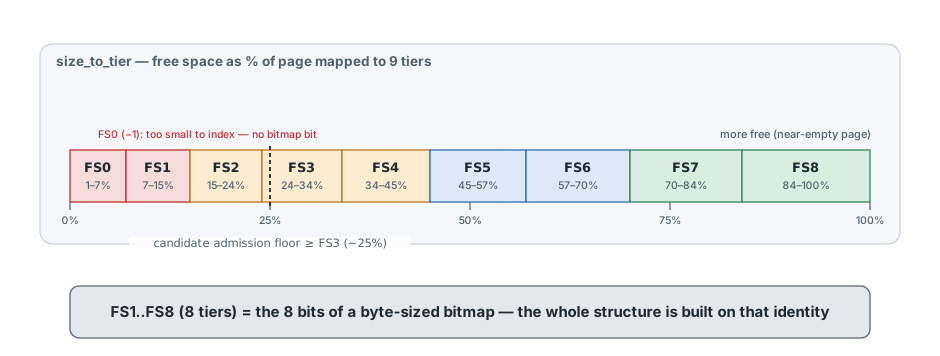
Figure 3 — the nine free-space tiers. size_to_tier buckets a page by percent
free; FS0 is too small to index, and the candidate admission floor sits at
FS3 (~25%). The eight indexable tiers FS1..FS8 map one-to-one onto the eight
bits of a byte-sized bitmap.
L1 — the leaf (one page). Same 8-byte layout as bestspace_entry, in a
64-byte atomic_wrapper<L1> so each of the 64 slots in a shard sits on its own
cache line.
// bestspace::L1 — src/storage/bestspace.hpp (accessors elided)class L1 { std::uint16_t m_freespace; short m_volid; int32_t m_pageid;};static_assert (sizeof (L1) == 8 && std::atomic<L1>::is_always_lock_free, "...");L2 and L3 — the summary bitmaps. Each is an 8-byte value = std::array<bitmap, 8>, one 1-byte bitmap per tier FS1..FS8:
L2[k]summarizes the 8L1slots in groupk. Bitjof theFStbitmap is set whenL1[k*8 + j]sits in tierFSt.L3summarizes the 8L2groups. Bitkof theFStbitmap is set when groupkhas any page in tierFSt.
One shard indexes L3_FANOUT (8) × L2_FANOUT (8) = 64 pages
(ENTRIES_PER_SHARD). A search for tier FSt reads one L3 word (which groups
have such a page), then one L2 word per candidate group (which slots), then
only those L1 leaves — two summary loads and a handful of leaves. Clearing a
tier bit across all 8 tiers is one masked 64-bit write
(val &= ~(0x0101010101010101ULL << index)).

Figure 4 — how one shard indexes 64 pages. L3 fans out to eight L2 groups,
each fanning out to eight L1 leaves (8 × 8 = 64). Each L2/L3 word is eight
one-byte bitmaps stacked by tier: within a word, bit j of the FSt byte marks
that child j holds a page in tier FSt, so a find for tier t is two summary
loads plus a few leaf reads.
shard and bestspace — the containers:
// bestspace::shard — src/storage/bestspace.hpp (fields, condensed)class alignas (64) shard { atomic_wrapper<bool> m_allocating; // single-allocator gate atomic_wrapper<L3> m_L3; atomic_wrapper<L2> m_L2[L3_FANOUT]; // 8 atomic_wrapper<L1> m_L1[L3_FANOUT * L2_FANOUT]; // 64 std::atomic<std::uint64_t> m_recs_num, m_recs_sumlen; bestspace &m_parent; struct { /* per-shard debug stats */ } m_stats;};static_assert (sizeof (shard) == 4800 && alignof (shard) == 64, "...");// bestspace — src/storage/bestspace.hpp (fields, condensed)class bestspace { std::deque<shard> m_shards; // shard_count of them tbb::concurrent_queue<bestspace_entry> m_candidates; // recycle queue std::uint16_t m_unfill_space; // per-heap update headroom};A shard is 4800 bytes; a bestspace at the default 8 shards is ~38 KB of index
plus its candidate queue — the memory cost of the per-class, per-shard design,
paid once per open heap file.
The find path — lock-free descent
Section titled “The find path — lock-free descent”bestspace::find is the hot path an INSERT calls. Given the record size it
returns a fixed, WRITE-latched page with room, having already reserved the space
in the index.
// bestspace::find — src/storage/bestspace.cpp (control flow, condensed)consume_space = size + SPAGE_SLOT_SIZE; // what the record takesneeded_space = consume_space + m_unfill_space; // plus update headroomif (needed_space > heap_nonheader_page_capacity ()) needed_space = consume_space; // headroom would never fitwhile (true) { for (i = 0; i < m_shards.size (); i++) { error = m_shards[(shard + i) % m_shards.size ()] .find (class_oid, hfid, needed_space, consume_space, bias, page_watcher); if (error == FOUND) return NO_ERROR; if (error == FAILURE) return er_errid (); // else ALLOCATING: this shard is mid-allocation, try the next } // every shard was ALLOCATING: yield / short sleep, check interrupt, retry}Two request sizes are threaded down: needed_space (record + slot +
unfill_space headroom) decides tier eligibility, while consume_space
(record + slot only) is subtracted from the page’s recorded free space on
success. The unfill_space reserve keeps room for a later in-place update to
grow without migrating.
Inside a shard the descent is L3_find → L2_find → L1_find:
flowchart TD
  A["shard::find(needed_size)"] --> B["minimum = size_to_tier(needed_size);\nif minimum < FS8: minimum++"]
  B --> C["L3_find: for tier t from minimum up to FS8\nload L3, list groups with a page at t"]
  C --> D["L2_find: for each candidate group\nload L2, list L1 slots at tier t"]
  D --> E["L1_find: load L1 slot"]
  E --> F{"recorded freespace\n>= needed_size?"}
  F -- no --> C
  F -- yes --> G["ordered_fix page\n(LK_FORCE_ZERO_WAIT)"]
  G -- timeout --> H["CONTENDED: skip this page"]
  G -- bad pageid --> I["stale: L1_remove, roll up"]
  G -- ok --> J{"still this class? actual\nspage free space >= needed?"}
  J -- no --> I
  J -- yes --> K["CAS L1 freespace -= consume_size\nL2_update / L3_update rollup"]
  K --> L["FOUND: return fixed page"]
Figure 5: the intra-shard descent. minimum is bumped one tier above the exact
fit so a chosen page comfortably clears the request; the search still walks
upward through richer tiers if the first is empty.
The subtle, load-bearing details:
- Advance one tier for headroom.
minimum = size_to_tier(needed_size)thenminimum++(unless alreadyFS8). Picking from a strictly richer tier avoids repeatedly landing on pages that just barely fit. - Bias for fairness (scaffolded, inert at head). The structure threads a
bias(used aspos[(i + bias) % length]at each level) and a rotating start shard so concurrent inserters descending the same bitmap would not all stampede the same first slot. At head81061660a5,bestspace::findsetsshard = 0; bias = 0;once and never advances them, so this anti-stampede rotation is present in the code but not yet active — worth re-checking as the PR evolves. - The recorded free space can lie.
L1_findfirst pre-filters on the atomicfreespaceword; only if that clears does it fix the page and read the truth viaspage_max_space_for_new_record. If the truth is short, it CAS-corrects theL1word (and rolls the correction up throughL2/L3) and returnsNOT_FOUND— a self-heal, echoing the legacy “recheck and repair.” - Ownership check. After fixing, it verifies the page is still
PAGE_HEAPand still belongs toclass_oid; if not, the entry is removed. A page can have been deallocated and reused elsewhere since it was indexed. - Contention is skip, not wait.
L1_fixusespgbuf_ordered_fixwithLK_FORCE_ZERO_WAIT; a latch timeout becomesCONTENDED(try the next candidate), not a block — the same non-blocking discipline as legacy, now without any header latch above it. - Reserve via CAS. On success the winning thread CASes the page’s
L1freespacedown byconsume_size. Only the thread that fixed the page and still sees the same VPID performs the update, so the reservation is single-writer per slot even though the structure is lock-free. pgbuf_ordered_fixeverywhere. The whole path uses ordered fix so multiple page latches cannot deadlock — an explicit PR fix (“use ordered fix to avoid deadlock in bestspace path”).
If no shard yields a page and none is allocating, the outer loop yields (or
sleeps 10 µs after 20 spins) and retries, honoring interrupts. A shard
mid-allocation returns ALLOCATING and the caller simply advances — allocation
never blocks a find.
The allocate path — victims, candidates, new pages
Section titled “The allocate path — victims, candidates, new pages”When a shard’s descent finds no page with room, shard::find calls allocate.
This refills the index: it evicts the poorest slots and installs better pages,
preferring recycled candidates over freshly allocated storage.
flowchart TD
  A["shard::allocate(consume_size)"] --> B{"allocate_mark:\nCAS m_allocating false to true"}
  B -- already set --> Z["ALLOCATING: caller advances\nto next shard"]
  B -- won --> C["allocate_pick_victims:\n4 L1 slots with least free space\n(also snapshot resident VPIDs)"]
  C --> D["allocate_pick_candidates:\npop from candidates queue,\nkeep those richer than the RICHEST victim,\ndedup vs residents  (up to 3)"]
  D --> E["allocate_new_pages:\nheap_alloc_new_pages for the remainder\n(batch of ALLOC_BATCH_SIZE = 4)"]
  E --> F["reserve one page for the caller\n(candidate[last].freespace -= consume_size)"]
  F --> G["allocate_replace_pages:\nstore new entries into victim L1 slots,\nL2_update / L3_update rollup"]
  G --> H["allocate_unmark; FOUND"]
Figure 6: refilling a shard. One allocator per shard at a time (the
m_allocating gate); everyone else keeps searching other shards meanwhile.
- One allocator per shard.
allocate_markis a CAS onm_allocating; a loser returnsALLOCATINGimmediately, so the expensive allocation work is never duplicated or serialized across shards. - Batch of four.
ALLOC_BATCH_SIZE == 4. The shard refreshes up to its four weakest slots per allocation — three unconditionally, the fourth (richest of the victims) only if the replacement beats it — amortizing the cost and leaving several fresh pages, not one. - Recycle before allocate.
allocate_pick_candidatesdrains the candidates queue for pages richer than the richest of the four victims (with aMAX_POP_TRIEScap and dedup against resident pages); onlyallocate_new_pagesallocates new storage for the shortfall via the batch primitiveheap_alloc_new_pages. If the biggest victim is already very rich (>= FS8), candidate picking is skipped — better to allocate clean pages than shuffle. - Guaranteed forward progress.
allocate_new_pagesalways allocates at least the pages needed to reach the batch, soallocatereturns with at least one usable page (the last, reserved for the caller).
Candidates queue and page recycling
Section titled “Candidates queue and page recycling”The candidates queue (tbb::concurrent_queue<bestspace_entry> m_candidates) is
the new home for “this page just gained free space.” It replaces the legacy
second_best reservoir with a lock-free MPMC queue:
- Producers. Any path that frees space nominates the page via
heap_add_bestpage(thread_p, hfid, page, prev_freespace)— the direct replacement for the legacyheap_stats_update, wired at the same call families: vacuum reclaiming space, the physical record-delete path (heap_delete_physical), and recovery undo of an insert (heap_rv_undo_insert). Candidates also enter from the heap header on rebuild. - Admission floor (tier FS3).
heap_add_bestpageenqueues a page only when its free space reaches tierFS3(~25%) — the tier-based analogue of the legacy 30%HEAP_DROP_FREE_SPACE. - Consumer. Only
allocatedrains the queue, and only as much as it needs (MAX_POP_TRIES), so a bulk vacuum that frees thousands of pages does not force a burst of index churn — pages wait until a shard actually refills. This is the new analogue of the legacy 1-in-1000 write-spreading, achieved structurally instead of by a sampling counter. - Dedup.
allocateskips candidates whose VPID already resides in the shard.
Registry and the thread-local cache
Section titled “Registry and the thread-local cache”A bestspace must be found by (class_oid, HFID) on every insert, so the lookup
itself must not become the new bottleneck. bestspace_registry (global singleton
cubstorage::bestspaces) is a mutex-guarded global list fronted by a per-thread
cache:
// bestspace_registry::find — src/storage/bestspace.cppbestspace *bestspace_registry::find (OID *class_oid, HFID *hfid) { bestspace *entry = find_from_cache (class_oid, hfid); // thread-local, no lock if (entry) return entry; return find_from_global (class_oid, hfid); // std::mutex, then cache it}- Thread-local first. Each thread keeps an LRU list of up to
TLS_MAX_SIZE (20)recent(class_oid, HFID) → bestspace*entries; a hit takes no lock and moves to the front. - Generation-stamped invalidation. The registry holds an atomic
m_generation;destroybumps it. On the nextfind, a thread whose cached generation differs invalidates its whole thread-local list in one comparison — a dropped table is never reachable through a stale cache pointer. - Global fallback under mutex. A miss takes the registry mutex, finds the entry in the global list, releases the mutex, and installs the pointer in the thread-local cache.
- Lifecycle.
createwhen a heap file’s bestspace is first needed or built;destroy(class_oid, vfid|hfid)when the heap file is dropped (seevacuum_rv_notify_dropped_file→bestspaces.destroy).
The mutex is touched only on cold lookups and lifecycle events; steady-state inserts resolve their heap file entirely in thread-local memory.

Figure 7 — resolving a heap file to its bestspace. A thread-local LRU cache
answers the common case with no lock; a miss takes the registry mutex, resolves
against the global list, and installs the pointer back into the cache. An atomic
m_generation bumped by destroy drops a whole thread-local list in one
comparison, so a dropped table is never reached through a stale pointer.
On-disk persistence and recovery
Section titled “On-disk persistence and recovery”The in-memory index is derived state, but rebuilding it from a full heap scan
after every restart would be prohibitive, so a compact, reconstructable form
is persisted. The heap header’s old estimates block is gone; in its place is a
bestspace sub-struct:
// heap_hdr_stats — src/storage/heap_file.c (next-version, condensed)struct heap_hdr_stats { OID class_oid; VFID ovf_vfid; VPID next_vpid, last_vpid; int unfill_space; int num_pages; uint64_t num_recs; uint64_t recs_sumlen; // aggregate estimates kept struct { int num_candidates; cubstorage::bestspace_entry candidates[128]; // pending candidates, persisted inline int num_shards; int num_pages; VPID pages[4]; // up to 4 dedicated storage pages } bestspace; int reserve0, reserve1, reserve2;};- Aggregate counters survive.
num_pages,num_recs,recs_sumlenremain (promoted out ofestimates) to feed average-record-size estimates. Thebest[10]/second_best[10]rings and cursors are deleted outright. - Serialized L1 entries. The shards’
num_shards × 64L1 entries serialize to up to four dedicated heap pages (bestspace.pages[4]), each flaggedHEAP_PAGE_FLAG_BESTSPACE. Header helpers (heap_create_bestspace,heap_update_bestspace) allocate, write, and update them. - Inline candidates. Up to 128 pending candidates live in the header
(
candidates[128],num_candidates), managed byheap_bestspace_add_candidate/heap_bestspace_clear_candidates. - Logged updates. On-disk entry updates are redo-logged under a new recovery
index
RVHF_UPDATE_BESTSPACE_ENTRIES(redo handlerheap_rv_redo_update) — unlike the legacy hints, the persisted form participates in recovery so a rebuilt index starts from a consistent snapshot. - Rebuild on demand. With no in-memory
bestspace(first access or after restart),heap_build_bestspacereads the header, loads entries and candidates from the storage pages, and callsbestspaces.create(class_oid, hfid, entries, num_entries, candidates, num_candidates, num_shards, unfill_space).compactdbrefreshes the persisted form.

Figure 8 — the durable form. The heap header carries aggregate estimates, up to
128 inline candidates, and up to four VPIDs pointing at dedicated storage pages
(flagged HEAP_PAGE_FLAG_BESTSPACE) that hold the serialized L1 entries;
updates are redo-logged under RVHF_UPDATE_BESTSPACE_ENTRIES. After a restart,
heap_build_bestspace reconstructs the in-memory index, and heap scans skip the
flagged pages so metadata is never read as records.
Because the L1 entries and candidates live in real heap pages, heap scans must
skip them. A predicate heap_page_is_bestspace() (backed by
HEAP_PAGE_FLAG_BESTSPACE) is checked at the ~15 heap-scan sites that must not
treat a metadata page as a record page — e.g. the parallel heap scan
(px_scan_input_handler_heap) and partition redistribution
(redistribute_partition_data) — which advance past bestspace storage pages.
Integration points
Section titled “Integration points”Beyond the two new files, PR #7353 touches ~20 files:
| Area | File | Change |
|---|---|---|
| System parameter | system_parameter.c/.h | New bestspace_shard_count (PRM_ID_BESTSPACE_SHARD_COUNT, server, user-changeable, default 8, min 1, max 28). PRM_ID_HF_MAX_BESTSPACE_ENTRIES marked PRM_OBSOLETED. |
| Vacuum | vacuum.c | Freed pages nominated via heap_add_bestpage; on drop, cubstorage::bestspaces.destroy(class_oid, vfid). |
| Parallel scan | px_scan_input_handler_heap.cpp | Skip pages where heap_page_is_bestspace is true. |
| Partitioning | locator_sr.c | redistribute_partition_data skips bestspace storage pages. |
| Slotted page | slotted_page.c/.h, storage_common.h | Remove the need_update_best_hint header bit, spage_set_need_update_best_hint, the need_update out-param of spage_get_free_space_without_saving, and HEAP_PAGE_INFO_UPDATE_BEST. |
| SHOW meta | show_meta.c | SHOW HEAP HEADER drops the whole Estimates_* column set; now exposes Last_vpid, Unfill_space, Num_pages, Num_recs, Avg_rec_len. Slotted-header show drops Need_update_best_hint. |
| Recovery | recovery.c/.h | New RVHF_UPDATE_BESTSPACE_ENTRIES = 130 (RV_LAST_LOGID bumped). |
| Heap API | heap_file.h | Remove HEAP_DROP_FREE_SPACE, HEAP_BESTSPACE, heap_stats_update. Add heap_add_bestpage, heap_alloc_new_pages (batch), heap_page_is_bestspace. |
| Build | CMakeLists.txt (×2) | Compile bestspace.cpp; link TBB. |
Within heap_file.c (a ~2600/2770 line rewrite), the legacy heap_stats_*
machinery (heap_stats_find_page_in_bestspace, heap_stats_sync_bestspace,
heap_stats_put/get_second_best, heap_Bestspace) is removed, and a new
heap_find_bestpage / heap_find_bestspace / heap_build_bestspace layer
delegates to cubstorage::bestspaces.
Legacy vs. next-version
Section titled “Legacy vs. next-version”| Dimension | Legacy heap_Bestspace | Next-version cubstorage::bestspace |
|---|---|---|
| Scope | One process-global hash for all heaps | One structure per heap file (class_oid, HFID) |
| Concurrency control | Heap-header WRITE latch across the whole selection + a global bestspace_mutex | Sharded, lock-free (per-node CAS on 64B-aligned atomics); mutex only on registry cold path |
| Parallelism unit | One inserter per heap at a time | bestspace_shard_count (default 8) independent shards per heap |
| Index structure | Global hash + on-disk best[10] / second_best[10] rings | 3-level bitmap (L3/L2/L1) over 64 slots per shard |
| Free-space classes | One 30% floor (HEAP_DROP_FREE_SPACE) | 9 tiers (FS0–FS8) |
| Page reuse | second_best reservoir, 1-in-1000 admission | Lock-free candidates queue, drained on demand |
| Fed by | Delete/update/vacuum → heap_stats_update | Delete / vacuum / insert-undo → heap_add_bestpage (candidate, ≥ FS3) |
| Lookup cost | Hash probe under mutex, then disk ring under header latch | Thread-local registry hit (no lock) → shard bitmap descent |
| Persistence | Header estimates ring, unlogged | Header sub-struct + dedicated pages, redo-logged (RVHF_UPDATE_BESTSPACE_ENTRIES) |
| Recovery | Stale hints, re-synced by next insert | Rebuilt from persisted snapshot via heap_build_bestspace |
| Tuning knob | bestspace_max_entries (now obsolete) | bestspace_shard_count (1–28) |
| Scan interaction | Hints reference normal pages | Storage pages flagged HEAP_PAGE_FLAG_BESTSPACE, skipped by scans |
Both remain approximate — a recorded free space may be wrong, and the code rechecks the real page and self-heals. The change is not accuracy; it is where the coordination happens: from a central latched header ring to a distributed lock-free per-class index.
Source Walkthrough
Section titled “Source Walkthrough”Symbols grouped by role.
New free-space index (src/storage/bestspace.hpp, src/storage/bestspace.cpp):
cubstorage::bestspace_entry— 8-byte page hint.bestspace::tier,bestspace::size_to_tier— the FS0–FS8 tiering.bestspace::bitmap,bestspace::L1,bestspace::L2,bestspace::L3— the three-level bitmap and its leaf.bestspace::atomic_wrapper<T>— 64-byte-aligned lock-free wrapper.bestspace::shardand its methods:find,L3_find/L2_find/L1_find,L1_fix/L1_remove,L2_update/L3_update,allocate,allocate_mark/allocate_unmark,allocate_pick_victims,allocate_pick_candidates,allocate_new_pages,allocate_replace_pages,initialize_by_entries.bestspace(top):find,initialize_by_entries,add_candidates,pop_candidate,size_to_tier,show_stats.bestspace_registryandcubstorage::bestspaces:find,find_from_cache/find_from_global,create(×2),destroy(×2),TLS_cache,m_generation.
Heap-manager integration (src/storage/heap_file.c, heap_file.h):
heap_find_bestpage— hot-path entry: resolve heap file →bestspace, callbestspace::find.heap_find_bestspace,heap_build_bestspace— resolve-or-build against the registry.heap_create_bestspace,heap_update_bestspace,heap_update_bestspace_chain— persist / update the on-disk form.heap_bestspace_add_candidate,heap_bestspace_clear_candidates— header candidate list.heap_add_bestpage— nominate a page as a candidate (delete / vacuum / insert-undo paths; enqueues only at tier ≥ FS3).heap_alloc_new_pages— batch page allocator used byshard::allocate.heap_page_is_bestspace— predicate overHEAP_PAGE_FLAG_BESTSPACE.heap_hdr_stats.bestspace— the header sub-struct.
Other files: PRM_ID_BESTSPACE_SHARD_COUNT (system_parameter.c);
RVHF_UPDATE_BESTSPACE_ENTRIES (recovery.h); heap_page_is_bestspace call
sites in px_scan_input_handler_heap.cpp and locator_sr.c.
Source verification (as of 2026-07-08)
Section titled “Source verification (as of 2026-07-08)”Line hints are from PR #7353 head 81061660a5 (the CBRD-26858 branch),
not from develop. They will not match the base branch and will drift as the
PR evolves. Anchor on the symbol names.
| Symbol | File | Line (PR head 81061660a5) |
|---|---|---|
bestspace_entry | src/storage/bestspace.hpp | 49 |
bestspace::tier (enum) | src/storage/bestspace.hpp | 83 |
bestspace::shard (class) | src/storage/bestspace.hpp | 237 |
bestspace (class) | src/storage/bestspace.hpp | 69 |
bestspace_registry | src/storage/bestspace.hpp | 357 |
bestspace::shard::find | src/storage/bestspace.cpp | 302 |
bestspace::shard::L3_find | src/storage/bestspace.cpp | 341 |
bestspace::shard::L1_find | src/storage/bestspace.cpp | 490 |
bestspace::shard::L1_fix | src/storage/bestspace.cpp | 574 |
bestspace::shard::allocate | src/storage/bestspace.cpp | 789 |
bestspace::shard::allocate_pick_candidates | src/storage/bestspace.cpp | 680 |
bestspace::find | src/storage/bestspace.cpp | 892 |
bestspace::size_to_tier | src/storage/bestspace.cpp | 986 |
bestspace_registry::find | src/storage/bestspace.cpp | 1150 |
bestspace_registry::find_from_cache | src/storage/bestspace.cpp | 1163 |
cubstorage::bestspaces (global) | src/storage/bestspace.cpp | 1345 |
RVHF_UPDATE_BESTSPACE_ENTRIES | src/transaction/recovery.h | 187 |
heap_page_is_bestspace (decl) | src/storage/heap_file.h | (added) |
heap_add_bestpage (decl) | src/storage/heap_file.h | (added) |
heap_alloc_new_pages (decl) | src/storage/heap_file.h | (added) |
Cross-check Notes
Section titled “Cross-check Notes”This doc analyzes an unmerged draft; the usual version-drift caveats apply, plus a few specific to that state:
- Line hints are PR-branch, not develop. The position-hint table is anchored
to head
81061660a5on branchCBRD-26858. When the PR merges (squash), all line numbers change; re-verify against the merge commit and re-anchor. heap_file.cline hints omitted. The heap-side integration symbols are named but not line-pinned — the file is a ~2600/2770-line rewrite still in flux, so per-symbol lines would be stale on the next force-push. Anchor on the symbol names until the PR stabilizes.- Bias/round-robin scaffolding is inert at head.
bestspace::findfixesshard = 0; bias = 0, so the anti-stampede rotation described in §“The find path” is present but not active. If a later commit wires it, the “divergence comes only from a skipped mid-allocation shard” claim becomes obsolete. - Legacy contrast pinned to Chapter 9. The legacy baseline and comparison
table are cross-checked against
cubrid-heap-manager-detail.mdChapter 9 as of itsupdated:date. If that doc is revised, re-check the comparison table. show_statsviaprintf. The debug stats print to stdout, and the registry destructor prints per-class stats — development-time instrumentation likely to change or be removed before merge; do not treat as a stable observability surface.- ASSM L1/L2/L3 analogy is illustrative, not a claim of shared code. The parallel to Oracle ASSM in §“Common DBMS Design” is a design-family observation (per-block bitmap hierarchy keyed by fullness), not an assertion that CUBRID ported Oracle’s structure.
Open Questions
Section titled “Open Questions”- Performance validation is pending. CBRD-26176’s acceptance criterion —
measured load distribution and throughput gain under INSERT-heavy load — is
the point of the change but not something this static analysis can confirm.
How it scales with
bestspace_shard_countneeds the benchmark. - Shard-count tuning and migration. Default 8, max 28. What guides the
choice — core count, per-table insert concurrency, memory (≈ 4800 B/shard)?
On rebuild,
heap_build_bestspacetakes the shard count from the live parameter, not the persistedbestspace.num_shards(which only sizes how many L1 entries to deserialize; surplus entries spill into the candidate queue), so after a parameter change plus restart a heap adopts the new shard count. - Candidate-queue and header-
candidates[128]overflow. If producers outrunallocate, does the concurrent queue grow unbounded, and how are more than 128 pending candidates handled at persist time? - Memory footprint. ~38 KB per open heap file at default shard count, per
class_oid+HFID; there is no global cap analogous to the obsoletedbestspace_max_entries. Worth measuring for schemas with many tables / partitions. - Recovery correctness of the lock-free rollup. The
L2_update/L3_updateCAS retry loops re-derive summaries under concurrent mutation; the interaction between an in-flightallocateand a crash deserves scrutiny once the code stabilizes. - Interaction with Direct I/O. CBRD-26176 is linked as a regression of
CBRD-26141
[POC] Direct I/O 지원— whether bestspace-page I/O assumes buffered semantics is unresolved here.
Sources
Section titled “Sources”- PR / issues.
- PR #7353
[CBRD-26176] bestspace— head81061660a5, basedevelop(draft). - CBRD-26857
[EPIC]— 힙 파일 여유 공간(best space) 관리 구조 개선 (Sharded Lock-free Bestspace Index). - CBRD-26858
[조사/설계]— 타사 여유 공간 정책 조사 및 개선 설계 (Oracle freelist/ASSM, PostgreSQL FSM); the survey behind §“Common DBMS Design”. - CBRD-26176 — 다수 트랜잭션 동시 INSERT 시 best space 정책 성능 병목 해결.
- Related: CBRD-26806 (중앙 집중형 metadata 경합 분석), CBRD-26141 ([POC] Direct I/O).
- PR #7353
- Source (PR head
81061660a5).src/storage/bestspace.{hpp,cpp},src/storage/heap_file.{c,h},src/storage/slotted_page.{c,h},src/storage/storage_common.h,src/query/vacuum.c,src/query/parallel/px_scan/px_scan_input_handler_heap.cpp,src/transaction/locator_sr.c,src/transaction/recovery.{c,h},src/base/system_parameter.{c,h},src/parser/show_meta.c. - Textbook. Petrov, Database Internals, Ch. 3–4 (slotted page, free space)
— see
../../research/dbms-general/captures. - Related KB docs.
cubrid-heap-manager.md(heap fundamentals, free-space intent),cubrid-heap-manager-detail.mdChapter 9 (the legacy bestspace machinery in full),cubrid-lockfree-overview.md(CUBRID’s lock-free building blocks),cubrid-disk-manager.md(page allocation).