CUBRID Transaction & Recovery — Section Overview
Contents:
- What this section covers
- The layered stack
- The ACID lens
- Reading order
- Cross-cutting concerns
- Detail-doc summaries
- Adjacent sections
What this section covers
Section titled “What this section covers”This section is the part of the CUBRID code-analysis tree that
implements the transactional contract a relational engine sells to
its clients: ACID. Every doc in txn-recovery/ is a piece of
that contract. Atomicity is the promise that a transaction either
commits in full or leaves no trace, and the engine keeps it through
undo records in the log and the recovery manager’s undo pass.
Durability is the promise that once COMMIT returns, the change
survives a crash, and the engine keeps it through write-ahead
logging, the prior-list commit pipe, periodic checkpoints, and the
double-write buffer (which lives in the Storage Engine section but
is named here because durability cannot be discussed without it).
Isolation is the promise that concurrent transactions see a
well-defined order of effects, and the engine keeps it through
MVCC snapshots for reads, the lock manager for write-write
conflicts, and the vacuum subsystem to reclaim the dead versions
that MVCC leaves behind. Consistency — preserving every constraint
the schema declares — is enforced above this layer (DDL, schema
manager, integrity rules), but every constraint check that fires
during DML emits log records through the same log manager and
prior list, so the txn-recovery section is where the bookkeeping
lives even if the rules are owned elsewhere.
Three docs extend the same machinery beyond local ACID. 2PC adds atomicity across multiple servers — the same TDES, the same log records, plus a coordinator/participant FSM and a prepared state that survives crash. Flashback turns the WAL into a queryable history: instead of replaying the log to recover, it replays the log to report what happened in a time window. Backup and restore packages the data volumes and a bracketed log range into a self-contained snapshot and uses the recovery manager’s redo pass to converge on any commit boundary inside the bracket — point-in-time recovery (PITR).
This overview is a router. It names which doc owns which piece of the contract, sketches how those pieces compose at run time, and points at the cross-section dependencies (the page buffer and the DWB live in Storage Engine; the boot path lives in Server Architecture; the locator lives in Storage Engine but is the caller of the log manager). The eleven detail docs hold the actual code-level analysis; this doc does not duplicate it.
The layered stack
Section titled “The layered stack”The storage-engine section ahead of this one organises its modules as a strict bottom-up stack (volumes -> buffer -> records -> keys). The transaction-and-recovery section is harder to pin down that way because its modules cluster around a state hub (the TDES) and a substrate (the WAL) rather than a vertical layering of storage abstractions. Even so, a structural diagram of who-talks-to-whom helps before the ACID-property carve-up below — it answers what this section’s perimeter is and how its eleven detail docs reach each other and the storage engine.
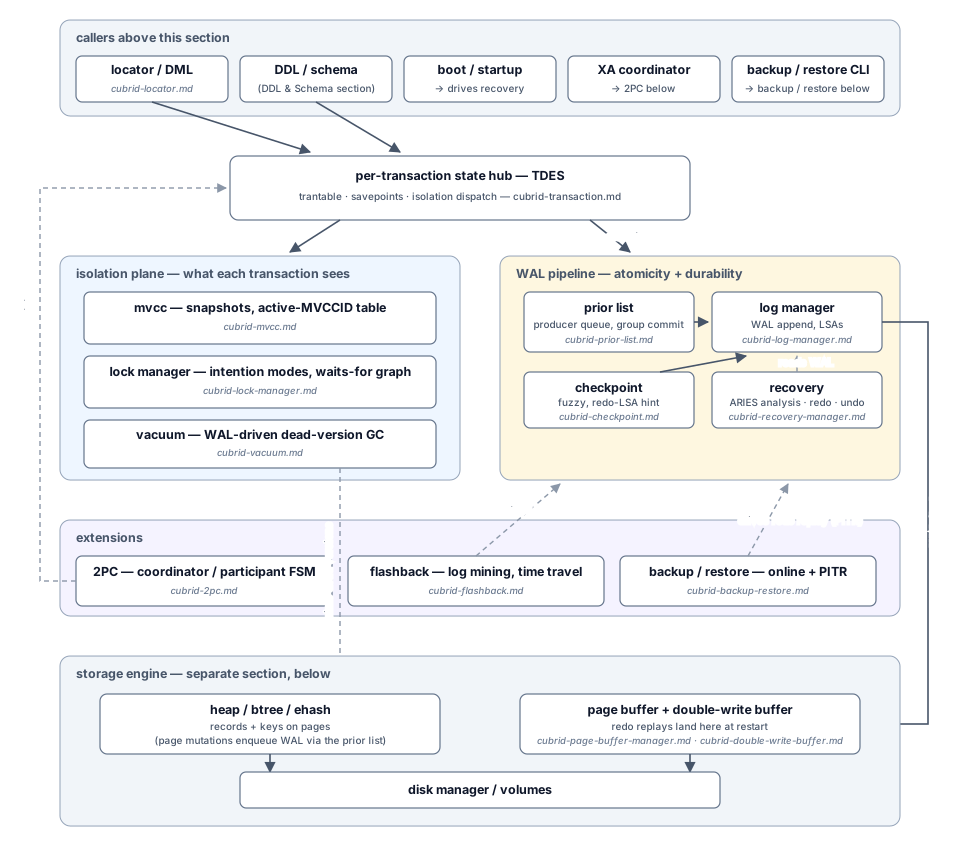
Figure 1 — Transaction & recovery module topology. Five caller entry points (locator, DDL, boot, XA, backup CLI) drive the TDES hub; the isolation plane (MVCC, lock manager, vacuum) and the WAL pipeline (prior list → log manager → checkpoint → recovery manager) radiate from it; extension modules (2PC, flashback, backup-restore) reuse the same TDES and WAL without adding new substrates; the storage engine (page buffer, heap/btree, disk manager) is the section boundary below.
Reading the diagram top-down:
- Callers above the section. Five entry points drive
everything in
txn-recovery/. The locator (cubrid-locator.md, in Storage Engine) is the DML hot path: it routes through the TDES for transaction state and reaches into the heap / B+Tree directly for the page mutation. DDL & Schema reaches the same hub plus the lock manager for schema-stability locks. Boot (cubrid-boot.md) is the cold path that runs the recovery manager at startup, before the server accepts clients. XA clients drive 2PC externally. Backup / restore utilities reuse the recovery manager in standalone mode. - Per-transaction state hub (
cubrid-transaction.md). Every later doc in this section reads or writes fields on the TDES — trid, MVCCID, isolation level, savepoint chain, undo-next / postpone-next LSAs, the per-transaction lock-table cursor. This is whycubrid-transaction.mdis the “read first” doc in the reading order: holding the descriptor in your head makes every later module fall into place. - Isolation plane. MVCC for read visibility, the lock manager for write-write conflicts and schema stability, vacuum to reclaim what MVCC leaves behind. The three are linked by the oldest-visible-MVCCID watermark (vacuum’s stop marker, derived from MVCC’s active table) and by the TDES, which carries both the snapshot identity and the lock-table cursor.
- WAL pipeline (atomicity + durability). The prior list
buffers
LOG_PRIOR_NODErecords produced by the heap, by the TDES (commit / abort), and (where applicable) by the lock manager. The log manager drains the queue, fsyncs, and exposes the durable-LSN watermark that group-commit waiters block on. Checkpoint anchors how far back recovery has to look. The recovery manager runs the ARIES three-pass restart by walking the same WAL forward (analysis + redo) and then backward (undo). - Extensions. 2PC, flashback, and backup / restore reuse the TDES + WAL machinery without adding new substrates of their own — they extend the same trantable, the same log records, the same recovery passes.
- Storage engine (below). Three boundary points cross the section line. Heap pages emit log records up into the prior list. The log manager (and the recovery manager’s redo pass) push log / data pages down through the page buffer (which routes through the DWB before reaching the disk manager). MVCC reads down into heap headers without going through the page-buffer flush path.
The next section, “The ACID lens”, revisits the same eleven modules from a different angle — which ACID property each one primarily supports.
The ACID lens
Section titled “The ACID lens”A useful frame for navigating the eleven docs is to ask which ACID property each one primarily supports, while being honest that almost all of them touch more than one. The mapping below is the dominant duty, not the only one.
Atomicity is owned by the recovery manager and the log
manager together. Every undo-eligible mutation emits a log
record carrying enough information to reverse itself
(physiological for the data side, logical for B+Tree
operations); rollback walks the per-transaction LSA chain
backward from the TDES head and applies each record’s undo
function, emitting a compensation log record (CLR) so the undo
itself is restartable. Restart-time atomicity uses the same
mechanism — the analysis pass classifies losers, the undo pass
unwinds them — but with the trantable rebuilt from the log
rather than carried forward. See cubrid-log-manager.md (record
shapes, LSA naming, append discipline) and
cubrid-recovery-manager.md (the three-pass restart, with the
undo pass driving atomicity at recovery time).
cubrid-transaction.md is where the per-transaction state — the
TDES with its head/tail/undo-next/postpone-next chains — that
both rollback and recovery walk lives.
Consistency is mostly enforced above this section. DDL
constraints, foreign keys, unique indexes, and the schema
manager’s integrity rules belong to Storage Engine and DDL & Schema.
But every constraint check that fires during DML emits log records
through cubrid-log-manager.md and cubrid-prior-list.md, and
every aborted constraint violation is rolled back through the
same atomicity machinery. The txn-recovery section therefore
carries consistency — it is the bookkeeping plane, even when
the rules are owned elsewhere.
Isolation is the joint operation of MVCC and the lock
manager, with vacuum cleaning up afterward. CUBRID’s default
isolation is snapshot isolation built on monotonic MVCCIDs and
an active-MVCCID table; readers consult the snapshot, never
block writers, and never get blocked by writers — that is the
core MVCC promise. Writers, however, still need exclusive locks
to serialise write-write conflicts, prevent lost updates, and
respect schema-stability requirements; the lock manager handles
this with intention modes (IS, IX, SIX, plus BU, SCH-S,
SCH-M, NON_2PL), a square conversion table, and a waits-for
graph deadlock detector. Vacuum is the gardener: every UPDATE
leaves a previous version, every DELETE leaves a tombstone, and
the engine cannot reuse the space until no live snapshot can
see them. CUBRID’s vacuum walks the WAL forward in fixed-size
blocks below the oldest-visible-MVCCID watermark and dispatches
per-block jobs to a worker pool. See cubrid-mvcc.md,
cubrid-lock-manager.md, and cubrid-vacuum.md.
Durability is the longest pipeline. A mutation produces a
LOG_PRIOR_NODE outside the global log latch, hands it to the
prior list, and (at commit) waits on a condition variable for
the durable-LSN watermark to advance past its tail; the
log-flush daemon drains the prior list under the log critical
section, copies bytes into the authoritative log pages, and
fsyncs. Group commit emerges naturally from many committers
sleeping on one CV. The page side is bracketed by checkpoints:
a periodic daemon emits LOG_START_CHKPT / LOG_END_CHKPT
carrying an active-transaction snapshot and a redo-LSA hint,
which advances log_Gl.hdr.chkpt_lsa so the next analysis pass
can skip everything below it. The data-page durability story
adds the double-write buffer (covered in Storage Engine,
cubrid-double-write-buffer.md): every dirty page lands in the
DWB before its home, so a torn write at the home is
recoverable from the DWB copy. See cubrid-log-manager.md,
cubrid-prior-list.md, cubrid-checkpoint.md, and
cubrid-recovery-manager.md.
Cross-server atomicity is cubrid-2pc.md. The same TDES
and log machinery, plus a LOG_2PC_EXECUTE enum that dispatches
by role (coordinator vs. participant), plus a prepared-state
log record that survives crash. The ARIES analysis pass picks
up in-doubt transactions and rebuilds the gtrid → tid map; XA
clients drive the FSM externally.
Time-travel queries are cubrid-flashback.md. Two-phase
forward log walk: phase 1 builds a per-transaction summary
(trid, user, time, INSERT/UPDATE/DELETE counts, classes
touched), phase 2 materialises a chosen transaction’s row
images. The wire format is shared with CDC, but flashback reads
against archived log volumes rather than the live tail.
Backup is cubrid-backup-restore.md. Online physical
backup snapshots data volumes while bracketing them with
start_lsa (current checkpoint) and the LOG_END_CHKPT after
the copy; restore mounts the page images and runs the recovery
manager’s redo pass forward to a user-supplied stop time.
PITR is by wall-clock timestamp (resolved internally to an
LSA-based stop point during redo). Three incremental levels
chain by skipping pages whose prv.lsa is older than the
parent backup’s start LSA.
flowchart TB
  subgraph A["Atomicity"]
    A1["cubrid-transaction.md<br/>(TDES, savepoints, LSA chains)"]
    A2["cubrid-log-manager.md<br/>(undo records, LSAs)"]
    A3["cubrid-recovery-manager.md<br/>(undo pass, CLRs)"]
  end

  subgraph I["Isolation"]
    I1["cubrid-mvcc.md<br/>(MVCCIDs, snapshots,<br/>active-MVCCID table)"]
    I2["cubrid-lock-manager.md<br/>(intention modes,<br/>waits-for graph)"]
    I3["cubrid-vacuum.md<br/>(WAL-driven dead-version GC)"]
  end

  subgraph D["Durability"]
    D1["cubrid-log-manager.md<br/>(WAL, append discipline)"]
    D2["cubrid-prior-list.md<br/>(commit pipe, group commit)"]
    D3["cubrid-checkpoint.md<br/>(fuzzy chkpt, redo-LSA hint)"]
    D4["cubrid-recovery-manager.md<br/>(redo pass)"]
    DWB["cubrid-double-write-buffer.md<br/>(torn-write protection)<br/><i>(in Storage Engine)</i>"]
  end

  subgraph C["Consistency"]
    CC["enforced above<br/>(DDL & Schema, integrity rules)<br/>but bookkeeping flows through D1+D2"]
  end

  subgraph X["Extensions"]
    X1["cubrid-2pc.md<br/>(cross-server atomicity)"]
    X2["cubrid-flashback.md<br/>(time-travel queries)"]
    X3["cubrid-backup-restore.md<br/>(PITR via redo replay)"]
  end

  TDES["TDES<br/>(per-transaction state hub)"]

  TDES --> A1
  TDES --> I1
  TDES --> X1

  A2 -. emits .-> D1
  I3 -. walks WAL .-> D1
  D2 -. drains into .-> D1
  D3 -. anchors .-> D4
  D4 -. uses .-> A3
  DWB -. brackets page writes .-> D1

  X1 -. extends .-> A1
  X2 -. reads archives via .-> D1
  X3 -. uses .-> D4
Figure 2 — ACID property mapping. TDES anchors the Atomicity cluster (transaction, log manager, recovery manager) and the Isolation cluster (MVCC, lock manager, vacuum); the Durability pipeline runs log manager → prior list → checkpoint → recovery manager → DWB; Consistency bookkeeping flows through the same D1+D2 path; 2PC, flashback, and backup-restore extend the core machinery as the Extensions cluster.
Reading order
Section titled “Reading order”A reader new to CUBRID’s transaction stack should not start with the recovery manager, even though it is the most theatrical of the eleven. Recovery makes sense only when you already know what is being recovered — what a transaction is in CUBRID, how its state is laid out, what an MVCC snapshot looks like, and what the log records that recovery walks contain. Read in this order:
-
cubrid-transaction.mdfirst. It defines the TDES, the trantable, the savepoint and system-op nesting model, and the dispatch from isolation level to either snapshot-based or lock-based reads. Every later doc reads or writes fields on the TDES; you need the descriptor in your head before anything else. -
cubrid-mvcc.mdnext. It explains how MVCCIDs are assigned, how the active-MVCCID table is maintained, how a snapshot is constructed at statement (or transaction) start, and how visibility is decided per row version. This is where the “snapshot for reads” half of CUBRID’s isolation story lives. -
cubrid-log-manager.mdfollows. WAL is the substrate everything below depends on: durability, recovery, replication, vacuum, flashback, backup. Read it for the record shapes (LOG_RECORD_HEADER, the union of record-type-specific bodies), the LSA decomposition into(page_id, offset), and the append discipline that hands off bytes from prior list to log page buffer. -
cubrid-prior-list.mdis the tight companion. It explains how the producer side stays out of the log critical section —LOG_PRIOR_NODErecords built outside the latch, queued under a small mutex, drained by the log-flush daemon. Group commit and the durable-LSN watermark live here. -
cubrid-checkpoint.mdcomes next because it is the recovery boundary that the next two docs presume. The fuzzy ARIES protocol, the active-transaction snapshot, the redo-LSA hint derived from the page-buffer dirty list, and the waylog_Gl.hdr.chkpt_lsaadvances are all here. -
cubrid-recovery-manager.mdis the payoff. ARIES three-pass restart — analysis fromchkpt_lsaforward to end-of-log, redo from min-redo-LSA forward (parallelised by a per-page worker pool throughRV_fun[]), undo backward per loser. With docs 1–5 in your head, every step has a familiar data structure underneath it. -
cubrid-lock-manager.mdis the “when MVCC isn’t enough” doc. Write-write conflicts, schema-stability locks, intention modes, and deadlock detection via the waits-for graph. CUBRID’s mode set extends the textbook withBU,SCH-S,SCH-M,NON_2PL. -
cubrid-vacuum.mdcloses the MVCC loop. WAL-forward replay below the oldest-visible-MVCCID watermark, fixed-size vacuum blocks, master/worker dispatch, dropped-files tracking. Read after bothcubrid-mvcc.md(you need the watermark concept) andcubrid-log-manager.md(vacuum reads the same WAL recovery does). -
cubrid-2pc.mdis for distributed-commit needs. Coordinator/participant FSM viaLOG_2PC_EXECUTE, prepared-state log records, in-doubt recovery folded into the analysis pass. -
cubrid-flashback.mdis for log-mining needs. Two-phase forward walk, summary then detail, archived-log access via the same log reader CDC uses. -
cubrid-backup-restore.mdis for operational PITR needs. The on-disk backup format, the LSA bracket, the three incremental levels, and the timestamp-to-LSA resolution at restore time.
Docs 9, 10, 11 can be read independently once 1–8 are in place; they are extensions of the core machinery rather than prerequisites for one another.
Cross-cutting concerns
Section titled “Cross-cutting concerns”Three integrations recur across the eleven docs and are easier to internalise as named patterns than to rediscover each time.
MVCC + lock manager: snapshot for reads, X-lock for writes
Section titled “MVCC + lock manager: snapshot for reads, X-lock for writes”CUBRID’s isolation is not “MVCC alone” or “locks alone” but a
specific division: readers go through MVCC visibility (no
blocking, no deadlock against writers), writers acquire
exclusive locks for write-write conflicts, lost-update
prevention, and schema stability. The TDES carries both the
MVCCID for snapshot identity and the lock-table cursor, and
the isolation-level dispatch in cubrid-transaction.md decides
which path a given access uses. This is why CUBRID supports
both read-committed and snapshot-isolation modes without two
separate access paths — the same code reads mvcc_snapshot for
visibility and consults the lock manager for writes; the
isolation level just changes when a fresh snapshot is taken.
See cubrid-transaction.md (dispatch), cubrid-mvcc.md
(snapshot), cubrid-lock-manager.md (writer locks).
Log + prior list + checkpoint + DWB: the durability pipeline
Section titled “Log + prior list + checkpoint + DWB: the durability pipeline”Durability is not one component; it is a four-stage pipeline where each stage has a distinct invariant and removing any stage breaks the contract.
- Prior list (
cubrid-prior-list.md). Producers buildLOG_PRIOR_NODErecords outside the log critical section and queue them with a short-held mutex. Producers’ work stays off the global hot path. - Log manager (
cubrid-log-manager.md). The log-flush daemon drains the prior list under the log critical section, copies bytes into the authoritative log page buffer, and fsyncs. Group commit emerges naturally from many committers sleeping on the durable-LSN CV. - Checkpoint (
cubrid-checkpoint.md). PeriodicLOG_START_CHKPT/LOG_END_CHKPTbrackets carry the active-transaction snapshot and the redo-LSA hint that bounds the next analysis pass. - Double-write buffer (
cubrid-double-write-buffer.md, in Storage Engine). Dirty data pages land in the DWB before their home. A torn write at the home is recovered from the DWB copy on restart.
The contract: a committed transaction’s log records are durable before commit returns (stages 1–2); the corresponding data pages need not be on disk yet (recovery’s redo pass will catch them up — stage 3 bounds how much it must replay); and no half-written page can corrupt either the home or the log (stage 4). Remove the DWB and torn writes silently corrupt; remove the checkpoint and recovery walks the entire log; remove the prior list and every commit serialises through the log latch.
Vacuum + MVCC + log: the GC loop
Section titled “Vacuum + MVCC + log: the GC loop”Vacuum’s input is the WAL itself, not the heap. Every
LOG_MVCC_* record describes one MVCC operation; vacuum walks
those records forward in fixed-size blocks below the
oldest-visible-MVCCID watermark and applies the appropriate
clean-up to the target page (heap row reclaim, B+Tree leaf
entry removal, OID list compaction). The watermark comes from
cubrid-mvcc.md — the smallest snapshot lower bound across
all live transactions, recomputed when transactions
start/finish. The log records come from
cubrid-log-manager.md — the same WAL that recovery uses,
read forward instead of for redo. The dispatch comes from
cubrid-vacuum.md — a master daemon partitions the log into
blocks, a worker pool consumes them. The trade-off (vs.
PostgreSQL’s heap-scan autovacuum or InnoDB’s undo-log purge)
is that workloads with many never-updated tuples save scan
cost but workloads with long scans without modifications gain
nothing.
Detail-doc summaries
Section titled “Detail-doc summaries”| Doc | What it owns | One-line summary |
|---|---|---|
cubrid-transaction.md | TDES, savepoints, isolation dispatch | Per-transaction state hub: trid, lifecycle, isolation level, LSA chains, side-state registries; nests partial rollback via system ops and savepoints. |
cubrid-mvcc.md | MVCCIDs, snapshots, active-MVCCID table | Snapshot construction with monotonic MVCCIDs and an in-memory active-MVCCID table; coordinates with vacuum through the oldest-visible watermark. |
cubrid-lock-manager.md | Locks, intention modes, deadlock detection | Multi-granularity locks per OID with intention modes (IS, IX, SIX, BU, SCH-S, SCH-M), conversion table, and a waits-for-graph deadlock detector. |
cubrid-vacuum.md | Dead-version reclamation | Walks WAL forward in fixed-size blocks below the oldest-visible-MVCCID watermark; master/worker dispatch; tracks dropped files separately. |
cubrid-log-manager.md | WAL, LSAs, append discipline | Lays out write-ahead-log records, names them with (page_id, offset) LSAs, disciplines the prior-list / append-page pipeline that flushes to disk. |
cubrid-prior-list.md | Lock-free producer queue | Singly-linked LOG_PRIOR_NODE queue with one short-held mutex; drained by the log-flush daemon under the log critical section; group commit emerges from the queue. |
cubrid-checkpoint.md | Fuzzy ARIES checkpoint | Periodic LOG_START_CHKPT / LOG_END_CHKPT bracket carrying an active-transaction snapshot and a redo-LSA hint; advances chkpt_lsa to bound restart work. |
cubrid-recovery-manager.md | ARIES three-pass restart | Analysis from chkpt_lsa forward, redo from min-redo-LSA forward (parallelised per page through RV_fun[]), undo backward per loser; CLRs make undo restartable. |
cubrid-2pc.md | Two-phase commit, in-doubt recovery | Coordinator/participant FSM via LOG_2PC_EXECUTE; prepared-state log records survive crash; in-doubt recovery folded into the ARIES analysis pass. |
cubrid-flashback.md | Log mining for time travel | Two-phase forward log walk: per-transaction summary (counts, classes), then per-transaction detailed log-info pull; reads archived log volumes via the CDC log reader. |
cubrid-backup-restore.md | Online backup, PITR | Snapshots data volumes bracketed by start_lsa and a checkpoint; restore mounts pages and replays log forward to a user timestamp; three incremental levels chain by skipping pages with prv.lsa <= parent.start_lsa. |
Adjacent sections
Section titled “Adjacent sections”Three other code-analysis subcategories are tightly coupled to this one and the cross-references run in both directions.
Storage Engine. The page buffer is the layer between the
log manager and the disk. Every dirty page goes through the
page buffer’s three-zone LRU and through the double-write
buffer before reaching its home volume; the DWB is what
makes a torn write at the home recoverable from the DWB copy.
The log manager’s “no dirty page may reach disk before its log
records do” invariant is enforced at the page buffer, which
consults the per-BCB oldest_unflush_lsa against the durable
LSN before flushing. Read cubrid-page-buffer-manager.md and
cubrid-double-write-buffer.md after the durability pipeline
in this section. The locator (cubrid-locator.md) is the
caller into the log manager — every DML routes through
locator_*_force which produces the log records the prior
list and the recovery manager later walk.
Server Architecture. The boot path
(cubrid-boot.md) is the dispatcher that runs the recovery
manager at startup. It loads the log header, finds
log_Gl.hdr.chkpt_lsa, and hands control to
log_recovery_analysis → log_recovery_redo →
log_recovery_undo before the server accepts any client.
Backup and restore enter through the SA-mode utility entry
points (util_cs.c, util_sa.c) and into boot_sr.c to
reuse the same machinery in standalone mode. Read
cubrid-boot.md and cubrid-sa-cs-runtime.md to see how
recovery is dispatched and how the SA-mode utilities reuse
the engine in-process.
HA & Replication. Replication consumes the same log the
recovery manager replays. copylogdb ships log records to a
slave and applylogdb (and the newer page-server replication
path) replays them. Flashback (cubrid-flashback.md) and CDC
share the log-reader infrastructure. The 2PC FSM
(cubrid-2pc.md) is the bridge between local commit and
external coordinators; XA clients drive it through the same
log records, and HA promotion uses the same in-doubt recovery
to clean up after a coordinator failure. Read
cubrid-ha-replication.md, cubrid-cdc.md, and
cubrid-heartbeat.md to see how the WAL becomes a network
artefact.
DDL & Schema. The “Consistency” gap in this section’s ACID
mapping is filled by DDL & Schema. Constraint definitions,
foreign-key enforcement, schema-modification locks (which use
the lock manager’s SCH-M mode), and the integrity-check
rules that fire from the locator are owned there. Every
constraint check that fires emits log records through this
section’s machinery, but the rules — what counts as a
violation — are external. Read cubrid-ddl-execution.md and
cubrid-class-object.md to see the rules; read this section
to see how their effects are recorded and recovered.