CUBRID OOS (Out-of-Line Storage) — Large-Column Off-Page Storage
IN-DEVELOPMENT FEATURE. This document analyzes the OOS (Out-of-Line Storage) feature on the
feat/oosbranch as observed at commitfa26eff3a(105 commits ahead ofdevelop). Milestone M1 is done (CRUD, WAL, HA replication, covered index); M2 is in progress (bestspace reuse, compaction, drop-table file destroy, vacuum integration); M3–M4 are planned. Symbol names are the stable anchor; the line numbers in the position-hint table and the APIs described here will drift as the branch evolves. Severalabort()calls andTODO(... remove before develop merge)markers are still live in the source — see Cross-check Notes. Treat this as a snapshot, not a spec.
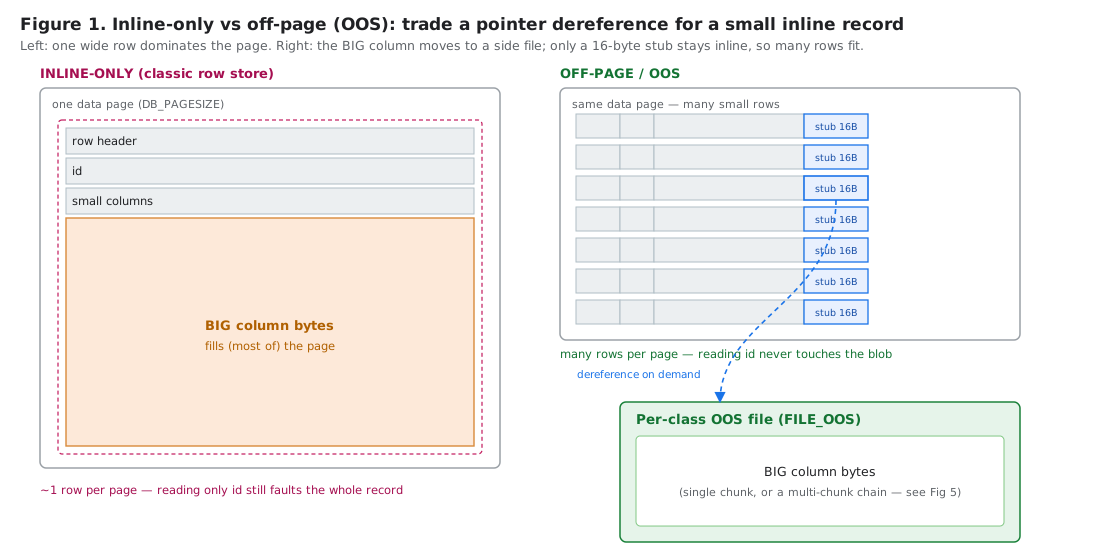
CUBRID’s heap stores every column of a row contiguously inside a single
slotted-page record. That is good for SELECT * but pathological for wide
rows: reading id from a table whose rows carry a 1 MB CLOB-shaped
VARCHAR still pulls the whole record (and overflow pages) into the buffer
pool. OOS addresses this by moving only the large columns into a separate
per-class file, leaving a fixed-size pointer where the value used to be.
Theoretical Background
Section titled “Theoretical Background”Row-store engines lay a tuple out as a contiguous byte string on a page: a header, a variable-offset table, the fixed-width columns, then the variable-width columns. This is optimal when queries touch most of the row, but it has two failure modes once individual attributes grow large:
- Read amplification. A page holds
PAGESIZE / avg_row_sizerows. If one column is huge,avg_row_sizeballoons, rows-per-page collapses, and a query that needs only the small columns still faults in pages dominated by bytes it never reads. Index-only (“covered”) scans help, but any heap touch pays the full record cost. - Page-size ceilings. A value larger than a page cannot live inline at all; the engine must spill it somewhere and leave a reference behind.
The standard answer is off-page / out-of-line storage: keep small columns inline, move large ones to a side structure, and store a small fixed-size pointer (plus, usually, the original length) in the record. The pattern has three recurring design choices — what triggers externalization, what the pointer looks like, and how the off-page bytes are reclaimed when the row changes or dies.
Comparable systems:
- PostgreSQL TOAST — values past a per-tuple target (
TOAST_TUPLE_THRESHOLD, derived from page size) are compressed (pglz / lz4) and, if still large, pushed to a per-tablepg_toast_*relation in ~2 KB chunks. The inline pointer (varatt_external) is roughly 18 bytes and records the toast OID and both raw and stored lengths. Chunks are reassembled on read. - MySQL/InnoDB off-page —
VARCHAR/BLOB/TEXToverflow is moved to off-page extents; the inline part keeps a ~20-byte pointer (space id, page number, offset, length) to the first overflow page, chained for large values. - CUBRID’s existing overflow (OVF) files — long strings already spill
into
FILE_MULTIPAGE_OBJECT_HEAPoverflow records. OOS is a different, finer-grained mechanism aimed at column-level externalization with a smaller inline footprint and per-column control, sitting alongside OVF rather than replacing it.
The conceptual through-line: trade a guaranteed-cheap pointer dereference for a guaranteed-small inline record. The engineering cost is all in the bookkeeping — the trigger heuristic, pointer integrity, and especially reclamation under MVCC, where an “old” pointer may still be the only thing a concurrent reader can see.
CUBRID’s Approach
Section titled “CUBRID’s Approach”OOS (the source consistently expands it as Out-of-row Storage /
Out-of-row Overflow Storage; the JIRA epic uses Out-of-Line Storage)
externalizes large variable-length columns into a per-class OOS file of
type FILE_OOS, leaving a fixed 16-byte inline stub in the heap record.
The epic is CBRD-26357.
Per-class file pairing
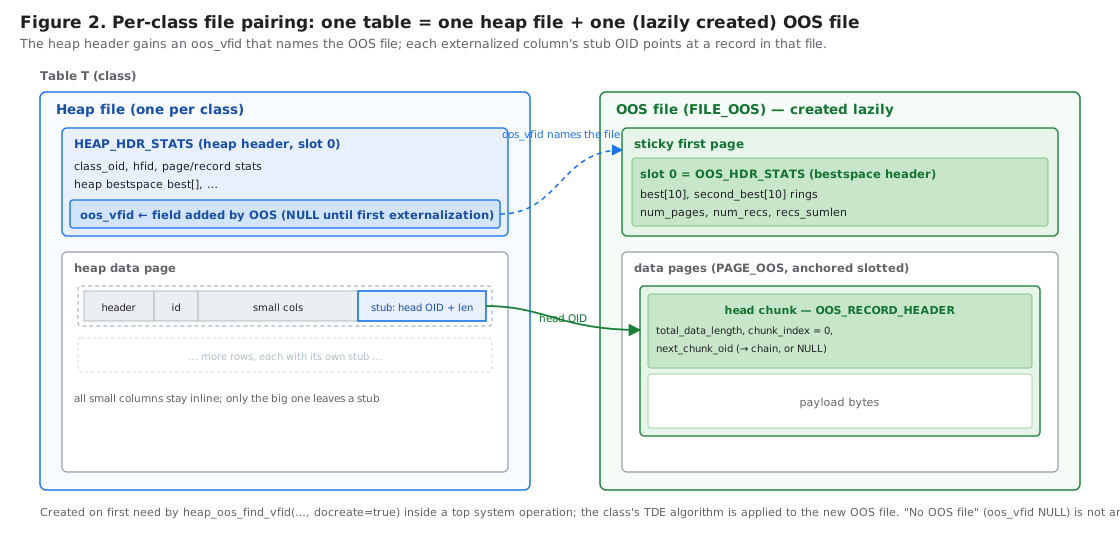
Section titled “Per-class file pairing”Each table is 1 heap file + 1 OOS file, created lazily. The heap header
(HEAP_HDR_STATS) gains an oos_vfid field. The first time a row needs to
externalize a column, heap_oos_find_vfid(..., docreate=true) creates the
OOS file, applies the class’s TDE algorithm to it, and stamps the VFID into
the heap header under a top system operation:
// heap_oos_find_vfid -- src/storage/heap_file.cif (VFID_ISNULL (&heap_hdr->oos_vfid)) { if (docreate == true) { log_sysop_start (thread_p); if (oos_create_file (thread_p, *oos_vfid) != NO_ERROR) { /* abort */ } // ... condensed: apply TDE to the new OOS file ... log_append_undo_data (thread_p, RVHF_STATS, &addr_hdr, sizeof (*heap_hdr), heap_hdr); VFID_COPY (&heap_hdr->oos_vfid, oos_vfid); log_append_redo_data (thread_p, RVHF_STATS, &addr_hdr, sizeof (*heap_hdr), heap_hdr); log_sysop_commit (thread_p); } // else: oos_vfid stays NULL — "no OOS file" is not an error }oos_create_file allocates a numerable FILE_OOS file and a sticky first
page that holds the OOS_HDR_STATS bestspace header at slot 0.
Two flags: HAS_OOS (per-row) and IS_OOS (per-column)
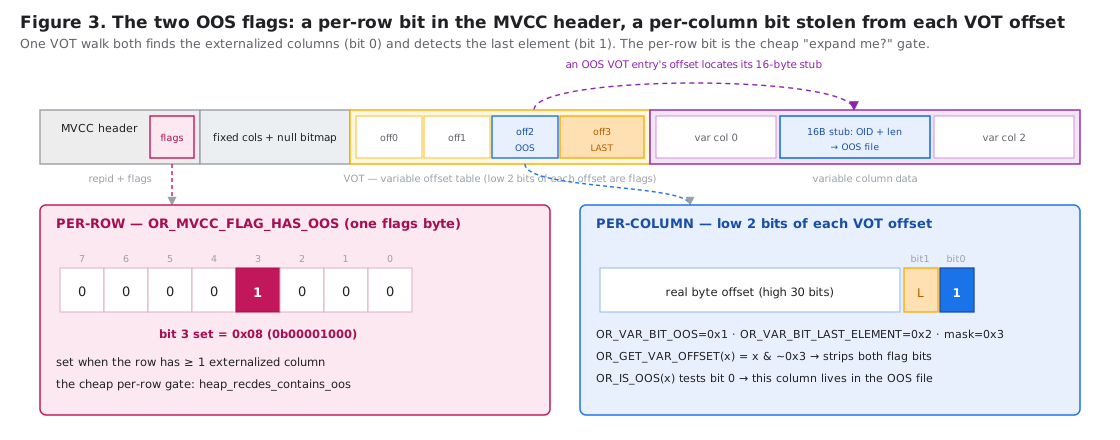
Section titled “Two flags: HAS_OOS (per-row) and IS_OOS (per-column)”OOS uses two independent flag bits:
-
OR_MVCC_FLAG_HAS_OOS=0x08— bit 3 of the MVCC header flags. Set on a heap record that has at least one externalized column. It is the cheap “does this record need OOS expansion?” test, read byheap_recdes_contains_oos. (ATODOin the header notes OOS is not actually MVCC-related and the bit should eventually move.)// OR_MVCC_FLAG_HAS_OOS -- src/base/object_representation_constants.h// TODO: OOS is not related to MVCC, move to another place when POC ends#define OR_MVCC_FLAG_HAS_OOS 0x08 // 0b00001000 -
OR_VAR_BIT_OOS=0x1— the low bit of each variable-offset-table (VOT) entry. The VOT already steals the two low bits of every offset for flags (OR_VAR_FLAG_MASK = 0x3): bit 0 marks an OOS column, bit 1 marks the last element. So a single VOT walk both finds the OOS columns and terminates.// OR_IS_OOS / OR_OOS_INLINE_SIZE -- src/base/object_representation.h#define OR_VAR_BIT_OOS 0x1#define OR_GET_VAR_OFFSET(length) ((int) (length) & (~OR_VAR_FLAG_MASK))#define OR_IS_OOS(length) (OR_GET_VAR_FLAG (length) & OR_VAR_BIT_OOS)/* OOS inline size: OOS OID (8 bytes) + OOS length (8 bytes) */#define OR_OOS_INLINE_SIZE (OR_OID_SIZE + OR_BIGINT_SIZE)
The inline stub: 16 bytes
Section titled “The inline stub: 16 bytes”Where the column value used to be, the record carries OR_OOS_INLINE_SIZE
= 16 bytes: an 8-byte CUBRID OID (the head-chunk locator) followed by an
8-byte BIGINT holding the full original value length. The OID itself
decomposes the way every CUBRID OID does — volid (2B), pageid (4B),
slotid (2B) — and the trailing length lets the reader size its
destination buffer without first fetching the chunk.
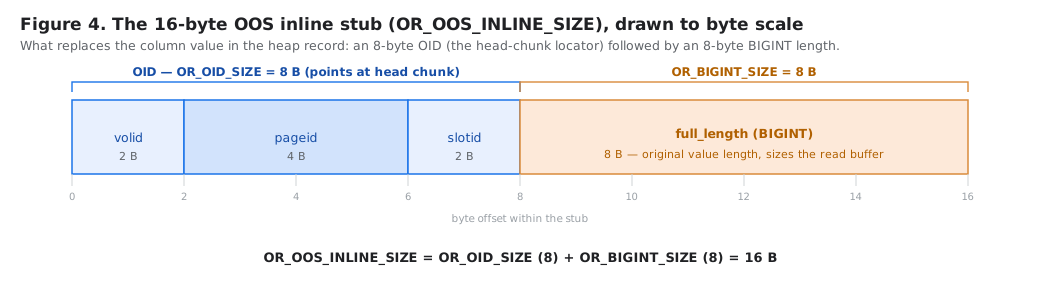
The design-epic phrasing “16-byte OOS OID” is the whole stub (OID + length), not the OID alone. The OID portion is 8 bytes; the length is the other 8.
The trigger heuristic
Section titled “The trigger heuristic”Externalization is decided in heap_attrinfo_determine_disk_layout while
computing the on-disk layout. As observed at this revision the rule is
PostgreSQL-TOAST-style, not the /8 + 512B rule stated in the original
design intent (see Cross-check Notes):
// heap_attrinfo_determine_disk_layout -- src/storage/heap_file.c/* push the largest variable column to OOS one by one until the heap record * fits within DB_PAGESIZE/4 (PG TOAST style) ... */if (header_size + payload_size + mvcc_extra > DB_PAGESIZE / 4) { // collect every variable, non-fixed column whose size > OR_OOS_INLINE_SIZE // sort candidates by size descending, then: for (auto & cand : oos_candidates) { if (header_size + payload_size + mvcc_extra <= DB_PAGESIZE / 4) break; (*oos_columns)[cand.second] = true; // mark this column OOS payload_size -= cand.first; // remove inline value payload_size += OR_OOS_INLINE_SIZE; // add the 16-byte stub *has_oos = true; } }So: if the assembled record would exceed DB_PAGESIZE/4, the engine
externalizes the largest variable column first, re-checks, and repeats
until the record fits — only externalizing as many columns as needed, and
only columns larger than the 16-byte stub (otherwise it would not shrink).
INSERT
Section titled “INSERT”For each marked column, the value is serialized to a scratch RECDES, then
oos_insert writes it to the OOS file and returns the head-chunk OID, which
is written into the inline stub. The per-row HAS_OOS bit and per-column
IS_OOS bits are set during the disk transform.
flowchart TD
  I0["INSERT row"] --> I1["determine_disk_layout:\nrecord > DB_PAGESIZE/4 ?"]
  I1 -- no --> I9["write fully inline record"]
  I1 -- yes --> I2["mark largest var columns IS_OOS\nset HAS_OOS"]
  I2 --> I3["heap_attrinfo_insert_to_oos:\nfor each OOS column"]
  I3 --> I4["serialize column to RECDES"]
  I4 --> I5["oos_insert -> head-chunk OID"]
  I5 --> I6["write 16B stub OID + length\ninto VOT slot"]
  I6 --> I7["push OID to thread oos_oids\nfor replication log"]
  I7 --> I8["spage_insert heap record"]
oos_insert picks single-chunk vs multi-chunk by comparing the payload to
the max chunk that fits one page:
// oos_insert -- src/storage/oos_file.cppif (src_len <= oos_get_max_chunk_size_within_page ()) { const OOS_RECORD_HEADER header{src_len, 0, OID_INITIALIZER}; err = oos_insert_within_page (thread_p, oos_vfid, src, header, oid); }else { err = oos_insert_across_pages (thread_p, oos_vfid, src, oid); }oos_insert_within_page prepends an OOS_RECORD_HEADER, finds a target
page via bestspace, spage_inserts, logs RVOOS_INSERT (undo/redo), and
updates the bestspace cache:
// oos_insert_within_page -- src/storage/oos_file.cppauto auto_page_ptr = oos_find_best_page (thread_p, oos_vfid, required_length, vpid);// ... condensed: oos_prepend_header builds [OOS_RECORD_HEADER | payload] into oos_recdes ...int sp_status = spage_insert (thread_p, page_ptr, &oos_recdes, &slotid);// ... condensed: error check ...oid.pageid = vpid.pageid;oid.slotid = slotid;oid.volid = vpid.volid;oos_log_insert_physical (thread_p, page_ptr, const_cast<VFID *> (&oos_vfid), &oid, &oos_recdes);int freespace_after = spage_max_space_for_new_record (thread_p, page_ptr);(void) oos_stats_add_bestspace (thread_p, &oos_vfid, &vpid, freespace_after);The returned oid (volid/pageid/slotid of the slot just written) is what
ends up in the heap stub for a single-chunk value, or as a chunk’s
next_chunk_oid for a multi-chunk chain. oos_prepend_header allocates a
fresh data area sized payload + OOS_RECORD_HEADER_SIZE and is freed by a
scope_exit on the way out — the bytes are copied into the page by
spage_insert, so the heap-side stub never aliases this buffer.
SELECT
Section titled “SELECT”The scan path never expands OOS. Code that needs the real bytes goes
through heap_get_visible_version_expand_oos, which sets
context.expand_oos = true; the record fetch then calls
heap_record_replace_oos_oids, which rebuilds a record that looks as if
OOS were never used.
flowchart TD
  S0["fetch visible version\nexpand_oos = true"] --> S1["heap_record_replace_oos_oids"]
  S1 --> S2{"HAS_OOS set?"}
  S2 -- no --> S9["return record unchanged"]
  S2 -- yes --> S3["parse VOT, find IS_OOS entries"]
  S3 --> S4["for each: read 16B stub\nOID + full_length"]
  S4 --> S5["oos_read OID into a sized buffer"]
  S5 --> S6["compute expanded layout\nVOT rewritten to 4-byte offsets"]
  S6 --> S7["build_record: inline blobs in place,\nclear HAS_OOS, reset offset-size bits"]
  S7 --> S8["return expanded record"]
The reconstruction is schema-change safe: it uses only oos_read plus the
on-record VOT, never the class representation. The output VOT is always
written with 4-byte offsets (BIG_VAR_OFFSET_SIZE) so arbitrarily large
expansions fit. The rebuild copies the header verbatim, then clears the
HAS_OOS flag and forces the 4-byte offset size so the expanded record is
indistinguishable from one that never used OOS:
// heap_oos_build_record -- src/storage/heap_oos.cppstd::memcpy (dst, state->src, state->src_header_size);unsigned int repid_bits = (unsigned int) OR_GET_INT (dst + OR_REP_OFFSET);repid_bits &= ~ ((unsigned int) OR_MVCC_FLAG_HAS_OOS << OR_MVCC_FLAG_SHIFT_BITS); // clear HAS_OOSrepid_bits &= ~ (unsigned int) OR_OFFSET_SIZE_FLAG;repid_bits |= OR_OFFSET_SIZE_4BYTE; // force 4B offsetsOR_PUT_INT (dst + OR_REP_OFFSET, (int) repid_bits);// ... condensed: rewrite VOT with new cumulative offsets, OOS entries sized to blob length ...// ... condensed: copy fixed+bitmap unchanged; inline each OOS blob in place of its 16B slot ...Reading sizes the destination from the stub’s stored length and cross-checks it against the chain header:
// heap_oos_read_blobs -- src/storage/heap_oos.cppOR_BUF buf;or_init (&buf, (char *) state->src + value_offset, OR_OOS_INLINE_SIZE);if (or_get_oid (&buf, &oos_oid) != NO_ERROR || OID_ISNULL (&oos_oid)) { /* fail */ }oos_len = or_get_bigint (&buf, &rc);// ... condensed: validate oos_len in (0, DB_MAX_STRING_LENGTH] ...state->oos_blobs[i].resize ((std::size_t) oos_len);if (oos_read (thread_p, oos_oid, oos_buffer (state->oos_blobs[i].data (), (std::size_t) oos_len)) != NO_ERROR) { /* fail */ }Multi-chunk chain
Section titled “Multi-chunk chain”A value larger than one OOS page is split into a chain of chunks. Each
chunk’s record begins with an OOS_RECORD_HEADER:
// oos_record_header -- src/storage/oos_file.hppstruct oos_record_header{ int total_data_length; /* total user-data length across all chunks (excludes OOS headers) */ int chunk_index; /* 0-based index of this chunk in the chain */ OID next_chunk_oid; /* OID of next chunk, or NULL OID if this is the last */};The head chunk is index 0; its OID is the one stored in the heap stub.
oos_insert_across_pages inserts chunks in reverse order (tail first)
so each chunk’s next_chunk_oid is already known when it is written, and
every chunk carries total_data_length so the slave applier can validate
the whole value before reassembly.
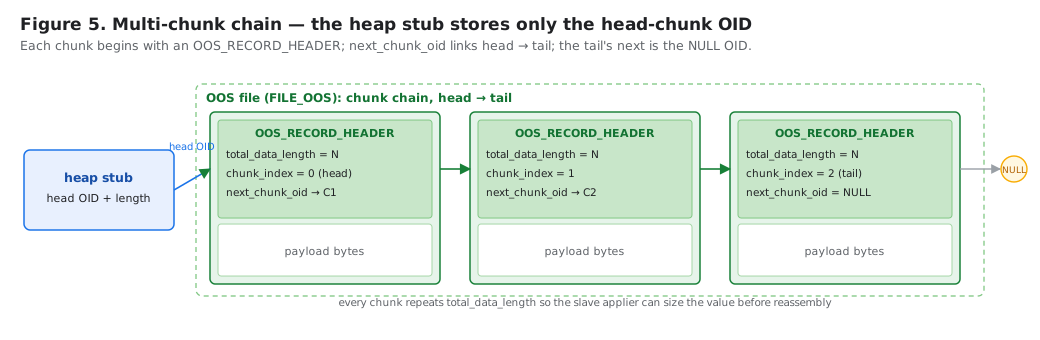
oos_read_across_pages follows next_chunk_oid from index 1, asserting the
index increments and total_data_length matches the head, and rejecting a
0-byte chunk (which would let a cyclic next_chunk_oid loop forever).
UPDATE / DELETE and reclamation
Section titled “UPDATE / DELETE and reclamation”This is where OOS interacts with MVCC. The governing rule is an invariant:
INVARIANT: one OOS OID is referenced by EXACTLY ONE heap record — OOS records are never shared across rows. OOS OIDs are freshly allocated per heap record. This is precisely what lets vacuum (and the eager path) delete an old OID unconditionally without reference counting: if a row version no longer references an OID, nobody else does.
- UPDATE (M1): always allocates a new OOS OID for the changed column. The old OOS record is kept alive so concurrent MVCC readers that still see the old row version can dereference it; vacuum reclaims it once the old version is dead. (M3 plans OID reuse when an OOS column is unchanged.)
- DELETE: the heap record is logically deleted; OOS records are left untouched and reclaimed later by vacuum.
- Non-MVCC paths (
!is_mvcc_op— SA_MODE, and SERVER_MODE on MVCC-disabled catalog classes) have no readers and no vacuum, so cleanup is eager:heap_oos_delete_unreferenceddeletes the OOS OIDs that the old record referenced and the new record does not.
stateDiagram-v2
  [*] --> Live : INSERT, oos_insert
  Live --> Updated : UPDATE M1, allocate NEW oos oid
  Updated --> OldDead : old version becomes invisible
  Live --> RowDeleted : DELETE, heap untouched
  OldDead --> Reclaimed : vacuum oos_delete
  RowDeleted --> Reclaimed : vacuum oos_delete
  Live --> EagerGone : non-mvcc delete or update, eager oos_delete
  Reclaimed --> [*]
  EagerGone --> [*]
Vacuum reclaims via two paths in vacuum_oos.cpp:
- REMOVE path —
vacuum_heap_oos_delete_within_sysopruns inside the caller’s existing sysop and deletes the OOS referenced by a heap record being vacuumed. - Forward-walk path —
vacuum_forward_walk_reclaim_oosinspects undo images ofRVHF_UPDATE_NOTIFY_VACUUM/RVHF_DELETE_NEWHOME_NOTIFY_VACUUMrecords (the pre-images of UPDATE/DELETE), and deletes OOS referenced only by those dead old versions, inside its own sysop (vacuum_forward_walk_oos_delete_atomic).
A single-slot VACUUM_OOS_VFID_MEMO caches the most-recently-resolved
heap-VFID → OOS-VFID mapping so a bulk UPDATE’s run of consecutive records
on the same heap skips repeated file/header lookups. The forward-walk path
is defensive throughout: lookups distinguish FOUND / NONE / ERROR, errors
are logged and cleared (a bounded, logged leak) rather than failing the
whole vacuum block, and oos_chunk_exists makes the delete idempotent on
block retry.
Bestspace
Section titled “Bestspace”To place new OOS records without scanning the whole file,
OOS_HDR_STATS.estimates keeps a heap-style multi-entry bestspace
estimate (header record at slot 0 of the sticky first page) plus a global
in-memory hash cache (oos_Bestspace). oos_find_best_page runs a 3-tier
search mirroring the heap manager:
flowchart TD
  B0["need page for rec_length"] --> B1["Tier 1: global hash cache\noos_stats_find_page_in_bestspace"]
  B1 -- hit --> BOK["fix page, recheck free space"]
  B1 -- miss --> B2["Tier 2: header best[] array"]
  B2 -- hit --> BOK
  B2 -- miss --> B3["Tier 3: sync scan pages\noos_stats_sync_bestspace, refill hints"]
  B3 -- still none --> B4["oos_file_alloc_new"]
  BOK --> BDONE["return page"]
  B4 --> BDONE
best[] holds up to OOS_NUM_BEST_SPACESTATS (10) candidate pages; a
second_best[] ring buffer holds evicted-but-still-good pages. Bestspace
updates are non-logged (log_skip_logging) because hints are reconstructable
and need not survive crash exactly. Sync uses conditional latches and
zero-wait mode to avoid contention.
The hash-cache lookup illustrates the contention-avoidance discipline: it
fixes candidate pages with a conditional write latch and zero-wait mode,
skipping any busy page rather than blocking, and re-verifies actual free
space (spage_max_space_for_new_record) before committing — the cached
estimate is only a hint and may be stale:
// oos_stats_find_page_in_bestspace -- src/storage/oos_file.cppold_wait_msecs = xlogtb_reset_wait_msecs (thread_p, LK_FORCE_ZERO_WAIT);// ... condensed: Phase A scans global hash, Phase B scans best[] for a candidate_vpid ...*out_pgptr = pgbuf_fix (thread_p, &candidate_vpid, OLD_PAGE, PGBUF_LATCH_WRITE, PGBUF_CONDITIONAL_LATCH);if (*out_pgptr == NULL) { /* busy or interrupted: skip / error, continue */ }int actual_free = spage_max_space_for_new_record (thread_p, *out_pgptr);if (actual_free >= needed_space) { *out_vpid = candidate_vpid; found = OOS_FINDSPACE_FOUND; }// ... condensed: else unfix, drop the stale hint, try next ...Because each insert constants its target via the cache and corrects the
estimate on miss, the file fills denser pages first without a full scan,
and oos_find_best_page only escalates to oos_stats_sync_bestspace (a
bounded page scan) or oos_file_alloc_new when the hints are exhausted. The
header best[] lives in the sticky-first-page record; the global hash cache
(oos_Bestspace, capacity OOS_BESTSPACE_CACHE_CAPACITY = 1000 entries
across all OOS files) is process-wide and rebuilt on restart.
WAL and logging
Section titled “WAL and logging”OOS physical operations are WAL-logged with dedicated redo handlers:
RVOOS_INSERT (oos_rv_redo_insert → spage_insert_for_recovery) and
RVOOS_DELETE (oos_rv_redo_delete → spage_delete). oos_delete uses
no sysop: each chunk delete is individually logged with full undo data,
so transaction abort or crash recovery restores the chain in reverse.
For HA, multi-chunk inserts need the slave to reassemble the same chain. The
master logs the chunks in reverse (tail first, head last), wraps the run in
a LOG_DUMMY_OOS_RECORD boundary marker, and suppresses the per-crumb
auto-queueing of intermediate chunks so only the head OID is enqueued for
replication:
// oos_insert_across_pages -- src/storage/oos_file.cpptrack_repl = oos_needs_repl_tracking (thread_p); // master only, replication allowedif (track_repl) { log_append_empty_record (thread_p, LOG_DUMMY_OOS_RECORD, NULL); LSA_COPY (&dummy_lsa, &tdes->tail_lsa); tdes->oos_suppress_insert_lsa_queueing = true; // intermediate chunks not enqueued }// ... condensed: reverse loop inserts chunk N-1 .. 0; capture tail_chunk_lsa at the tail ...if (track_repl) { tdes->oos_insert_lsa_queue.push (dummy_lsa); tdes->oos_insert_lsa_queue.push (tail_chunk_lsa); thread_p->oos_oids.push_back (oid_Null_oid); // caller pushes the real head OID after return }The replication path then emits one RVREPL_DUMMY_OOS_RECORD for the null
OID followed by one RVREPL_OOS_INSERT for the real head OID — so the slave
applier sees exactly one logical OOS-insert per value regardless of how many
physical chunks it spanned. oos_needs_repl_tracking gates this to the
master (!LOG_CHECK_LOG_APPLIER && log_does_allow_replication()); the slave
must not emit its own markers while replaying.
Note oos_log.hpp is a separate debug/diagnostic logging facility
($CUBRID/log/oos.log), unrelated to WAL — it is a header-only printf-style
logger whose oos_error/oos_warn macros stay active in release builds for
QA and replication diagnostics, with oos_trace/oos_debug/oos_info
compiled to no-ops under NDEBUG.
Source Walkthrough
Section titled “Source Walkthrough”Symbols grouped by subsystem. Functions are the stable anchor; the table at
the end pairs each with a (file, line) hint scoped to this revision.
OOS file core — src/storage/oos_file.{cpp,hpp}
Section titled “OOS file core — src/storage/oos_file.{cpp,hpp}”oos_record_header/OOS_RECORD_HEADER_SIZE— the per-chunk chain header (total_data_length,chunk_index,next_chunk_oid).oos_buffer— alias forcubbase::span<char>; the caller-owned byte span used byoos_insert(read-from) andoos_read(write-into).oos_create_file/oos_remove_file/oos_remove_page— file lifecycle.oos_create_filemakes theFILE_OOSfile + sticky header page;oos_remove_filedefers destroy viafile_postpone_destroy;oos_remove_page(file_dealloc) is marked “called by vacuum when OOS vacuum is implemented”.oos_insert— public entry; routes to within-page or across-pages.oos_insert_within_page— single-chunk insert:oos_prepend_header,oos_find_best_page,spage_insert,oos_log_insert_physical, bestspace update.oos_insert_across_pages— multi-chunk insert (reverse order) with HA replication boundary tracking.oos_read— public read; validates head chunk (chunk_index == 0), cross-checkstotal_data_lengthagainst the caller’s buffer size, then walks the chain.oos_read_within_page/oos_read_across_pages— single-chunk fetch viabyte_span_writer; chain walk with consistency asserts.oos_delete/oos_delete_chain— delete a (possibly multi-chunk) record; per-chunkRVOOS_DELETEundo, no sysop.oos_chunk_exists— idempotency probe (page deallocated or slot removed both report “gone” withNO_ERROR); used by vacuum block retry.oos_get_length— readstotal_data_lengthfrom a head chunk’s header (used by tests; production reads the inline stub length).oos_get_max_chunk_size_within_page—spage_max_record_sizealigned down, minus the chain header.oos_rv_redo_insert/oos_rv_redo_delete— WAL redo handlers.oos_needs_repl_tracking— master-only replication gate.oos_push_oos_oid— appends an OID tothread_p->oos_oidsfor the replication log.
Bestspace (all in oos_file.cpp):
oos_bestspace,oos_hdr_stats,OOS_NUM_BEST_SPACESTATS,OOS_FINDSPACE— the estimate structures and the find-result enum.oos_bestspace_initialize/oos_bestspace_finalize— global hash cache (oos_Bestspace, vpid_ht + vfid_ht) lifecycle.oos_stats_add_bestspace/oos_stats_del_bestspace_by_vpid/oos_stats_del_bestspace_by_vfid— cache entry management.oos_find_best_page— the 3-tier search driver.oos_stats_find_page_in_bestspace— hash-then-best[]lookup with conditional latch + actual-free recheck.oos_stats_sync_bestspace— scan pages to refill hints (partial or full).oos_stats_update/oos_stats_update_internal— refresh hints after delete/insert.oos_stats_put_second_best/oos_stats_get_second_best— thesecond_best[]ring buffer.oos_file_alloc_new/oos_vpid_init_new— allocate + init a new OOS data page (PAGE_OOS, anchored slotted page).xoos_get_stats_by_class_oid/oos_get_stats_by_vfid— server-side stats (page count, live record count, body-byte sum) backing the client API.
Heap integration — src/storage/heap_oos.{cpp,hpp} + heap_file.c
Section titled “Heap integration — src/storage/heap_oos.{cpp,hpp} + heap_file.c”heap_record_replace_oos_oids— SELECT-side expansion entry; gated oncontext.expand_oosandheap_recdes_contains_oos.HEAP_OOS_EXPAND_STATE+heap_oos_parse_vot/heap_oos_read_blobs/heap_oos_compute_layout/heap_oos_build_record— the four-phase expansion: parse VOT, read blobs viaoos_read, compute output layout (4-byte offsets), assemble the expanded record and clearHAS_OOS.heap_oos_delete_unreferenced— eager (non-MVCC) cleanup: delete OOS OIDs inold_recdesnot innew_recdes(NULLnew = delete all).heap_oos_find_vfid— find or (withdocreate) create the heap’s OOS file; applies TDE.heap_attrinfo_determine_disk_layout— the trigger heuristic (DB_PAGESIZE/4, largest-column-first).heap_attrinfo_insert_to_oos— per-column INSERT-side externalization.heap_recdes_contains_oos— testsOR_MVCC_FLAG_HAS_OOS.heap_recdes_get_oos_oids— walk the VOT, collect everyOR_IS_OOSOID.heap_get_visible_version_expand_oos— the OOS-expanding fetch wrapper (CBRD-26847flags it for a caller audit).
Vacuum — src/query/vacuum_oos.{cpp,hpp}
Section titled “Vacuum — src/query/vacuum_oos.{cpp,hpp}”vacuum_oos_vfid_memo/VACUUM_OOS_VFID_LOOKUP_RESULT— the per-worker-per-block one-entry memo and the FOUND/NONE/ERROR tri-state.vacuum_oos_vfid_lookup— heap-VFID → OOS-VFID resolution with caching; never caches transient errors.vacuum_forward_walk_reclaim_oos— undo-image-driven reclamation (copies the undo image to a stable, aligned buffer first).vacuum_forward_walk_oos_delete_atomic— owns its OID vector by value, sorts by(volid, pageid, slotid), deletes inside its own sysop.vacuum_heap_oos_delete_within_sysop— REMOVE-path delete inside the caller’s sysop.vacuum_oos_find_vfid_for_heap_record— first-need lookup for the heap-record vacuum path.
Flags & file type
Section titled “Flags & file type”OR_MVCC_FLAG_HAS_OOS(object_representation_constants.h) — per-row bit0x08.OR_VAR_BIT_OOS/OR_IS_OOS/OR_SET_VAR_OOS/OR_OOS_INLINE_SIZE(object_representation.h) — per-column VOT flag and 16-byte stub size.FILE_OOS(file_manager.h) — the new file type.
Client stats — src/compat/db_oos.h
Section titled “Client stats — src/compat/db_oos.h”db_oos_stats/db_get_oos_stats— client-side struct and call exposinghas_oos_file, the OOS VFID, user-page count, live record count, and body-byte sum (mirrors server-sideoos_stats_info).
Logging — src/storage/oos_log.hpp
Section titled “Logging — src/storage/oos_log.hpp”oos_log::OosLogLevel/oos_log_internal+ theoos_error,oos_warn,oos_trace,oos_debug,oos_infomacros — a header-only diagnostic logger to$CUBRID/log/oos.log(oos_error/oos_warnactive in release; the rest debug-only). Not WAL.
Position hints as of this revision
Section titled “Position hints as of this revision”Line numbers observed on feat/oos @ fa26eff3a, 2026-06-21. Paths are the
canonical repo paths.
| Symbol | File | Line |
|---|---|---|
oos_record_header | src/storage/oos_file.hpp | 26 |
OOS_RECORD_HEADER_SIZE | src/storage/oos_file.hpp | 34 |
oos_buffer (alias) | src/storage/oos_file.hpp | 43 |
OOS_NUM_BEST_SPACESTATS | src/storage/oos_file.hpp | 45 |
oos_bestspace | src/storage/oos_file.hpp | 53 |
oos_hdr_stats | src/storage/oos_file.hpp | 60 |
OOS_FINDSPACE (enum) | src/storage/oos_file.hpp | 101 |
oos_bestspace_initialize | src/storage/oos_file.cpp | 184 |
oos_stats_find_page_in_bestspace | src/storage/oos_file.cpp | 454 |
oos_stats_sync_bestspace | src/storage/oos_file.cpp | 634 |
oos_create_file | src/storage/oos_file.cpp | 910 |
oos_remove_file | src/storage/oos_file.cpp | 996 |
oos_insert | src/storage/oos_file.cpp | 1048 |
oos_insert_across_pages | src/storage/oos_file.cpp | 1109 |
oos_insert_within_page | src/storage/oos_file.cpp | 1205 |
oos_read | src/storage/oos_file.cpp | 1372 |
oos_find_best_page | src/storage/oos_file.cpp | 1460 |
oos_delete_chain | src/storage/oos_file.cpp | 1696 |
oos_chunk_exists | src/storage/oos_file.cpp | 1779 |
oos_delete | src/storage/oos_file.cpp | 1851 |
oos_get_max_chunk_size_within_page | src/storage/oos_file.cpp | 1861 |
oos_rv_redo_insert | src/storage/oos_file.cpp | 1911 |
oos_get_length | src/storage/oos_file.cpp | 1942 |
xoos_get_stats_by_class_oid | src/storage/oos_file.cpp | 1991 |
oos_get_stats_by_vfid | src/storage/oos_file.cpp | 2043 |
oos_oid_in_vector | src/storage/oos_util.cpp | 35 |
heap_recdes_compute_oos_flag_debug | src/storage/oos_util.cpp | 83 |
HEAP_OOS_EXPAND_STATE | src/storage/heap_oos.cpp | 48 |
heap_oos_parse_vot | src/storage/heap_oos.cpp | 69 |
heap_oos_read_blobs | src/storage/heap_oos.cpp | 129 |
heap_oos_compute_layout | src/storage/heap_oos.cpp | 184 |
heap_oos_build_record | src/storage/heap_oos.cpp | 242 |
heap_record_replace_oos_oids | src/storage/heap_oos.cpp | 338 |
heap_oos_delete_unreferenced | src/storage/heap_oos.cpp | 425 |
vacuum_oos_vfid_memo | src/query/vacuum_oos.hpp | 44 |
vacuum_oos_vfid_lookup | src/query/vacuum_oos.cpp | 86 |
vacuum_forward_walk_oos_delete_atomic | src/query/vacuum_oos.cpp | 154 |
vacuum_forward_walk_reclaim_oos | src/query/vacuum_oos.cpp | 223 |
vacuum_oos_find_vfid_for_heap_record | src/query/vacuum_oos.cpp | 339 |
vacuum_heap_oos_delete_within_sysop | src/query/vacuum_oos.cpp | 400 |
OR_MVCC_FLAG_HAS_OOS | src/base/object_representation_constants.h | 178 |
OR_VAR_BIT_OOS | src/base/object_representation.h | 441 |
OR_IS_OOS | src/base/object_representation.h | 451 |
OR_OOS_INLINE_SIZE | src/base/object_representation.h | 455 |
FILE_OOS | src/storage/file_manager.h | 53 |
heap_attrinfo_determine_disk_layout | src/storage/heap_file.c | 12183 |
heap_oos_find_vfid | src/storage/heap_file.c | 12259 |
heap_attrinfo_insert_to_oos | src/storage/heap_file.c | 12435 |
heap_get_visible_version_expand_oos | src/storage/heap_file.c | 26450 |
heap_recdes_contains_oos | src/storage/heap_file.c | 27772 |
heap_recdes_get_oos_oids | src/storage/heap_file.c | 27779 |
db_get_oos_stats | src/compat/db_oos.h | 47 |
oos_log_internal | src/storage/oos_log.hpp | 97 |
oos_error (macro) | src/storage/oos_log.hpp | 168 |
Cross-check Notes
Section titled “Cross-check Notes”This is an active feature branch; both the design intent and the line
numbers above will drift. Specific discrepancies and rough edges observed at
fa26eff3a:
Trigger heuristic differs from the design intent
Section titled “Trigger heuristic differs from the design intent”The original epic states the trigger as row size > DB_PAGESIZE/8 (2 KB
at a 16 KB page) AND column size > 512 B. The code at this revision uses a
different, simpler rule: row size > DB_PAGESIZE/4 AND column size >
OR_OOS_INLINE_SIZE (16 B), externalizing the largest column first and
stopping as soon as the record fits (heap_attrinfo_determine_disk_layout,
commented “PG TOAST style”). A TODO: change the statistics sits directly
above it. Trust the code, not the epic, for the live threshold.
Milestone status
Section titled “Milestone status”| Milestone | JIRA | Status | Scope |
|---|---|---|---|
| M1 | CBRD-26584 | DONE (~2026-02) | CRUD, WAL logging, HA replication, covered index. Limits: no oos_file_destroy, UPDATE always allocates a new OID, vacuum not wired. |
| M2 | CBRD-26583 | IN PROGRESS | bestspace reuse (CBRD-26658), spage_compact compaction (CBRD-26536), drop-table oos_file_destroy (CBRD-26608), vacuum integration (CBRD-26668), develop merge + CI. |
| M3 | — | PLANNED | OOS OID reuse on unchanged UPDATE columns, PEEK mode, across-page compaction. |
| M4 | — | TBD | ordered page-fix for deadlock avoidance, monitoring. |
Not yet implemented / in flux
Section titled “Not yet implemented / in flux”oos_remove_pagecarries// TODO: will be called by vacuum when OOS vacuum is implemented— empty-page deallocation is not yet wired; vacuum deletes slots but does not free pages.- Live
abort()calls in vacuum.vacuum_oos.cppdeliberately callsabort()in two places —vacuum_forward_walk_reclaim_oos(theVACUUM_OOS_VFID_NONEbranch) andvacuum_oos_find_vfid_for_heap_record— each markedTODO(do not review, remove before develop merge): force a hard crash in CI. These intentionally crash release-build CI to surface an invariant violation (OOS flag set but heap has no OOS file) instead of leaking silently. They MUST be removed before merge; until then the branch will hard-crash on that condition. <cstdlib>include invacuum_oos.cppis annotated/* abort - TODO: remove before develop merge (temporary CI crash) */.heap_get_visible_version_expand_oosover-expansion — CBRD-26847 notes many call sites were migrated mechanically and may expand OOS unnecessarily; an audit is pending.
Known bugs / rough edges (from the epic)
Section titled “Known bugs / rough edges (from the epic)”unloaddbruns 1.6–1.7× slower with OOS (CBRD-26458).- UPDATE triggers a triple
oos_read(CBRD-26516). - CDC flashback cannot resolve an OOS OID.
- Unnecessary OOS replication log emitted in
locator_add_or_remove_index. RECDES.lengthis a 4-byteint, capping a single expanded record at ~2 GB;heap_oos_compute_layoutexplicitly guardsnew_lengthagainstINT_MAX.- No payload compression in M1 (unlike TOAST’s pglz/lz4); compression is an open PR (CBRD-26881 / #7258).
Legacy-record handling
Section titled “Legacy-record handling”heap_recdes_get_oos_oids and heap_recdes_compute_oos_flag_debug note that
records lacking OR_VAR_BIT_LAST_ELEMENT (old-format VOTs) are “not fully
supported yet” — the upper-bound max_var_count may include padding/fixed
bytes, and old odd offsets could false-positive OR_IS_OOS. The debug
auditor returns false for any VOT without a LAST_ELEMENT sentinel.
Open Questions
Section titled “Open Questions”From the 2026-03-05 design discussion, still undecided:
- One stored record per OOS column, or merge multiple OOS columns of a row
into one stored OOS record? Undecided. The current code stores each
column individually (
heap_attrinfo_insert_to_oosloops per column). - OOS page latch contention — pages may be split later to reduce
contention (an M4 concern;
oos_find_best_pagealready uses conditional zero-wait latches to mitigate). - OVF + OOS coexistence test cases are still needed.
- Should
CHAR(not onlyVARCHAR) be OOS-eligible? The eligibility check is!last_attrepr->is_fixed, so fixed-widthCHARis currently excluded.
Found in the code (TODO/FIXME/XXX) at this revision:
oos_insert—TODO: Once the OOS_RECORD_HEADER spec is finalized (first segment header and rest segment header), review whether the segment headers can be generated inside oos_insert_within_page / across_pages(the chunk-header format may still change).oos_get_max_chunk_size_within_page—TODO: fix bug for spage_max_record_size returning incorrect size(declared out of scope for OOS), andTODO: make it a constant initialized once in oos_boot().oos_delete_chain—TODO: concurrency — this function assumes the caller holds a row-level lock (e.g. X_LOCK) to prevent concurrent deletion of the same OOS chain. Verify this assumption when wiring callers.oos_stats_sync_bestspace—TODO: ideally find the index of full_search_vpid; for now start from 1(resume point is approximate).vacuum_*— twoTODO(perf)notes thatoos_deletere-fixes the OOS page per OID; OIDs are already page-sorted, so per-page batching is a future optimization.- The
abort()/ develop-merge TODOs listed under Cross-check Notes.
Broader unresolved: how OOS coexists with CDC/flashback (currently cannot
resolve an OOS OID), and whether the OR_MVCC_FLAG_HAS_OOS bit should be
relocated out of the MVCC header (the constant itself carries TODO: OOS is not related to MVCC, move ... when POC ends).
Sources
Section titled “Sources”JIRA
- Epic: http://jira.cubrid.org/browse/CBRD-26357 — milestones CBRD-26584 (M1), CBRD-26583 (M2); survey CBRD-26198. Linked rough-edge issues: CBRD-26458 (unloaddb slowdown), CBRD-26516 (UPDATE triple read), CBRD-26847 (expand-OOS caller audit), CBRD-26881 (payload compression), CBRD-26658 (bestspace reuse), CBRD-26536 (spage_compact compaction), CBRD-26608 (drop-table destroy), CBRD-26668 (vacuum integration), CBRD-26628 (multi-chunk insert replication).
Design / explanation docs
- Notion — multi-chunk insert replication (CBRD-26628): https://glaze-girl-1d0.notion.site/CBRD-26628-OOS-multi-chunk-insert-34bfe9311b558092a524d46229b496e2
- Git — vacuum cleanup code-review explanation (CBRD-26668): https://github.com/vimkim/my-cubrid-docs/blob/main/cbrd-26668/CBRD-26668-code-review-explanation.md
- Notion — related INTERNAL LOB design: https://glaze-girl-1d0.notion.site/INTERNAL-LOB-2b1fe9311b55808692e2ed1774c60fde
Branch / PRs
- Branch
feat/oos(105 commits ahead ofdevelop), analyzed atfa26eff3a. Key PRs: #7097 (oos_read/oos_insert → oos_buffer refactor), #7158 (demote largest variable column to OOS), #7296 (inline-OOS read failure propagation), #7295 (TDE on OOS files), #7169 / #7168 (vacuum reclaim OOS chunks), #7258 (OOS payload compression, open), #6864 (CI tracking draft).
Code
src/storage/oos_file.cpp,src/storage/oos_file.hppsrc/storage/oos_log.hppsrc/storage/oos_util.cpp,src/storage/oos_util.hppsrc/storage/heap_oos.cpp,src/storage/heap_oos.hppsrc/query/vacuum_oos.cpp,src/query/vacuum_oos.hppsrc/compat/db_oos.h- Touchpoints:
src/base/object_representation_constants.h(OR_MVCC_FLAG_HAS_OOS),src/base/object_representation.h(OR_IS_OOS,OR_OOS_INLINE_SIZE),src/storage/file_manager.h(FILE_OOS),src/storage/heap_file.c(trigger, find_vfid, insert, expand, contains/get OIDs call sites).