CUBRID Prior List — Lock-Free Producer-Side WAL Queue Decoupling Per-TX Commit From the Log Writer
Contents:
- Theoretical Background
- Common DBMS Design
- CUBRID’s Approach
- Source Walkthrough
- Cross-check Notes
- Open Questions
- Sources
Theoretical Background
Section titled “Theoretical Background”The write-ahead-log (WAL) protocol of Mohan et al.’s ARIES paper (ARIES: A Transaction Recovery Method Supporting Fine-Granularity Locking and Partial Rollbacks Using Write-Ahead Logging, TODS 17.1, 1992) imposes two rules on the engine: log records describing a modification must reach stable storage before the dirty data page they describe (durability), and they must reach stable storage in LSN order (ordering). Database Internals (Petrov, ch. 5 §“Recovery”) repeats the contract and adds the engineering observation that the ordering rule is what makes WAL a concurrency problem — many threads producing records must agree on a single total order before anything is written.
Naïve implementations of that order-then-write step are catastrophic
for throughput. The textbook design parks every appender on a global
log latch for the duration of the copy-and-stamp work. The latch
holds across a memcpy whose size is the record length and across
a cursor advance. Mohan and DeWitt’s 1992 commit pipe research
named the structural cure: split the pipeline. Producers build
records outside the latch into a staging structure; a single
drain thread is responsible for the latch-protected work of moving
bytes into the authoritative log page.
The split has three moving parts. First, a queue from producers to drain — typically a multi-producer, single-consumer (MPSC) structure (Michael & Scott’s lock-free FIFO, 1996, is the textbook reference; production engines often use a short-held mutex around an enqueue-at-tail operation because the producer’s other work — record formatting, MVCC metadata stamping — happens outside the mutex). Second, a wakeup channel from producers to drain. Third, an ack channel from drain back to producers. The canonical answer for (2) and (3) is a condition variable plus a durable LSN watermark: committers sleep on the CV with a target LSN; the drain broadcasts on each advance. Group commit falls out of this naturally — many committers sleeping on one CV all wake from one fsync’s advance.
The drain must keep up with producers in steady state, or the queue grows without bound. Real systems install a soft cap: when the queue exceeds a threshold, producers either help drain (the self-help pattern) or sleep on backpressure. The choice changes latency but not throughput, which is bounded by the disk’s effective write bandwidth.
Postgres’s XLogInsert is the latch-protected reference point:
appenders take a WALInsertLock (8 striped locks in current
versions), copy bytes directly into the WAL buffer pages, and
release. No separate producer queue, no separate drain thread on the
insert path. CUBRID’s prior list is the deliberate inversion:
appenders never touch the authoritative log pages; they hand off
LOG_PRIOR_NODE records to a queue that only the log-flush daemon
(or a help-out path under the log critical section) ever drains into
pages.
Common DBMS Design
Section titled “Common DBMS Design”The patterns every WAL engine combines into its commit pipe repeat across PostgreSQL, InnoDB, Oracle, SQL Server, and CUBRID; only the partitioning of the work changes.
PostgreSQL XLogInsert — centralised, latch-protected
Section titled “PostgreSQL XLogInsert — centralised, latch-protected”XLogInsert (in src/backend/access/transam/xlog.c) is the
simplest model. An appender computes its record size, acquires a
WALInsertLock (a striped set of 8 in PG 9.4+, selected by a
backend-local index seeded from MyProcNumber % NUM_XLOGINSERT_LOCKS
(pre-17: pgprocno) and advanced to the neighbouring lock whenever an
acquisition had to wait), copies bytes directly into the WAL buffer pages at
the LSN it just claimed, and releases. On commit, XLogFlush(LSN)
acquires WALWriteLock, calls pg_pwrite / pg_fsync on the WAL
segment, and advances WriteRqst.Flush. The cost: WALInsertLock
held across a memcpy whose size is the record length. The
benefit: simplicity — no separate producer queue, no drain thread,
LSN order matches lock-acquisition order trivially.
MySQL InnoDB — group commit on top of a circular buffer
Section titled “MySQL InnoDB — group commit on top of a circular buffer”InnoDB writes redo records into the global log_buf ring buffer.
Mini-transactions (mtr_t) batch records locally; on commit they
flush into log_buf under log_sys->mutex. The log_writer
thread drains log_buf into redo segments; the log_flusher
issues fsync. Group commit emerges from os_event waits. The
shape is closer to CUBRID’s (producer / drain / flusher are
distinct stages), but the producer still synchronises on
log_sys->mutex to write into the authoritative buffer.
Oracle — multi-strand redo
Section titled “Oracle — multi-strand redo”Each strand has its own in-memory log buffer and its own LGWR ordering; LGWR interleaves strands at write time. Producers are partitioned across strands (by trid hash) to reduce per-strand mutex contention. Ordering across strands is reconstructed at LGWR time from sequence numbers. CUBRID gets away with a single prior list because all producers feed it under one short-held mutex that does not hold across record-byte movement.
CUBRID — producer-side batched queue, single-consumer drain
Section titled “CUBRID — producer-side batched queue, single-consumer drain”CUBRID’s prior list is a single-consumer queue of LOG_PRIOR_NODE
records. A producer:
- Builds its record into a fresh malloc’d
LOG_PRIOR_NODEoutside any global mutex, including the optional zlib compression of undo/redo payloads (the most expensive thing on the producer path). - Takes
prior_lsa_mutex, assigns the next monotonic LSN to the node, links it onto the tail, releases. The mutex hold time covers only LSN arithmetic and list-tail link manipulation. - Optionally, if
list_sizeexceeds the page-buffer capacity, wakes the log-flush daemon and yields 1 ms — the backpressure path. - On commit, calls
logpb_flush_pages(lsn), which schedules a force flush and parks the caller on the group-commit CV untilnxio_lsa >= my_commit_lsn.
The log-flush daemon does the latch-protected work:
LOG_CS_ENTER, logpb_prior_lsa_append_all_list (detach + copy
each LOG_PRIOR_NODE into the authoritative LOG_PAGE ring
buffer), logpb_flush_all_append_pages (write to disk, advance
nxio_lsa), broadcast the group-commit CV.
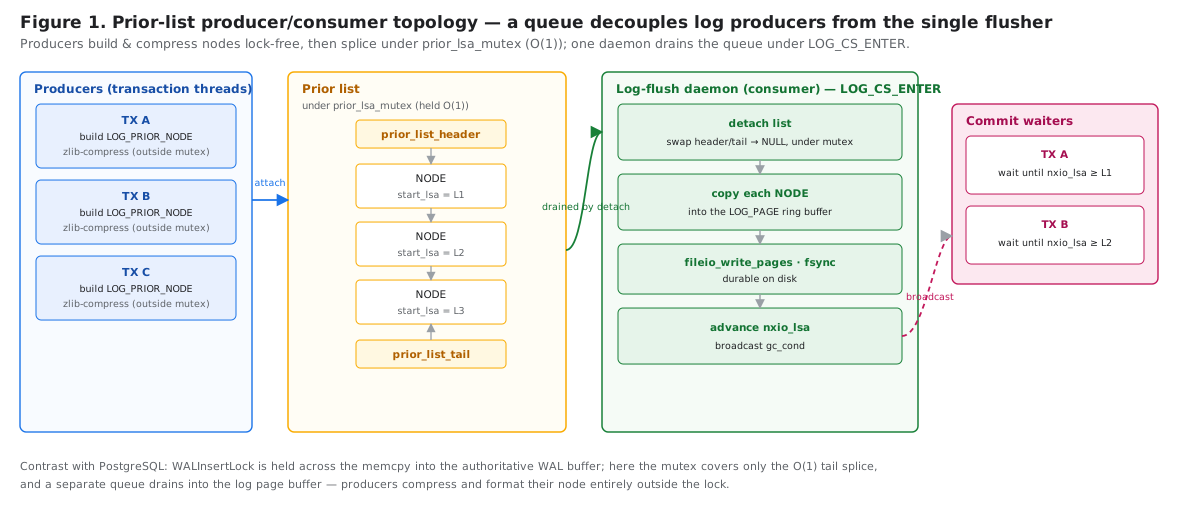
Figure 1 — Prior-list producer/consumer topology. Transaction threads build and attach LOG_PRIOR_NODEs to the queue under prior_lsa_mutex; the log-flush daemon drains the queue under LOG_CS_ENTER, copies bytes into the LOG_PAGE ring buffer, writes to disk, and broadcasts gc_cond to waiting commit threads.
CUBRID’s distinguishing claim is that the only mutex on the
producer path is prior_lsa_mutex and its hold time is dominated
by O(1) arithmetic, not by record-size memcpy. The expensive bytes
are moved into the prior node before the mutex is taken (in
prior_lsa_alloc_and_copy_*), and the equally expensive bytes are
copied into authoritative log pages after the mutex is dropped
(by the drain thread, under LOG_CS_OWN_WRITE_MODE).
CUBRID’s Approach
Section titled “CUBRID’s Approach”The prior list has eight moving parts. The LOG_PRIOR_NODE
shape that defines what is queued. The producer-side allocator
that builds it. The producer-side attach that assigns the LSN
and links it onto the tail. The prior-list state (prior_list_header,
prior_list_tail, list_size, prior_lsa, prev_lsa) that the
mutex protects. The drain detach that hands the producer-side
list to a flush-side list. The drain copy that walks the
flush-side list and fills authoritative LOG_PAGE frames. The
commit-waiter mechanism that parks committers on nxio_lsa. The
backpressure path that triggers when the queue grows past the
page-buffer’s capacity. We walk them in producer-to-consumer order.
LOG_PRIOR_NODE — the queued record
Section titled “LOG_PRIOR_NODE — the queued record”The struct lives in log_append.hpp. Three byte buffers, four
length fields, one forward link:
// log_prior_node — src/transaction/log_append.hppstruct log_prior_node{  LOG_RECORD_HEADER log_header;   /* prev_tranlsa, back_lsa, forw_lsa, trid, type */  LOG_LSA           start_lsa;    /* assigned at attach time; for assertions */  bool              tde_encrypted;
  int   data_header_length;       /* type-specific data header */  char *data_header;  int   ulength;  char *udata;    /* undo data (zlib-compressed if eligible) */  int   rlength;  char *rdata;    /* redo data (zlib-compressed if eligible) */
  LOG_PRIOR_NODE *next;};
The node is a malloc’d free-store object — not pooled — allocated
in prior_lsa_alloc_and_copy_data / _crumbs
(log_append.cpp:273 / :410) and freed in the drain
(logpb_append_prior_lsa_list — log_page_buffer.c:3040). The
malloc/free pair lives outside the prior-list mutex; only the link
manipulation is mutex-protected. The node carries a fully-formed
record header including prev_tranlsa (per-transaction back-link)
and back_lsa (physical previous record), both filled by
prior_lsa_start_append under the mutex because they depend on
tdes->tail_lsa and prior_info.prev_lsa which the attach
mutates.
LOG_PRIOR_LSA_INFO — the queue state
Section titled “LOG_PRIOR_LSA_INFO — the queue state”// log_prior_lsa_info — src/transaction/log_append.hppstruct log_prior_lsa_info{ LOG_LSA prior_lsa; /* next LSA to assign */ LOG_LSA prev_lsa; /* last attached node's LSA */
LOG_PRIOR_NODE *prior_list_header; /* singly-linked producer queue */ LOG_PRIOR_NODE *prior_list_tail; INT64 list_size; /* bytes — backpressure trigger */
LOG_PRIOR_NODE *prior_flush_list_header; /* drain-owned hand-off */
std::mutex prior_lsa_mutex;};Invariants. prior_lsa is the next LSN — every attach copies
it into start_lsa and advances it past the record’s serialised
size (via log_prior_lsa_append_advance_when_doesnot_fit,
_add_align, prior_lsa_append_data, which walk
{pageid, offset} forward across page boundaries). prev_lsa
is the previous LSN, used for the new node’s back_lsa before
prior_lsa is advanced. list_size is the cumulative byte
count (sizeof(LOG_PRIOR_NODE) + data_header_length + ulength + rlength, summed); it triggers backpressure when greater than
logpb_get_memsize(). prior_flush_list_header is owned by
the drain side; it is NULL outside the drain CS. The drain
detaches prior_list_header under the mutex, releases, then
stages the detached list at prior_flush_list_header for the
walk-and-copy loop. log_Gl.prior_info is the singleton.
Producer step 1 — build the node outside the mutex
Section titled “Producer step 1 — build the node outside the mutex”prior_lsa_alloc_and_copy_data (log_append.cpp:273) is the
allocator for non-UNDOREDO records. It mallocs a node, zeros the
fields, sets log_header.type, then dispatches on rec_type to a
per-type generator (prior_lsa_gen_postpone_record,
prior_lsa_gen_dbout_redo_record, prior_lsa_gen_2pc_prepare_record,
prior_lsa_gen_end_chkpt_record, or the catch-all
prior_lsa_gen_record). Each generator mallocs a
data-header struct (sized to LOG_REC_POSTPONE /
LOG_REC_DONETIME / etc.) and copies the caller’s data via
prior_lsa_copy_undo_data_to_node / _redo_data_to_node (which
both malloc(length) + memcpy).
Nothing in this path takes a mutex; nothing touches
log_Gl.prior_info. The heavy lifting — formatting the record,
possibly compressing it — is wholly outside the critical section.
prior_lsa_alloc_and_copy_crumbs (log_append.cpp:410) is the
sister allocator for UNDOREDO-shaped records (the most common kind).
It accepts undo and redo as arrays of LOG_CRUMB { length, data } so
callers can hand in scattered buffers without pre-concatenating, and
delegates to prior_lsa_gen_undoredo_record_from_crumbs
(:651) which handles diff-encoding (LOG_DIFF_UNDOREDO_DATA),
MVCC stamping (LOG_REC_MVCC_UNDOREDO), and zlib compression.
Compression is the load-bearing detail. UNDOREDO records larger than
log_Zip_min_size_to_compress (default 255 bytes) are zlib-compressed
via log_zip(zip_undo, ...) / log_zip(zip_redo, ...) on per-thread
LOG_ZIP contexts (log_append_get_zip_undo / _redo —
:1725 / :1751). Compression is CPU-bound and can take tens of
microseconds for kilobyte-sized records. If compression had to happen
under prior_lsa_mutex, the queue would serialise on the slowest
compressor. By doing it before the mutex, CUBRID lets N producers
compress in parallel, each finishing with a fully-formed
LOG_PRIOR_NODE ready to attach in O(1).
Producer step 2 — assign LSN and attach under the mutex
Section titled “Producer step 2 — assign LSN and attach under the mutex”The attach is prior_lsa_next_record (log_append.cpp:1553) which
delegates to prior_lsa_next_record_internal (:1357).
// prior_lsa_next_record_internal — src/transaction/log_append.cpp:1357 (condensed)static LOG_LSAprior_lsa_next_record_internal (THREAD_ENTRY *thread_p,                                LOG_PRIOR_NODE *node,                                LOG_TDES *tdes, int with_lock){  if (with_lock == LOG_PRIOR_LSA_WITHOUT_LOCK)    log_Gl.prior_info.prior_lsa_mutex.lock ();
  prior_lsa_start_append (thread_p, node, tdes);    /* assign start_lsa */  LOG_LSA start_lsa = node->start_lsa;
  /* MVCC bookkeeping (chain prev_mvcc_op_log_lsa for vacuum) and     tdes state stamping for SYSOP_START_POSTPONE / SYSOP_END /     COMMIT_WITH_POSTPONE / SYSOP_ATOMIC_START / COMMIT / ABORT */  if (LOG_IS_MVCC_OP_RECORD_TYPE (node->log_header.type) || ...) {    prior_update_header_mvcc_info (start_lsa, mvccid);  }
  /* advance prior_lsa past data_header + udata + rdata */  log_prior_lsa_append_advance_when_doesnot_fit (node->data_header_length);  log_prior_lsa_append_add_align (node->data_header_length);  if (node->ulength > 0) prior_lsa_append_data (node->ulength);  if (node->rlength > 0) prior_lsa_append_data (node->rlength);
  prior_lsa_end_append (thread_p, node);             /* fill forw_lsa */
  /* link the node onto the tail */  if (log_Gl.prior_info.prior_list_tail == NULL)    log_Gl.prior_info.prior_list_header = log_Gl.prior_info.prior_list_tail = node;  else {    log_Gl.prior_info.prior_list_tail->next = node;    log_Gl.prior_info.prior_list_tail       = node;  }  log_Gl.prior_info.list_size +=    sizeof (LOG_PRIOR_NODE) + node->data_header_length + node->ulength + node->rlength;
  if (with_lock == LOG_PRIOR_LSA_WITHOUT_LOCK) {    log_Gl.prior_info.prior_lsa_mutex.unlock ();    /* backpressure: queue too big -> wake daemon and yield, or self-help drain */    if (log_Gl.prior_info.list_size >= (INT64) logpb_get_memsize ()) {      perfmon_inc_stat (thread_p, PSTAT_PRIOR_LSA_LIST_MAXED);#if defined(SERVER_MODE)      if (!log_is_in_crash_recovery ()) {        log_wakeup_log_flush_daemon (); thread_sleep (1);      } else { LOG_CS_ENTER (thread_p); logpb_prior_lsa_append_all_list (thread_p); LOG_CS_EXIT (thread_p); }#else      LOG_CS_ENTER (thread_p); logpb_prior_lsa_append_all_list (thread_p); LOG_CS_EXIT (thread_p);#endif    }  }  tdes->num_log_records_written++;  return start_lsa;}
The function does five things under the mutex: assign start_lsa
from prior_lsa; update MVCC bookkeeping
(prev_mvcc_op_log_lsa chain, vacuum info,
tdes->rcv.atomic_sysop_start_lsa reset, tdes->commit_abort_lsa
stamp); advance prior_lsa past the record’s serialised size; link
the node onto the tail; bump list_size. None involves bytes — all
pointer and integer arithmetic — so the mutex hold time is bounded
by a small constant number of cache-line accesses.
prior_lsa_start_append (:1593) fills node->start_lsa = prior_lsa and the back-links (prev_tranlsa = tdes->tail_lsa,
back_lsa = prior_info.prev_lsa), then advances prior_lsa past
the header. prior_lsa_end_append (:1652) fills forw_lsa = prior_info.prior_lsa after the data has advanced prior_lsa. The
node’s header has correct prev/back/forw pointers as if the
record had already been serialised.
Two consequences. (a) The LSN returned to the caller is the
LSN that record will have when it reaches disk; the caller can
stamp it on a data page (pgbuf_set_lsa), use it as a savepoint
LSN, hand it to an HA replica. (b) A producer that has finished
prior_lsa_next_record has no further work on the WAL path; the
bytes will be moved by the drain, the page flushed by the daemon,
the durable LSN advanced without the producer’s involvement.
prior_lsa_next_record_with_lock (:1559) is the sibling that
expects the caller to already hold prior_lsa_mutex — used during
checkpoint where the mutex must wrap LOG_END_CHKPT stamping so no
record interleaves between start and end LSAs.
The drain side — logpb_prior_lsa_append_all_list
Section titled “The drain side — logpb_prior_lsa_append_all_list”The drain runs under LOG_CS_OWN_WRITE_MODE — the global log
critical section. Three callers reach it: the log-flush daemon
(via logpb_flush_pages_direct), any thread that LOG_CS_ENTERs
and calls logpb_flush_pages_direct directly (e.g., the
backpressure self-help path on small builds, or a log_no_logging
forced flush at commit), and the partial-record flush path
(logpb_append_next_record calls logpb_flush_all_append_pages
when a record straddles a buffer boundary).
// logpb_prior_lsa_append_all_list — src/transaction/log_page_buffer.c:3106intlogpb_prior_lsa_append_all_list (THREAD_ENTRY * thread_p){  LOG_PRIOR_NODE *prior_list;  INT64 current_size;
  assert (LOG_CS_OWN_WRITE_MODE (thread_p));
  log_Gl.prior_info.prior_lsa_mutex.lock ();  current_size = log_Gl.prior_info.list_size;  prior_list   = prior_lsa_remove_prior_list (thread_p);  log_Gl.prior_info.prior_lsa_mutex.unlock ();
  if (prior_list != NULL) {    perfmon_add_stat (thread_p, PSTAT_PRIOR_LSA_LIST_SIZE,                      (unsigned int) current_size / ONE_K);    perfmon_inc_stat (thread_p, PSTAT_PRIOR_LSA_LIST_REMOVED);    logpb_append_prior_lsa_list (thread_p, prior_list);  }  return NO_ERROR;}
The detach is the simplest possible: under the mutex, snapshot
list_size, swap prior_list_header to NULL, swap
prior_list_tail to NULL, zero list_size, release. The mutex
is held for exactly three pointer stores and one INT64 store.
No bytes are moved while the mutex is held. The detached list is a
private singly-linked list whose nodes are no longer reachable
from any other thread.
prior_lsa_remove_prior_list (log_page_buffer.c:3084) is the
helper that does the swap. It is called only from
logpb_prior_lsa_append_all_list and asserts
LOG_CS_OWN_WRITE_MODE.
logpb_append_prior_lsa_list (log_page_buffer.c:3040) is the
walk:
// logpb_append_prior_lsa_list — src/transaction/log_page_buffer.c:3040static intlogpb_append_prior_lsa_list (THREAD_ENTRY * thread_p, LOG_PRIOR_NODE * list){  LOG_PRIOR_NODE *node;  assert (LOG_CS_OWN_WRITE_MODE (thread_p));
  /* stage the detached list at the flush-side header */  assert (log_Gl.prior_info.prior_flush_list_header == NULL);  log_Gl.prior_info.prior_flush_list_header = list;
  while (log_Gl.prior_info.prior_flush_list_header != NULL) {    node = log_Gl.prior_info.prior_flush_list_header;    log_Gl.prior_info.prior_flush_list_header = node->next;
    logpb_append_next_record (thread_p, node);     /* copy bytes into LOG_PAGE */
    if (node->data_header) free_and_init (node->data_header);    if (node->udata)       free_and_init (node->udata);    if (node->rdata)       free_and_init (node->rdata);    free_and_init (node);  }  return NO_ERROR;}
logpb_append_next_record (log_page_buffer.c:2981) is where the
actual bytes finally meet the authoritative pages. It validates
that node->start_lsa == log_Gl.hdr.append_lsa (the prior list’s
LSAs match the page-side cursor — a sanity check that the queue
was assembled in order); it pre-flushes if the next record would
overflow the in-memory log buffer; it stamps the page’s
tde_encrypted flag from the node; it calls logpb_start_append
(writes the record header), then logpb_append_data for each of
{data_header, udata, rdata}, then logpb_end_append.
The flush-side header pointer is not strictly needed — the drain
could walk a local pointer just as well — but it is checked at
many other places as a liveness signal (“a record is being
appended; do not concurrently re-detach”). The assertion
assert(prior_flush_list_header == NULL) at the top of
logpb_append_prior_lsa_list enforces that only one drain runs at
a time.
After each node’s bytes are copied into the page, the node’s
malloc’d payload (data_header, udata, rdata, and the node
itself) is freed. There is no node pool; allocation pressure
falls on the C library’s malloc arenas. CUBRID’s monitoring
exposes PSTAT_PRIOR_LSA_LIST_SIZE (the average bytes per drain)
and PSTAT_PRIOR_LSA_LIST_REMOVED (the drain count) so an
operator can tell whether the queue is being drained smoothly.
Flush — making it durable
Section titled “Flush — making it durable”logpb_flush_all_append_pages (log_page_buffer.c:3232) is the
write-to-disk half. It walks the log-page-buffer’s dirty list,
issues fileio_write_pages to the active log volume, and advances
log_Gl.append.nxio_lsa. The function is large (≈ 600 lines)
because it has to handle two-step flushing of partial records: it
flushes everything except the page where the most-recent record
header lives, then flushes that header page last so a crash mid-
flush leaves either an old end-of-log marker or a new one — never a
dangling forward pointer. The two-step dance is documented inline
at :3355-3380.
logpb_force_flush_pages (log_page_buffer.c:4096) is the
bare-bones force path:
// logpb_force_flush_pages — src/transaction/log_page_buffer.c:4096voidlogpb_force_flush_pages (THREAD_ENTRY * thread_p){  LOG_CS_ENTER (thread_p);  logpb_flush_pages_direct (thread_p);  LOG_CS_EXIT (thread_p);}
// logpb_flush_pages_direct — src/transaction/log_page_buffer.c:3952voidlogpb_flush_pages_direct (THREAD_ENTRY * thread_p){  assert (LOG_CS_OWN_WRITE_MODE (thread_p));  logpb_prior_lsa_append_all_list (thread_p);   /* drain the prior list */  (void) logpb_flush_all_append_pages (thread_p);  /* write pages to disk */  log_Stat.direct_flush_count++;}
logpb_flush_pages_direct is the canonical “make sure everything
in the prior list is on disk” entry point. It first drains the
prior list into the page buffer, then writes the dirty pages out
and fsyncs them. The two-stage call mirrors the producer/consumer
split: the drain is the queue-to-page step, the flush is the
page-to-disk step.
Commit waiters — the group-commit path
Section titled “Commit waiters — the group-commit path”log_commit → log_commit_local → … → logpb_flush_pages(commit_lsa)
(log_page_buffer.c:3980) is the committer’s path. The function
implements an explicit four-quadrant policy on
(PRM_ID_LOG_ASYNC_COMMIT, group_commit):
| async | gc | Behaviour |
|---|---|---|
| no | no | Wake LFT, wait on gc_cond until nxio_lsa >= flush_lsa. |
| no | yes | Wait on gc_cond (LFT ticks every log_get_log_group_commit_interval). |
| yes | no | Wake LFT, return immediately (commit acked before durable). |
| yes | yes | Return immediately, LFT will tick. |
The synchronous-with-group-commit case is the interesting one: the
committer does not wake the daemon. The daemon’s looper has a
timed period; each daemon tick batches all committers waiting on
gc_cond since the previous tick. Fewer wakeups → larger batches.
That is the group-commit win.
The committer parks in a CV loop:
// logpb_flush_pages — log_page_buffer.c:3980 (committer wait, condensed)nxio_lsa = log_Gl.append.get_nxio_lsa ();while (LSA_LT (&nxio_lsa, flush_lsa)) { timespec to = now() + max_wait_time_in_msec; /* 1 second */ pthread_mutex_lock (&gc->gc_mutex); nxio_lsa = log_Gl.append.get_nxio_lsa (); if (LSA_GE (&nxio_lsa, flush_lsa)) { pthread_mutex_unlock (&gc->gc_mutex); break; } if (need_wakeup_LFT) log_wakeup_log_flush_daemon (); pthread_cond_timedwait (&gc->gc_cond, &gc->gc_mutex, &to); pthread_mutex_unlock (&gc->gc_mutex); need_wakeup_LFT = true; nxio_lsa = log_Gl.append.get_nxio_lsa ();}The group-commit ack is pthread_cond_broadcast (&gc_cond) issued
by the daemon’s log_flush_execute (log_manager.c:10377) after
logpb_flush_pages_direct returns — i.e., after the drain and the
page flush have both completed and nxio_lsa has been advanced:
// log_flush_execute — log_manager.c:10377static voidlog_flush_execute (cubthread::entry & thread_ref){ if (!BO_IS_SERVER_RESTARTED () || !log_Flush_has_been_requested) return; LOG_CS_ENTER (&thread_ref); logpb_flush_pages_direct (&thread_ref); /* drain + write to disk */ LOG_CS_EXIT (&thread_ref); log_Stat.gc_flush_count++; pthread_mutex_lock (&log_Gl.group_commit_info.gc_mutex); pthread_cond_broadcast (&log_Gl.group_commit_info.gc_cond); log_Flush_has_been_requested = false; pthread_mutex_unlock (&log_Gl.group_commit_info.gc_mutex);}The daemon is registered with a cubthread::looper whose period is
log_get_log_group_commit_interval — a function pointer to the live
config value, so changing the parameter propagates without restart.
Backpressure — when producers grow the queue faster than the drain
Section titled “Backpressure — when producers grow the queue faster than the drain”The backpressure path is the “self-help” pattern at the tail of
prior_lsa_next_record_internal:
// excerpt from prior_lsa_next_record_internal — log_append.cpp:1521if (log_Gl.prior_info.list_size >= (INT64) logpb_get_memsize ()) { perfmon_inc_stat (thread_p, PSTAT_PRIOR_LSA_LIST_MAXED);#if defined(SERVER_MODE) if (!log_is_in_crash_recovery ()) { log_wakeup_log_flush_daemon (); thread_sleep (1); /* 1 millisecond */ } else { LOG_CS_ENTER (thread_p); logpb_prior_lsa_append_all_list (thread_p); LOG_CS_EXIT (thread_p); }#else LOG_CS_ENTER (thread_p); logpb_prior_lsa_append_all_list (thread_p); LOG_CS_EXIT (thread_p);#endif}logpb_get_memsize () returns the in-memory log page buffer size
(typically a few thousand pages). When the queued bytes exceed
that, the producer recognises that the drain is falling behind
and:
- in server mode (the normal case), wakes the flush daemon and yields the OS thread for 1 ms. The daemon does the drain; the producer comes back, observes the drained queue, and proceeds to its commit wait.
- in crash recovery (no daemon yet) or standalone mode (no daemon at all), the producer takes the log critical section itself and drains. This is the “self-help” path — it is slower (the drain happens on the producer thread instead of in parallel) but correct.
The PSTAT_PRIOR_LSA_LIST_MAXED counter is the operator-visible
signal that backpressure is firing. Steady-state firing means the
producer load has saturated the daemon’s drain rate; the cure is
either faster I/O, larger log page buffer, or
async-commit / group-commit tuning.
State machine — one transaction’s commit
Section titled “State machine — one transaction’s commit”stateDiagram-v2
[*] --> Active: BEGIN
Active --> ProducerBuilding: log_append_undoredo_data\n(or any append-API call)
ProducerBuilding --> ProducerAttaching: prior_lsa_alloc_and_copy_*\n(zlib compress, malloc node)
ProducerAttaching --> Active: prior_lsa_next_record\n(LSN assigned, node on tail)
Active --> ProducerBuilding: more log records
Active --> Committing: log_commit
Committing --> CommitNodeAttached: append LOG_COMMIT,\nattach to prior list
CommitNodeAttached --> Waiting: logpb_flush_pages(commit_lsa)
Waiting --> Waiting: nxio_lsa < commit_lsa\n(timed wait on gc_cond)
Waiting --> Durable: nxio_lsa >= commit_lsa\n(daemon broadcast)
Durable --> [*]: log_complete, ack client
state ProducerBuilding {
[*] --> Allocating
Allocating --> Compressing: large UNDOREDO?
Compressing --> Filling
Allocating --> Filling: small record
Filling --> [*]
}
state Waiting {
[*] --> CheckLsn
CheckLsn --> WakeLFT: need_wakeup_LFT
WakeLFT --> Sleep
CheckLsn --> Sleep: !need_wakeup_LFT
Sleep --> CheckLsn: cond_timedwait wake
}
Figure 2 — Single-transaction commit state machine. The transaction stays in Active/ProducerBuilding until log_commit; only then does it enter Waiting on gc_cond; the log-flush daemon’s nxio_lsa broadcast advances it to Durable.
The diagram makes explicit that the producer phase has no
durable-LSN dependency — the transaction is allowed to keep
producing records until the commit; only at commit does the
transaction enter Waiting, and only then does its progress depend
on the drain’s progress.
Comparative Mermaid — Postgres central latch vs CUBRID prior list
Section titled “Comparative Mermaid — Postgres central latch vs CUBRID prior list”flowchart TB
subgraph PG["PostgreSQL XLogInsert (centralised, latch-protected)"]
direction TB
PGT1["TX A"]
PGT2["TX B"]
PGT3["TX C"]
PGL["WALInsertLock\n(8 striped locks)"]
PGB["WAL buffer pages\n(authoritative)"]
PGW["WAL writer\n(XLogFlush)"]
PGF["WAL segment file"]
PGT1 -->|hold lock| PGL
PGT2 -->|hold lock| PGL
PGT3 -->|hold lock| PGL
PGL -->|memcpy under lock| PGB
PGB --> PGW
PGW --> PGF
end
subgraph CUB["CUBRID prior list (producer-side queued)"]
direction TB
CT1["TX A"]
CT2["TX B"]
CT3["TX C"]
CN1["build NODE\n(zlib outside mutex)"]
CN2["build NODE\n(zlib outside mutex)"]
CN3["build NODE\n(zlib outside mutex)"]
CL["prior_lsa_mutex\n(O(1) hold)"]
CQ["prior_list\n(singly-linked queue)"]
CD["log-flush daemon\n(LOG_CS_ENTER)"]
CB["LOG_PAGE buffer\n(authoritative)"]
CF["active log file"]
CT1 --> CN1
CT2 --> CN2
CT3 --> CN3
CN1 -->|attach under mutex| CL
CN2 -->|attach under mutex| CL
CN3 -->|attach under mutex| CL
CL --> CQ
CQ -->|drain| CD
CD --> CB
CB --> CF
end
Figure 3 — PostgreSQL centralised WAL latch versus CUBRID prior-list queue. In Postgres, WALInsertLock is held across the memcpy into the authoritative WAL buffer; in CUBRID, prior_lsa_mutex is held only for O(1) link-tail attachment, and a separate queue drains into the log page buffer under LOG_CS_ENTER.
Two structural differences are highlighted by the diagram. (a)
Postgres’s lock holds across the memcpy of record bytes; CUBRID’s
mutex holds across O(1) link-tail manipulation. (b) Postgres
has no intermediate queue between the appender and the
authoritative buffer; CUBRID has a queue. The price CUBRID pays is
two-stage memory traffic — bytes are copied first into the prior
node, then later into the log page. The price Postgres pays is
contention serialised on the lock. In low-concurrency CPU-bound
workloads Postgres wins; in high-concurrency I/O-bound workloads
CUBRID’s design has more headroom.
Failure cases — crash with non-empty prior list
Section titled “Failure cases — crash with non-empty prior list”Records in the prior list at crash time are in main memory only —
not on disk. The owning transaction has not received a commit
ack (it would still be parked on gc_cond if it had finished its
append). On recovery:
- The active log file ends at whatever LSN was durably written before the crash. LSNs beyond that never existed.
- Recovery’s analysis pass finds no
LOG_COMMITfor the transaction; it is marked active at crash time. Undo rolls back whatever the transaction did manage to log durably. - Data pages obey the WAL invariant: they cannot be fresher than the durable log, so undo can roll them back.
The crucial property: a transaction never sees a commit ack
unless its LOG_COMMIT record is durable, because log_commit
calls logpb_flush_pages(commit_lsa) which blocks until
nxio_lsa >= commit_lsa. “Non-empty prior list at crash” can only
mean “no in-flight commit was lost” by construction; what is lost
is uncommitted work, which is supposed to be lost. The malloc’d
nodes that did not drain are simply leaked at process exit.
Mermaid — commit FSM
Section titled “Mermaid — commit FSM”sequenceDiagram
participant TX as TX thread
participant API as log_append_*
participant PA as prior_lsa_alloc_and_copy_*
participant PN as prior_lsa_next_record
participant DR as logpb_prior_lsa_append_all_list
participant FA as logpb_flush_all_append_pages
participant FD as log_Flush_daemon
participant DK as Disk
TX->>API: log_append_undoredo_data(...)
API->>PA: malloc node, format header,\nzlib-compress payload (outside mutex)
PA-->>API: LOG_PRIOR_NODE *
API->>PN: prior_lsa_mutex.lock()
PN->>PN: assign start_lsa,\nstamp tdes / MVCC,\nlink to prior_list_tail,\nbump list_size
PN->>PN: prior_lsa_mutex.unlock()
PN-->>API: LSN
API-->>TX: return LSN
Note over TX: business logic continues
TX->>API: log_commit(...)
API->>PA: build LOG_COMMIT node
API->>PN: attach commit node, get commit_lsa
TX->>FD: logpb_flush_pages(commit_lsa)\n[wake daemon if !group_commit]
TX->>TX: pthread_cond_timedwait(gc_cond)
loop daemon iteration
FD->>FD: LOG_CS_ENTER
FD->>DR: logpb_prior_lsa_append_all_list
DR->>DR: detach prior list under mutex
DR->>DR: walk nodes,\nlogpb_append_next_record\n(copy bytes into LOG_PAGE)
DR->>DR: free nodes
FD->>FA: logpb_flush_all_append_pages
FA->>DK: fileio_write_pages, fsync
FA->>FA: nxio_lsa = append_lsa
FD->>FD: LOG_CS_EXIT
FD->>TX: pthread_cond_broadcast(gc_cond)
end
TX->>TX: nxio_lsa >= commit_lsa? yes
API-->>TX: TRAN_UNACTIVE_COMMITTED
Figure 4 — End-to-end commit sequence. log_append_undoredo_data allocates and formats a LOG_PRIOR_NODE outside the mutex; prior_lsa_next_record attaches it to the queue; logpb_flush_pages wakes the log-flush daemon; the daemon drains via logpb_prior_lsa_append_all_list, writes and fsyncs via logpb_flush_all_append_pages, then broadcasts gc_cond to unblock the waiting transaction.
Source Walkthrough
Section titled “Source Walkthrough”Anchor on symbol names, not line numbers. Lines drift.
Producer-side types and globals (log_append.hpp)
Section titled “Producer-side types and globals (log_append.hpp)”LOG_PRIOR_NODE— queued record (header, TDE flag, three byte buffers, forward link).LOG_PRIOR_LSA_INFO— queue state (head/tail, size, prior_lsa, prev_lsa, mutex, flush-side header).log_append_info— page-side cursor (vdes, atomicnxio_lsa,prev_lsa,log_pgptr, TDE-on-new-page flag).LOG_PRIOR_LSA_LOCK— with/without-lock enum for the attach API.LOG_DATA_ADDR— (vfid, page, offset) triple passed by every append call; high bits ofoffsetcarry partial-update flags (LOG_RV_RECORD_INSERT,_DELETE,_UPDATE_ALL,_UPDATE_PARTIAL).
Producer-side allocators and attach (log_append.cpp)
Section titled “Producer-side allocators and attach (log_append.cpp)”prior_lsa_alloc_and_copy_data— non-UNDOREDO allocator; dispatches to per-type generators (prior_lsa_gen_postpone_record/_dbout_redo_record/_2pc_prepare_record/_end_chkpt_record/_record).prior_lsa_alloc_and_copy_crumbs— UNDOREDO allocator over scatteredLOG_CRUMBarrays; delegates toprior_lsa_gen_undoredo_record_from_crumbswhich handles MVCC stamping, zlib compression, diff-encoding.prior_lsa_copy_{undo,redo}_data_to_node/_{undo,redo}_crumbs_to_node— buffer copy helpers (malloc + memcpy).prior_lsa_next_record/_with_lock/_internal— the attach (assign LSN, stamp MVCC / sysop / commit state ontdes, advanceprior_lsa, link node, fire backpressure on overflow).prior_lsa_start_append— fillsstart_lsa,prev_tranlsa,back_lsa.prior_lsa_end_append— fillsforw_lsa.prior_lsa_append_data— advancesprior_lsaby length, crossing page boundaries.log_prior_lsa_append_align/_advance_when_doesnot_fit/_add_align— alignment / boundary helpers.prior_update_header_mvcc_info— chains MVCC operations throughlog_Gl.hdr.mvcc_op_log_lsafor vacuum.prior_set_tde_encrypted/prior_is_tde_encrypted— TDE flag.log_append_init_zip/_final_zip/log_append_get_zip_undo/_redo— per-thread zlib context lifecycle.log_append_realloc_data_ptr/_get_data_ptr— per-thread scratch buffer for compression staging.log_prior_has_worker_log_records— drain-side HA check.LOG_RESET_APPEND_LSA/LOG_RESET_PREV_LSA/LOG_APPEND_PTR— global cursor manipulation used at boot / recovery.
Consumer side (log_page_buffer.c)
Section titled “Consumer side (log_page_buffer.c)”logpb_prior_lsa_append_all_list— entry underLOG_CS_OWN_WRITE_MODE; detach + walk.prior_lsa_remove_prior_list— detach (swap head/tail to NULL under mutex).logpb_append_prior_lsa_list— walk-and-copy loop.logpb_append_next_record— copy one node into authoritativeLOG_PAGE; pre-flush on overflow.logpb_next_append_page— page-boundary cross; dirty current page in flush-info.logpb_flush_all_append_pages— write dirty pages, two-step partial-record dance, advancenxio_lsa.logpb_flush_pages_direct— drain + flush in existing CS.logpb_flush_pages— committer path with(async, group)matrix.logpb_force_flush_pages/_header_and_pages— force-flush wrappers.
Daemon (log_manager.c)
Section titled “Daemon (log_manager.c)”log_flush_execute— daemon body: drain + flush + broadcast.log_wakeup_log_flush_daemon— setlog_Flush_has_been_requested, callwakeup().log_is_log_flush_daemon_available— presence check.log_flush_daemon_init— create daemon with looper periodlog_get_log_group_commit_interval.
Public append API (consumed by the rest of the engine)
Section titled “Public append API (consumed by the rest of the engine)”log_append_undoredo_data / _undoredo_crumbs (UNDOREDO),
log_append_undo_data, log_append_redo_data,
log_append_dboutside_redo, log_append_postpone,
log_append_run_postpone, log_append_compensate (CLR),
log_append_savepoint, log_append_ha_server_state,
log_append_supplemental_* (CDC). Each builds a node via
prior_lsa_alloc_and_copy_* and attaches via
prior_lsa_next_record.
Position hints as of 2026-05-01
Section titled “Position hints as of 2026-05-01”| Symbol | File | Line |
|---|---|---|
log_append_info | log_append.hpp | 73 |
log_prior_node | log_append.hpp | 91 |
log_prior_lsa_info | log_append.hpp | 112 |
log_prior_has_worker_log_records | log_append.cpp | 152 |
log_append_init_zip / _final_zip | log_append.cpp | 185 / 232 |
prior_lsa_alloc_and_copy_data | log_append.cpp | 273 |
prior_lsa_alloc_and_copy_crumbs | log_append.cpp | 410 |
prior_lsa_copy_{undo,redo}_data_to_node | log_append.cpp | 493 / 524 |
prior_lsa_copy_{undo,redo}_crumbs_to_node | log_append.cpp | 555 / 600 |
prior_lsa_gen_undoredo_record_from_crumbs | log_append.cpp | 651 |
prior_lsa_gen_postpone_record | log_append.cpp | 1062 |
prior_lsa_gen_dbout_redo_record | log_append.cpp | 1109 |
prior_lsa_gen_2pc_prepare_record | log_append.cpp | 1144 |
prior_lsa_gen_end_chkpt_record | log_append.cpp | 1181 |
prior_lsa_gen_record | log_append.cpp | 1217 |
prior_update_header_mvcc_info | log_append.cpp | 1320 |
prior_lsa_next_record_internal | log_append.cpp | 1357 |
prior_lsa_next_record | log_append.cpp | 1553 |
prior_lsa_next_record_with_lock | log_append.cpp | 1559 |
prior_set_tde_encrypted / prior_is_tde_encrypted | log_append.cpp | 1565 / 1581 |
prior_lsa_start_append | log_append.cpp | 1593 |
prior_lsa_end_append | log_append.cpp | 1652 |
prior_lsa_append_data | log_append.cpp | 1660 |
log_append_get_zip_undo / _redo | log_append.cpp | 1725 / 1751 |
log_prior_lsa_append_align and friends | log_append.cpp | 1892-1922 |
logpb_next_append_page | log_page_buffer.c | 2630 |
logpb_append_next_record | log_page_buffer.c | 2981 |
logpb_append_prior_lsa_list | log_page_buffer.c | 3040 |
prior_lsa_remove_prior_list | log_page_buffer.c | 3084 |
logpb_prior_lsa_append_all_list | log_page_buffer.c | 3106 |
logpb_flush_all_append_pages | log_page_buffer.c | 3232 |
logpb_flush_pages_direct | log_page_buffer.c | 3952 |
logpb_flush_pages | log_page_buffer.c | 3980 |
logpb_force_flush_pages | log_page_buffer.c | 4096 |
log_commit | log_manager.c | 5352 |
log_wakeup_log_flush_daemon | log_manager.c | 10126 |
log_flush_execute | log_manager.c | 10377 |
log_flush_daemon_init | log_manager.c | 10493 |
Cross-check Notes
Section titled “Cross-check Notes”This section reconciles what the prior-list-from-the-outside view in sibling docs says with what the source actually does.
-
vs
cubrid-log-manager.md§“The prior list — staging before the page buffer”. The log-manager doc names the queue, the mutex, and the drain function correctly. What it does not zoom into is the producer-side separation of “build” (outside the mutex) from “attach” (under the mutex), nor the role of zlib compression in keeping the mutex hold time short. The log-manager doc leaves “what is the exact group-commit window policy” as an open question; the answer (verified above) is the four-quadrant(async_commit, group_commit)matrix inlogpb_flush_pagesplus the daemon’s looper periodlog_get_log_group_commit_interval. There is no count-based threshold; the policy is purely time-based plus on-demand wakeup. -
vs
cubrid-double-write-buffer.md§“Producer-side staging is split: stage → WAL force → commit”. The DWB doc notes that page-flush sequence isdwb_set_data_on_next_slot→ WAL force →dwb_add_page. The WAL force islogpb_flush_log_for_wal, which threads through tologpb_flush_pages(page_lsa)— the same group-commit parking described here. The prior list is in the page-flush durability path: a dirty page cannot be home-written unless its log-LSN has been drained from the prior list and fsync’d. -
vs
cubrid-thread-worker-pool.md§“Daemon consumers”. The worker-pool doc listslog-flushwith looper policy “INF (woken by commits)”. The “INF” claim is imprecise:log_flush_daemon_initregisters a looper withlog_get_log_group_commit_interval, a period function —WAIT_PERIODIC_FUNCmode, notWAIT_INF. The daemon ticks on the interval and responds to wakeups. The daemon body short-circuits iflog_Flush_has_been_requestedisfalse, so an empty tick does no work. Net behaviour: at most one flush per interval, plus on-demand flushes. -
The drain runs inside the global log critical section.
LOG_CS_ENTERacquireslog_Gl.log_cs(a heavyweightcsect_t) in writer mode. This is the outer lock;prior_lsa_mutexis the inner lock. Producers take only the inner; the drain takes both — outer first, inner briefly to detach. No path takes them in the opposite order. -
The prior-list mutex’s hold time is bounded but not formalised. Under the mutex,
prior_lsa_next_record_internaldoes per-record-type stamping (MVCC chain, sysop state, commit state, vacuum link, prior_lsa alignment). More than O(1) in the strict sense (one branch per record type), but bounded by a small constant — no loops over bytes, no loops over the list itself, no I/O. -
Backpressure is not flow control. The
list_size >= logpb_get_memsize()check is a soft cap: wake daemon, yield, continue. No hard cap blocks producers. A pathological producer can outpace the daemon; the symptom is OOM. In practice the disk’s effective bandwidth flow-controls producers via the WAL invariant on data pages.
Open Questions
Section titled “Open Questions”-
Multiple consumer threads. The single-daemon design is enforced by
assert (prior_flush_list_header == NULL)at the top oflogpb_append_prior_lsa_list. Two daemons could not help because the destinationLOG_PAGEbuffer is also single- writer underLOG_CS. The right axis to widen is concurrent fsync (multiple log segments fsync’d in parallel, à la PostgreSQL’s segment striping), not multiple drain threads. -
Per-NUMA-node prior lists. Oracle’s redo strands shard the queue across NUMA nodes; CUBRID’s single mutex is a possible bottleneck on high-core machines. Sharding would require an LSN-merge step at drain time; LSNs would no longer be monotonic at attach time. Worth investigating only if
prior_lsa_mutexshows measurable contention under load. -
The cost of malloc / free per node. Every node is
malloc’d by the producer andfree’d by the drain. A per-thread node pool (each producer keeps a small free-list, drain returns nodes) would be NUMA-friendly and remove an allocator hotspot if profiling shows malloc/free in the top hotspots. -
The
list_sizeaccounting overhead. Every attach is one cache-line write tolist_size. Switching to record count would lose precision because record sizes vary by orders of magnitude (tinyLOG_DUMMY_GENERICvs multi-kilobyte UNDOREDO). -
prior_lsa_next_record_with_lockcallers. The variant that expects an externally-held mutex is used during checkpoint.std::mutexis not recursive, so the caller must guarantee single acquisition — every caller needs auditing. -
TDE-encrypted node lifecycle. A
LOG_PRIOR_NODEwithtde_encrypted = truelands on a log page markedappending_page_tde_encrypted. If the master key rotates between node build and drain, encryption is by the old key but the page records the current generation. The prior list carries no IV bookkeeping; the IV mechanism warrants the same investigation as the DWB’s open question 1. -
Help-out drain in standalone mode. SA_MODE has no daemon; the producer drains itself when
list_sizeoverflows. The producer releasesprior_lsa_mutexbefore enteringLOG_CS, so recursion is impossible — but any future code path that holds the mutex intoLOG_CSwould deadlock. -
Async commit observability. With
PRM_ID_LOG_ASYNC_COMMIT = true, a committer returns before its commit LSN is durable.log_Stat.async_commit_request_countcounts requests; there is no “ack’d but not yet durable” gauge.
Sources
Section titled “Sources”Source-only document; no curated raw analyses focus on the prior list specifically.
CUBRID source (/data/hgryoo/references/cubrid/)
Section titled “CUBRID source (/data/hgryoo/references/cubrid/)”src/transaction/log_append.hpp— public types (LOG_PRIOR_NODE,LOG_PRIOR_LSA_INFO,log_append_info).src/transaction/log_append.cpp— allocator and attach (prior_lsa_alloc_and_copy_*,prior_lsa_next_record*,prior_lsa_start_append,_end_append,_append_data).src/transaction/log_record.hpp—LOG_RECORD_HEADER,LOG_RECTYPE, per-type record structs.src/transaction/log_manager.c— daemon (log_flush_execute,log_wakeup_log_flush_daemon), commit pipeline (log_commit).src/transaction/log_page_buffer.c— drain (logpb_prior_lsa_append_all_list,_append_prior_lsa_list,_append_next_record), flush (logpb_flush_all_append_pages,_force_flush_pages,_flush_pages_direct,_flush_pages).src/transaction/log_postpone_cache.{hpp,cpp}— adjacent in-memory buffering for postpone records; not part of the prior list but conceptually related.src/storage/page_buffer.c— WAL-invariant consumer vialogpb_flush_log_for_wal.
Sibling docs in this knowledge base
Section titled “Sibling docs in this knowledge base”cubrid-log-manager.md— full WAL discipline, LSA scheme, log record types, archive bookkeeping.cubrid-double-write-buffer.md— page-flush durability that depends on prior-list drain.cubrid-thread-worker-pool.md— daemon framework,cubthread::loopersemantics,LOG_CSheavyweightcsect_t.cubrid-recovery-manager.md— recovery walks the prior list’s durable byproduct.cubrid-mvcc.md— consumer ofLOG_MVCC_*records the prior list stamps.cubrid-page-buffer-manager.md—pgbuf_flush_check_log_lsainvariant.
Theoretical references
Section titled “Theoretical references”- Mohan et al., ARIES (TODS 17.1, 1992) — the WAL contract the prior list services.
- Database Internals (Petrov), ch. 5 §“Recovery” / §“Write-Ahead Logging” — commit-pipe and group-commit framing.
- Mohan & DeWitt commit-pipe research (1992) — structural argument for splitting appender from writer.
- Michael & Scott, Simple, Fast, and Practical Non-Blocking and Blocking Concurrent Queue Algorithms (PODC 1996) — canonical MPSC FIFO; CUBRID’s prior list is its short-mutex equivalent.
- Herlihy & Shavit, The Art of Multiprocessor Programming — lock-free queue patterns.
Comparative engines
Section titled “Comparative engines”- PostgreSQL
XLogInsert/WALInsertLock— centralised, latch-protected; the contrast point. - MySQL InnoDB
log_buf+log_writer/log_flusher— group commit on a circular buffer. - Oracle redo strands — multi-strand with merge-at-LGWR.
- SQL Server log buffer + WAL writer — comparable to InnoDB.